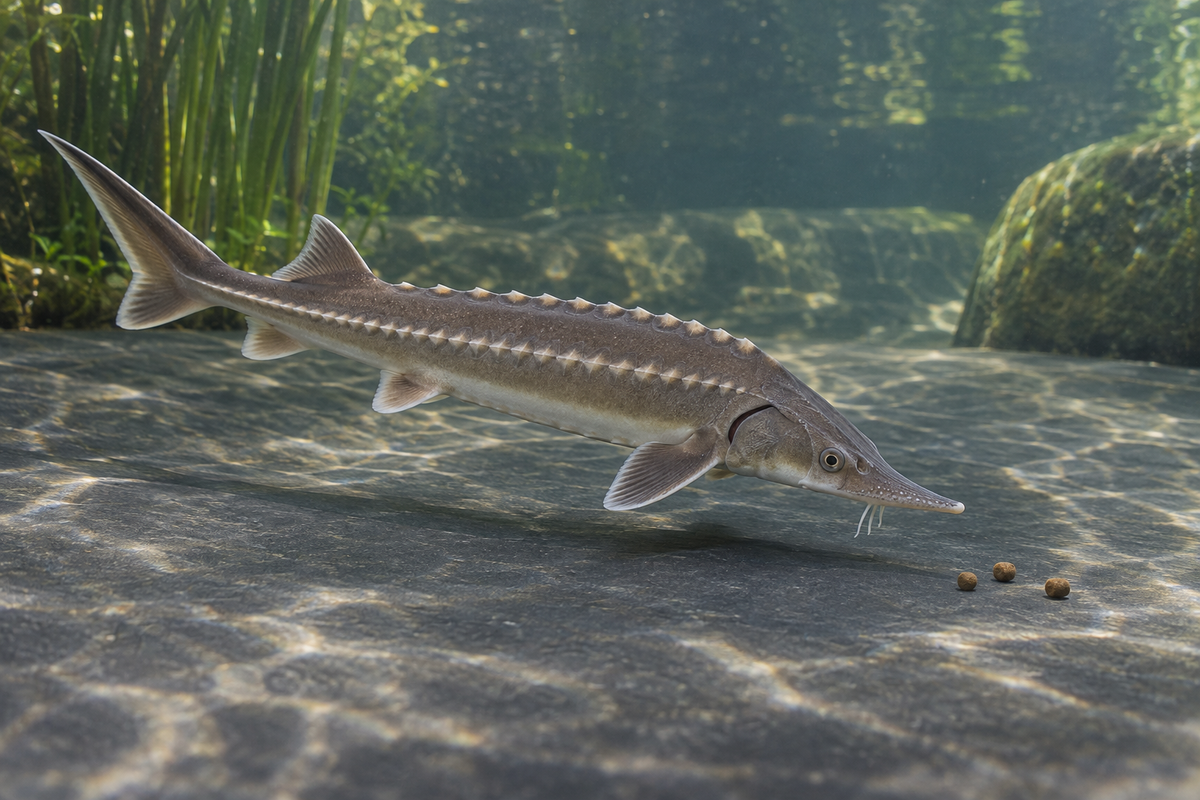
Food suitable for a pond sturgeon must be sinking, formulated for sturgeon, and easy to grasp with its mouth located under its head. The size of the pellet and actual access to the ration are just as important as the composition.
A quality food is useless if the koi eat it before the sturgeon can. Choosing food must therefore go hand-in-hand with a distribution method and water monitoring, both in summer and winter.

Why specific food?
Not all pond fish foods meet the same needs. The OATA lists the sturgeon among the fish that require a sinking food with an appropriate protein and fat content.
Floating koi food is therefore not the base choice to offer it. Even if a sturgeon seems to be trying to reach pellets on the surface, this observation does not prove that it is receiving an appropriate ration.
Look for food whose use for sturgeons is clearly indicated. Compare its composition, pellet size, and manufacturer recommendations rather than selecting solely based on the highest protein rate.
The size and species of your fish remain important. The needs of a small, growing subject and those of a large individual that has been settled for several years are not simply a matter of the same daily handful.
Choosing the pellet size
The pellet must be easy to grasp and swallow without difficulty. A size that is too large may be ignored; particles that are too small become harder to track and may scatter on the bottom.
In the Aquifood range offered on Aquishop, the indications allow for an initial selection:
| Food | Pellet size | Label indication |
|---|---|---|
| Aquifood Sturgeon 1,550 g | 3 mm | Sturgeon up to 25 cm. |
| Aquifood Sturgeon 5 kg | 6 mm | Sturgeon over 25 cm. |
These range guidelines do not replace observing the actual feeding. When changing size, check that the fish is indeed grasping the new pellets and that they are not left uneaten.
If you do not know the size or species of your sturgeon, prepare a photo and an estimate of its length before asking for advice. Avoid catching it just to get an exact measurement.
What Aquifood Sturgeon feeds offer
The two products mentioned are sinking foods. Their specs indicate 38% crude protein and 12% fat. Aquiflor presents this range as food intended for pond sturgeon throughout the year.

The packaging should correspond to your consumption. A large bucket is only worthwhile if you can use its contents under good freshness and storage conditions.
Keep the label: it allows you to find the composition, instructions, and batch information. The recommendations on the packaging received take precedence for its use.
How to verify that the sturgeon is really eating?
Choose an open area where you can observe the bottom. Distribute a small amount, then watch the fish search for and take the pellets.
The disappearance of the food is not enough if other fish are nearby. Take the time to identify who is consuming it. A sturgeon can remain undernourished in a pond where all the food seems to disappear quickly.
A routine in a regular spot facilitates monitoring. Note any changes: the time before the fish arrives, interest in the food, remaining quantity, or visible changes in its silhouette.
When the bottom is difficult to see, first improve observation conditions and the distribution method. Adding more food "just in case" may primarily increase waste.
Limiting competition from koi
Aquiflor advises distributing koi food on the other side of the pond to give the sturgeon time. The goal is to separate feeding areas and monitor everyone's consumption.
A clean tube can also guide the sinking pellets to a specific area of the bottom, as described by Aquiflor. Use a suitable accessory with no sharp edges, handled without bumping into the fish or the liner.
This method facilitates delivery; it does not guarantee that the koi will leave the ration intact once it is on the bottom. Remain present during feeding and adjust the setup if necessary.
Do not compensate for competition by systematically doubling the ration. More targeted distribution is often more useful than a general increase.
What quantity to distribute?
There is no identical dose for all sturgeons. Size, species, activity, temperature, the fish's condition, and the pond's ability to process waste all play a role.
Start with the manufacturer's indications and advice adapted to your fish. Measuring the ration with a small scale allows you to track adjustments more precisely than a variable handful.
Distribute in a way that allows you to observe consumption. If pellets remain on the bottom, remove the accessible remains and look for why they were not eaten: excessive quantity, competition, unsuitable food, or a water issue.
Very young fish require special monitoring. Ask the seller for a feeding schedule corresponding to the species and size, rather than applying a routine intended for a large sturgeon without adaptation.
Should the sturgeon be fed in winter?
Yes, its nutrition must continue to be monitored during the winter. The OATA explicitly distinguishes sturgeon from fish for which feeding can be stopped when the water gets cold.
Adapt quantities to food intake and pond conditions. "Feeding all year round" does not mean automatically keeping the summer ration.
Monitor water quality when filtration activity changes. An unconsumed ration continues to produce waste, even if the water is cold and seems clear.
If the pond freezes, maintain a gas exchange area using a suitable, monitored device. Do not break the ice to create an opening. Access to food and oxygenation must remain considered together.
In summer, oxygen remains a priority
Warm water contains less dissolved oxygen than cold water. Feeding must take into account the fish's activity and oxygenation conditions.
Check the operation of aeration and circulation. An air pump must be sized according to the pond and its depth; an example of a kit like the AquaOxy 1000 does not constitute a valid recommendation for all sturgeon ponds.
If the fish is breathing abnormally, swimming unusually, or suddenly refuses food, check the water and look for the cause. Do not insist with repeated distributions in a distress situation.
A refusal of food deserves a complete observation
Note the temperature, available analysis results, and recent changes: new food, arrival of new fish, maintenance, treatment, or equipment failure.
Check for ammonia and nitrites specifically with suitable tests. Transparent water can have a problem that is not visible to the naked eye.
Weight loss, lesions, or persistent refusal require professional or even veterinary advice. Enriched food does not replace identifying a health or environmental problem.
Storing food to keep a healthy ration
Store closed packaging in a dry, cool place protected from light. Use a clean, dry scoop; avoid putting pellets that have touched water back into the bucket.
Respect the manufacturer's date and instructions. If the food becomes damp, moldy, or has an abnormal odor, do not distribute it.
Keep a small amount accessible for meals and protect the rest from unnecessary openings if the packaging and its instructions allow for it. Simple tracking of the opening date helps organize subsequent purchases.
Choosing the right Aquifood size
First compare the size of the fish and the pellets, then choose packaging consistent with your consumption.
See Aquifood Sturgeon in 3 mm →
See Aquifood Sturgeon in 6 mm →
Sources
- OATA — Pond fish care: specific nutrition, sinking pellets, and winter feeding of sturgeon.
- Aquiflor — Advice before introducing a sturgeon: distribution and competition with koi.
- Aquiflor — Presentation of Aquifood Sturgeon: use of the range.
- USGS — Dissolved oxygen and water temperature.
- Hikari — Frequently asked questions about nutrition: food preservation principles.
- Aquishop product sheets for Aquifood Sturgeon 3 mm and 6 mm linked in the article.