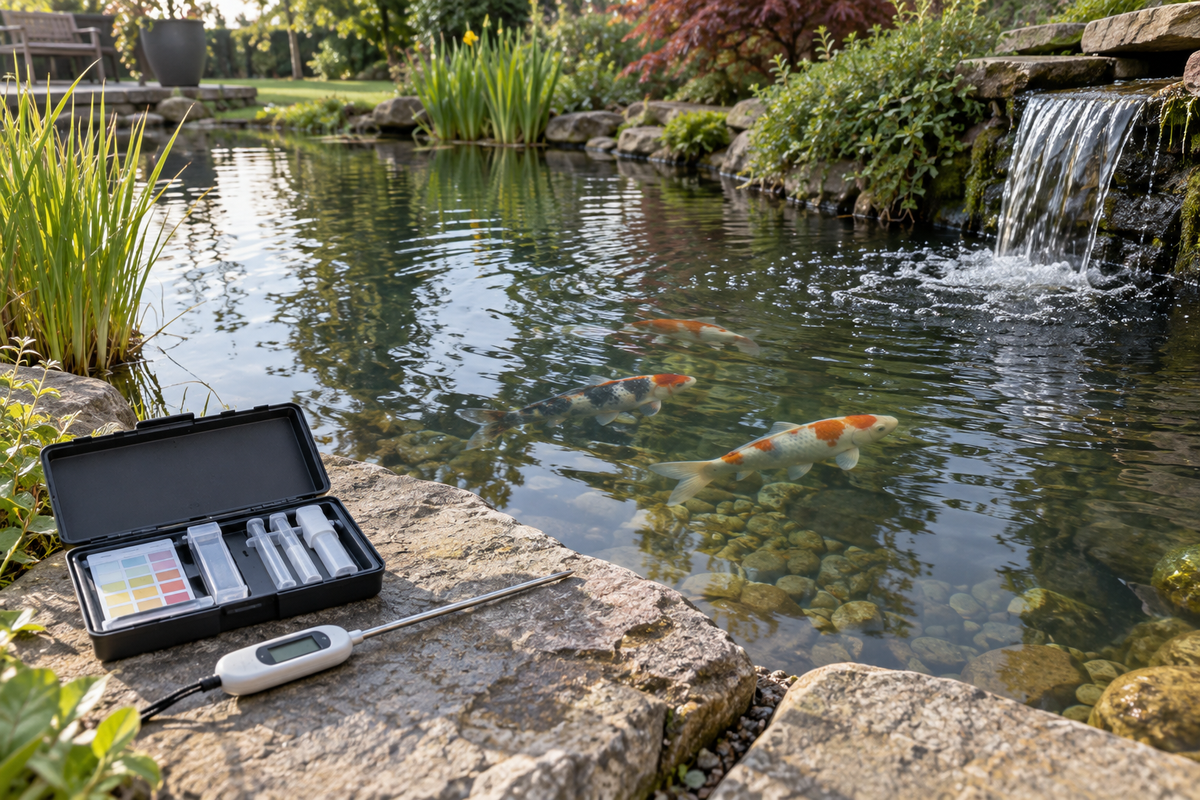
When a nitrite spike occurs, you must act on the water and on the cause of the increase. Adding bacteria can support biological recovery, but it is no substitute for checking the filtration or reducing the fish's exposure. Initial decisions depend on the measured results, the condition of the animals, and the quality of the water available for a partial change.
A living room aquarium and a large pond are not corrected with the same volumes or the same logistics. The reasoning remains the same: confirm measurements, support gas exchange, limit pollutant input, and restore functional filtration.

First priorities if the fish are in distress
Rapid breathing, clustering near the outlet, or fish gasping for air at the surface are signs of an alert. Nitrites can reduce the efficiency of oxygen transport in the blood. These behaviors can also have other causes: they are not enough to establish a diagnosis.
- Immediately verify that the filtration and aeration are working.
- Increase surface exchange with suitable equipment, without disturbing the deeper layers of a large pond.
- Suspend the next feeding and remove any leftover food that remains accessible. Have the duration of the restriction adapted to the species and the situation.
- Measure nitrites, ammonia compounds, pH, and temperature; check oxygen if you have the equipment.
- In case of severe distress, loss of balance, or mortality, contact a veterinarian specialized in fish promptly.
Do not catch the fish solely to better observe their gills. Chasing them adds stress and delays useful checks. A video, test results, and a timeline of events will be more helpful in guiding the response.
Confirm what the test is measuring
Nitrites are noted as NO2. Nitrates, NO3, correspond to a different measurement. Also check whether the result is expressed as NO2 or NO2-N: the two numbers cannot be compared directly. Keep the unit indicated by your test.
Repeat a questionable reading with clean equipment, usable reagents, and the specified reaction time. If the color exceeds the scale, do not consider the last digit to be the exact value. Request a suitable measurement rather than improvising a dilution.
For the pond, the JBL ProAquaTest CombiSet Pond includes NO2 and NH4, among others, with pH, KH, GH, and PO4. For the aquarium, the CombiSet Plus NH4 includes NO2, NO3, NH4/NH3, pH, and KH, among others. Check the contents of your kit: none of these sets replaces an oxygen measurement.
Reducing nitrites with suitable replacement water
A partial water change can dilute nitrites. Its effectiveness depends on the volume replaced and the concentration of the new water. You must also control the temperature, mineralization, pH, and any potential disinfectants in the mains water.
Example of a calculation, without recommendation value: replacing half of a volume of water containing 1 mg/l of NO2 with water at 0 mg/l theoretically yields 0.5 mg/l after mixing, if no further production occurs. This decrease does not mean the situation is resolved. The filter may continue to produce nitrites between two measurements.
Therefore, check the replacement water and prepare it with a product corresponding to its treatment and the environment concerned. In a freshwater aquarium, JBL Biotopol should be used according to its instructions. A product intended for a few tens of liters should not be extrapolated to a pond of several cubic meters without calculation.
An old, highly acidic aquarium with a lot of ammonium presents a special case: a sudden rise in pH can increase the proportion of toxic ammonia. Have the correction established by a professional rather than proceeding with a massive, improvised water change.
In a pond, prepare the renewal before opening the tap
Estimate the actual volume of the pond, the quantity of water to add, and the authorized drainage capacity. Monitor the filling and plan for a reliable shut-off. A forgotten hose can cause an overflow or an excessive input of unprepared water.
Avoid turning the intervention into a major bottom cleaning. Stirring up an old layer of deposits can suddenly degrade conditions. In a large pond, poorly placed circulation can also mix waters of different qualities. An on-site diagnosis is preferable if the volume, depth, or state of the sediments complicates the intervention.
Finding the cause: five frequent leads
| Recent event | Check to perform |
|---|---|
| Startup or seasonal restart | Biological maturity, temperature, feeding progression |
| Major cleaning | Supports replaced or disinfected, circulation after reassembly |
| Pump failure | Duration of downtime, state of the filter, flow actually restored |
| Increase in population or food | Total load, fish growth, food remains |
| Treatment or new water | Product used, biological compatibility, and water preparation |
The volume advertised on a filter box is not enough to rule out under-sizing. Fish biomass, meals, accessories, and clogging influence its performance. Photograph the setup, fittings, and media before asking for advice: a circulation fault can be more decisive than the brand of bacteria chosen.
Aquipond NitriBoost to support pond recovery
Aquipond NitriBoost for ponds is intended for seeding filtration, particularly during a restart or after significant maintenance. The product sheet indicates a base dosage of 1 liter per 10 m³, with a temperature above 10°C and a pH between 6.5 and 8 for optimal operation.
Check the instructions on the packaging used before any application. These indications do not justify suddenly changing the pH of a pond to bring it into range. They also do not guarantee the disappearance of nitrites at a specific time. Continue analyses and maintain appropriate oxygenation.

In an aquarium, use the reference intended for this use
Aquipond Aquarium NitriBoost 150 ml is a distinct reference intended for freshwater aquariums. Its dosage and frequency cannot be inferred from those of the pond canister. Use the instructions on the bottle and ask for confirmation if any instruction is unclear.
The activator is a supplement to the restoration of good conditions. Water that has become clear again after its addition does not confirm a decrease in NO2. A check allows you to monitor progress and adapt accordingly.
What does not replace spike correction
A UV-C designed for suspended algae does not directly eliminate dissolved nitrites. A clarifier may improve the appearance of the water without providing proof of safety for the fish. Salt can be involved in certain professional treatments, but its compatibility depends on the species and treatments in particular: do not apply a universal dose found online.
If the accumulation of sludge contributes to the pond's load, plan for reasoned maintenance afterward. A PondoVac vacuum helps with localized removal of deposits. Aquipond Bactovase addresses organic matter according to its instructions. Their use should be considered after stabilization; they do not constitute the immediate treatment for a nitrite spike.
Check the recovery in the following days
Note the measurements before and after interventions, then continue close monitoring as long as the situation remains unstable. Reintroduce feeding according to the progress and needs of the fish. Postpone any new introduction of animals.
To prepare an appropriate correction, contact Aquiflor with the volume, results, and recent changes. A photo of the filter and its connections will help in examining the technical cause. In the presence of distressed fish, involve a veterinarian in this process without delay.