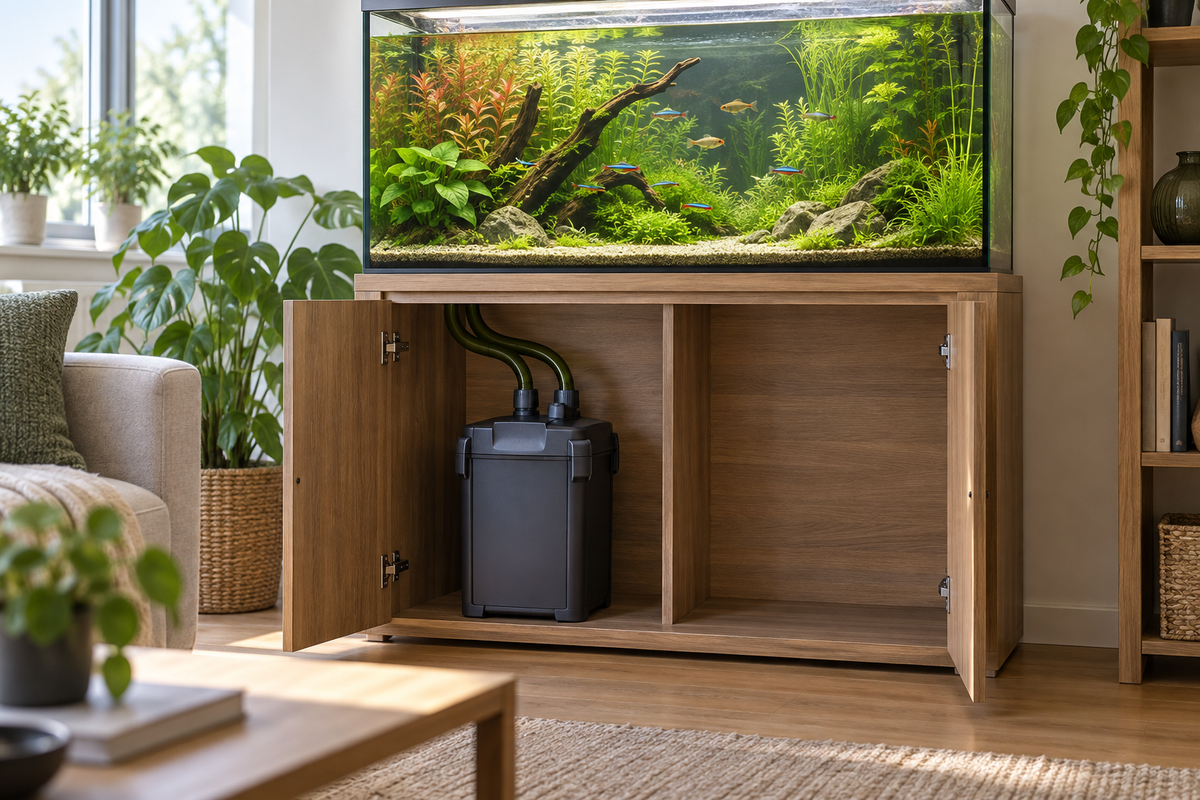
An external filter should be chosen based on its ability to support the aquarium over time: consistent circulation, accessible maintenance, and equipment suitable for the fish. The OASE BioMaster Thermo adds two features to this foundation: a removable pre-filter and an integrated heater. These features can simplify your life, provided you select the correct model and leave enough space for it in the cabinet.
Below are the advantages, limitations, and points to check before purchasing. This analysis is based on the devices' specifications and their intended use. It is not based on a comparative test performed in your specific aquarium: its population, decor, and hoses will influence the actual result.

What is a BioMaster Thermo used for?
The BioMaster is a filter placed outside the aquarium. Water flows into a canister containing filtration elements, then returns to the tank. The sponges trap some of the particles; the colonized media contribute to biological filtration. The filter thus helps convert nitrogenous waste, without replacing the need for water changes or substrate cleaning.
The Thermo version includes an integrated heater. This frees up space in the aquarium and reduces visible equipment. This discreetness is particularly appealing for planted aquariums, where the goal is to maintain an unobstructed view of the decor. It also implies that the filtration, water circulation, and temperature control must be considered together.
First point: distinguishing between BioMaster and BioMaster²
The range name requires attention. OASE now offers a BioMaster² generation, with developments concerning the water path and connections in particular. The characteristics of a device bearing this name should not automatically be attributed to an older BioMaster.
To compare two offers, note the manufacturer's reference, the full designation, and the accessories provided. An identical model number, such as "350," is not sufficient. The figures below concern the BioMaster Thermo references from the specified Aquishop product pages, not all generations on the market.
Comparing the four proposed models
| Model and reference | Advertised maximum volume | Advertised maximum flow rate | Canister dimensions | Heating |
|---|---|---|---|---|
| Thermo 250 — 42737 | 250 liters | 900 l/h | 24 × 24 × 37 cm | 150 W |
| Thermo 350 — 42738 | 350 liters | 1,100 l/h | 24 × 24 × 42.5 cm | 200 W |
| Thermo 600 — 42739 | 600 liters | 1,250 l/h | 24 × 24 × 48 cm | 300 W |
| Thermo 850 — 77108 | 850 liters | 1,550 l/h | 24 × 24 × 53.5 cm | 400 W |
These values come from the Aquishop product pages consulted. The advertised volume is a guide for the range: a heavily stocked aquarium and a sparsely planted tank do not strain the filter in the same way. The maximum flow rate does not necessarily correspond to the flow rate obtained once the hoses, filter media, and accessories are installed.

The EasyClean pre-filter: a concrete advantage
The pre-filter traps some of the debris before it reaches the other elements. Its separate access allows for routine maintenance without systematically dismantling the entire canister. This is useful in an aquarium where dead leaves and particles accumulate regularly.
Its usefulness, however, depends on available access. If the pre-filter is wedged under a shelf, the promised ease disappears. You must be able to remove it according to the instructions, have a container ready, and reach the controls without pulling on the hoses.
The cleaning frequency is determined by observing accumulation and circulation. A rigid schedule does not suit every aquarium. Checking the pre-filter regularly allows you to spot a drop in flow before it becomes significant.
The integrated heater: discreet, but needs monitoring
The integrated heater removes one device from the decor. It does not replace an independent thermometer: the actual temperature of the tank remains the measurement to follow. The need for heating depends on the water volume, room temperature, the lid, and the temperature required for the species.
Before any maintenance, follow the power-off procedure and cooling precautions indicated by OASE. Do not operate a heater in conditions other than those specified. After reassembly and priming, check the circulation, the absence of leaks, and the temperature over the following hours.
If your aquarium does not need to be heated, this version is worth comparing to a version without a heater. The right equipment meets a real need; adding an unused function does not make biological filtration more effective.
Limitations to anticipate before installation
Flow decreases in a real installation
Hoses that are too long, bends, an additional accessory, or clogged sponges can reduce circulation. Prepare a simple path, without kinks, by respecting the filter's position and the lengths authorized by the manual. A well-oriented spray bar can improve water distribution without imposing excessive current on the fish.
The cabinet must accommodate maintenance operations
Measure the door opening, the interior height, and the space taken up by the connections. The canister dimensions do not represent the clearance required to remove equipment. Also, verify that the cabinet floor can support the filled device and that electrical connections remain protected from accidental spills.
Silence also depends on the setup
An external filter should not be chosen based on a promise of absolute silence. Trapped air, vibration transmitted to the cabinet, a hose in contact with a wall, or a worn part can produce noise. Persistent annoyance justifies checking the setup and parts, not a succession of improvised adjustments.
Maintaining the filter without compromising its biological balance
Biological media house a community of microorganisms. Replacing all the media at once or cleaning the entire unit thoroughly can disrupt their function. For routine maintenance, keep the media that are still usable and rinse them gently in water removed from the aquarium when necessary.
Mechanical sponges, seals, the impeller, and hoses require different care. The model's manual remains the reference for their disassembly and approved products. A pre-filter sponge should also be chosen based on its compatibility and porosity: the set of four 30 ppi BioMaster sponges should not be bought based solely on a photo looking similar.
After major intervention, observe the fish and monitor ammonia/ammonium as well as nitrites. Clear water does not attest to proper biological function. Also, avoid adding a large population immediately after a thorough cleaning.
Which model to choose for your aquarium?
Prepare four pieces of information: approximate actual volume, population, cabinet dimensions, and desired temperature. Add a photo of the installation and the list of intended accessories. An aquarium hosting fish sensitive to current requires thought on the outlet diffusion; a very heavily stocked tank mainly requires reviewing total capacity and maintenance.
The BioMaster Thermo is particularly suitable when looking for an external filter with an accessible pre-filter and discreet heating. The choice must remain consistent with the tank. A larger filter does not correct overpopulation, excessive feeding, or lack of water changes.
Need to choose a reference? Consult the BioMaster Thermo 350 and other sizes in the table, then contact Aquiflor with the measurements of your aquarium and its cabinet. These details make it possible to verify available space and maintenance constraints before purchase.
Sources and references
- OASE — presentation of the BioMaster² generation, the pre-filter, and the integrated heater.
- Aquishop product pages for the BioMaster Thermo 250, 350, 600, and 850, linked in the table: references, dimensions, flow rates, and heaters.
- OATA — setting up and looking after a freshwater aquarium.