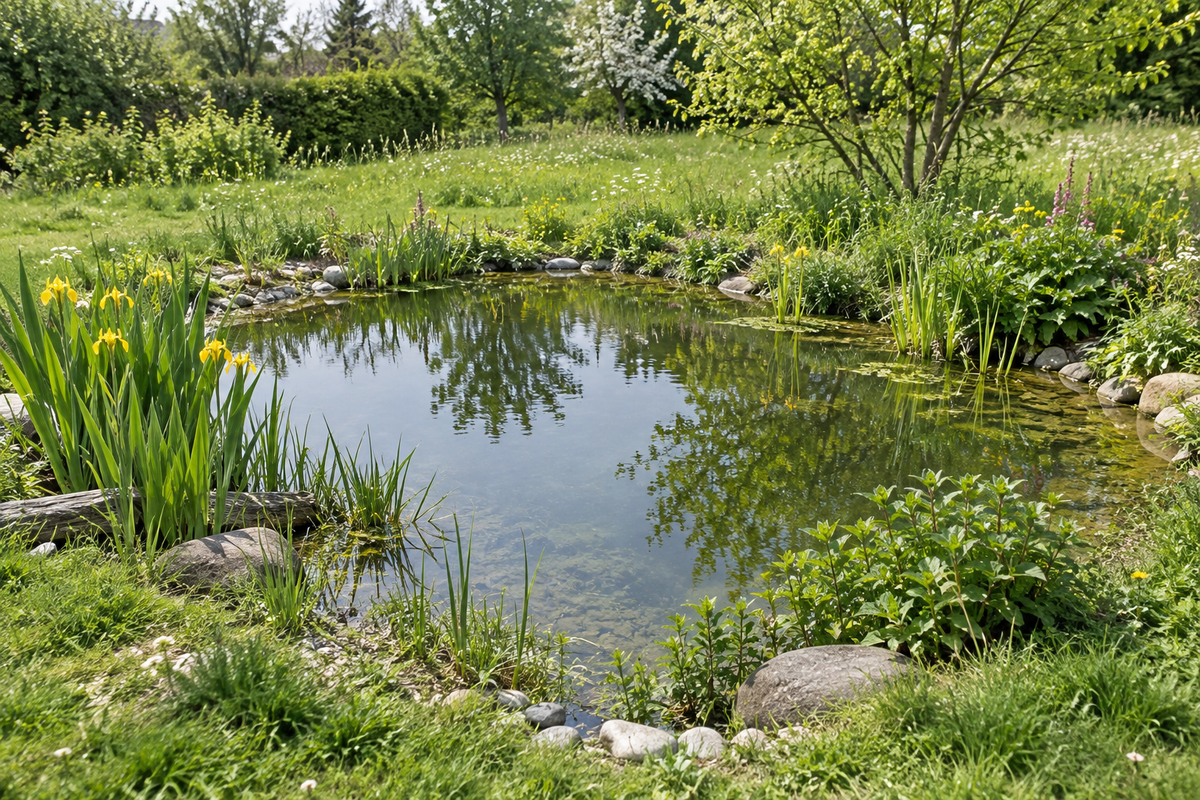
The cost of a natural pond depends primarily on earthworks, waterproofing, and finishing. A small pond built by oneself on accessible terrain does not have the same budget as a project entrusted to a professional involving soil removal. Therefore, the water surface area alone does not allow for a reliable price estimate.
However, a concrete benchmark helps to get started: in the detailed example below, the membrane and geotextile item represents approximately €354, based on the price per square meter consulted in the catalog. The other supplies and work remain to be added. This amount is a material calculation, not the price of a finished pond.

Which pond are we talking about?
In this article, a natural pond refers to a water feature designed primarily for garden plants and wildlife. It may include a waterproof membrane while still hosting insects and amphibians. The word "natural" does not necessarily mean that the soil retains water without intervention.
This pond differs from a pond heavily populated with fish or a natural swimming pool. The requirements for filtration, equipment, and maintenance are not the same. For a pond intended for amphibians, Natagora recommends not introducing fish, as they can consume their eggs and larvae.
Setting this objective from the start avoids buying devices for a use you have not chosen. A waterfall, lighting, and a filter may suit a decorative project, but are not automatically part of the budget for a biodiversity pond.
The seven items to include in your budget
| Item | What to account for | What varies the amount |
|---|---|---|
| Preparation | Surveys, potential administrative procedures, and site organization | Terrain constraints and project complexity |
| Earthworks | Digging, leveling, and bank formation | Volume, soil, access, and manual or mechanical work |
| Soil | Storage, relocation, or removal | Distance and possibility of authorized on-site reuse |
| Waterproofing | Membrane, protection, and appropriate accessories | Actual profile, cutting width, and nature of the substrate |
| Planting | Plants, potential containers, and appropriate substrate | Planted surface and number of plants chosen |
| Finishing | Banks, access, protections, and restoration | Materials, safety, and level of finish |
| Filling | Water, useful checks, and initial maintenance | Water source and startup conditions |
Add a reserve for contingencies identified with the contractor or supplier. Soil that is more difficult than expected, an access path that is too narrow, or changes to the banks can alter the cost. A margin chosen with full knowledge of the situation is more useful than a percentage presented as valid for all gardens.
Example: calculating waterproofing for a small pond
Let's take a project 3 m long, 2 m wide, and 60 cm deep at maximum. These dimensions serve only to illustrate the calculation; they do not constitute a depth requirement for every pond.
The estimation formula proposed for the Aquitechnics membrane adds twice the depth and 1 m of total margin to each dimension. This gives 5.20 m in one direction and 4.20 m in the other. The final measurement must then follow the actual excavated profile, with its shelves and finishes.
By retaining, for this example, an available width of 4.27 m and a length of 5.20 m, the theoretical cutting surface reaches 22.204 m². At €15.95/m², the price of the EPDM and geotextile pack consulted in the Aquishop catalog on September 28, 2026, the calculation results in €354.15.
The quote must confirm the achievable length, order rounding, invoiced surface, delivery conditions, and applicable price. The amount changes if the final profile requires more membrane. For comparison, simply multiplying the 6 m² of water surface by the price per square meter would significantly underestimate this item.
Consult the Aquitechnics EPDM pack with geotextile to check the price and available widths before preparing your order.
Why membrane protection deserves its own line
A membrane laid on a poorly prepared surface can be damaged by sharp elements. Cleaning the bottom, ensuring the stability of the shelves, and providing appropriate protection are therefore full-fledged tasks. The geotextile does not replace this preparation.

If you are comparing a liner alone with a pack, check what is included so as not to count the geotextile twice or, conversely, to forget it. Also, check the accessories needed for any penetrations and joints. A connection made afterward may require more material and work than an assembly planned from the start.
Earthworks: access changes many things
The same volume of soil can represent very different site conditions. A machine that arrives directly at the back of the garden works under different conditions than a team that has to cross a narrow passage and protect every surface. Note the minimum access width, turns, steps, and fragile areas.
Ask if the quote includes soil removal, transport, potential tipping fees, and restoration. The extracted soil is not limited to the planned water volume: shapes, shelves, and site adjustments also count. Its volume after extraction may differ from that of the soil in place.
If you do the work yourself, account for tool rental, transport, and your available time. Doing it yourself can reduce labor expenses but does not remove the constraints of stability, safety, or waste management.
Should you plan for a pump and filter?
An ecological pond without fish can be designed without a pump or electric filtration. Its functioning relies primarily on placement, water quality, vegetation, and controlling inputs. The Freshwater Habitats Trust emphasizes the value of water that is not polluted and banks adapted to wildlife.
If you add a waterfall or wish to raise fish, have the project recalculated. You will then need to examine circulation, filtration, power supply, and operating expenses. Adding fish is not just about the price of the animals.
To estimate electrical equipment, multiply its power in kilowatts by its operating duration and then by your rate. The calculation must correspond to the actual devices selected, with their seasonal program.
Plant gradually to control expenses
You do not need to cover the entire pond with adult plants immediately. A reasonable selection, placed at the right depths, leaves the plants time to develop. Choose species adapted to the region and sourced from cultivation, with a clearly identified botanical name.
The Caltha palustris and water mint are examples to consider for shallow areas, depending on the space available. Their growth must be anticipated to avoid having to replant too quickly.
Also, plan for future maintenance: selective removal of leaves, control of dominant plants, and observation of the water level. A pond does not need to be drained and scrubbed every year to remain valuable for wildlife.
Comparing truly comparable quotes
Send the same plan to the companies consulted and ask for a breakdown of services. Materials, quantities, access, soil management, and finishes must be explicit. Check who handles the necessary administrative procedures and which operations will remain your responsibility.
A price per square meter can serve as a commercial benchmark, but it becomes misleading if it ignores depth, relief, and access. Always ask what the advertised square meter corresponds to: water surface, membrane surface, or total landscaped surface.
To price your pond, send a sketch, dimensions, and photos of the access to support@aquiflor.com. This will allow you to prepare the budget for supplies and specify the work to be entrusted to a professional.