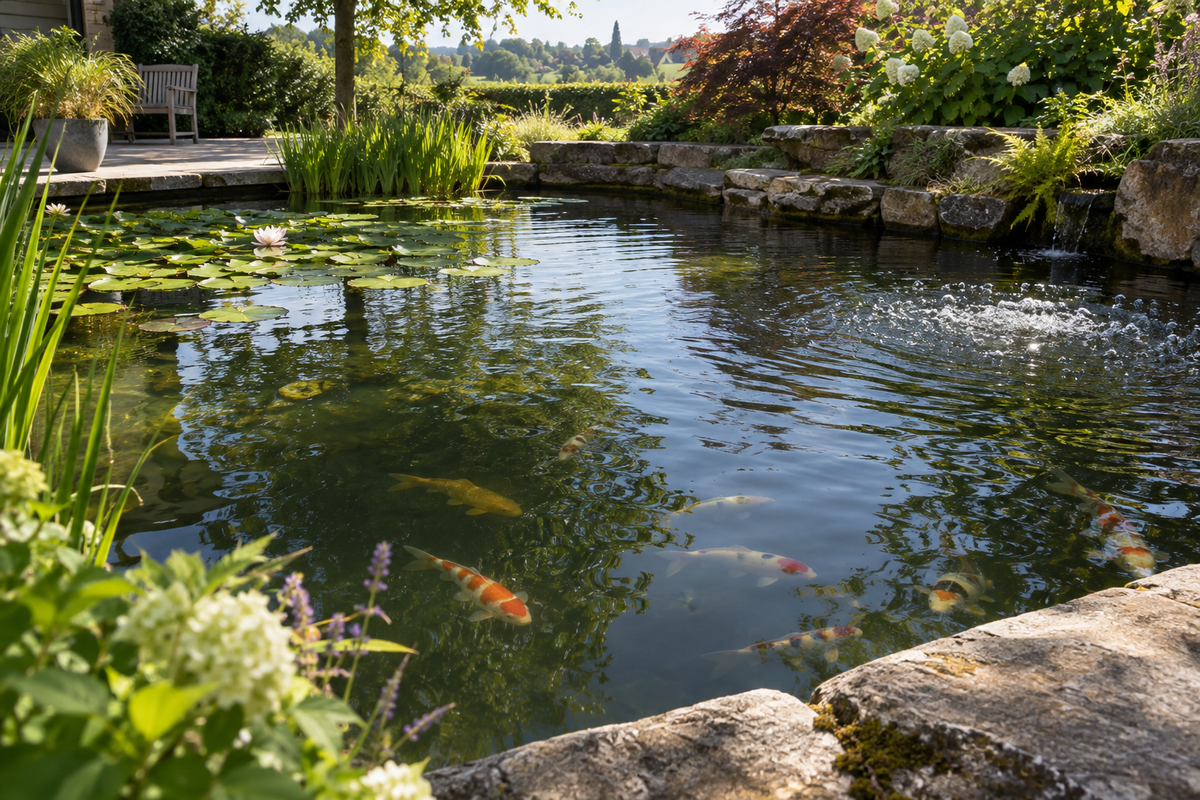
A pond may appear calm even as its fish begin to lack oxygen. During a period of high heat, the water warms up, the needs of living organisms change, and the differences between day and night become more significant. Beautiful transparency is not enough to know if everything is fine under the surface.
The priority is to maintain adequate aeration, monitor the fish, and limit inputs that stress the pond. Here is what changes with the heat, followed by the checks to perform before choosing equipment or treatment.

Warmer water can hold less oxygen
Fish breathe oxygen dissolved in water. Under comparable conditions, warm water holds less oxygen at saturation than cold water. This is a physical property noted by the USGS. At the same time, temperature influences the activity of the fish and the organisms in the pond.
Be careful of the difference between theoretical capacity and measured concentration. A chart giving saturation at a specific temperature does not necessarily describe your pond. Exchanges with the air, photosynthesis, and oxygen consumption alter the actual result. Altitude and water composition also play a role.
The thermometer is therefore used to monitor the water's change. To know the available oxygen, a dedicated measurement is required, using a suitable test or a correctly used oximeter. The air temperature announced in the weather forecast does not replace the temperature recorded in the pond.
Why night and dawn deserve your attention
In light, aquatic plants and algae carry out photosynthesis. At night, this oxygen production stops, while respiration continues. Fish, plants, and microorganisms continue to consume it. Concentrations can reach their minimum at the end of the night.
A large mass of algae can accentuate these variations. Their decomposition, following significant mortality, adds to oxygen consumption. This is one of the reasons why aggressive treatment against algae requires great caution during a hot period.
Concretely, a check performed only after lunch may miss the most unfavorable time. During an at-risk episode, compare observations early in the morning and at the end of the day. Note the time of each measurement: two results without a timestamp are much less useful for understanding a variation.
Stratification mainly concerns certain bodies of water
In a pond that is deep enough and has little movement, a warmer surface layer can remain above cooler water. Oxygen can then become scarce at depth, especially when organic matter decomposes there. The cooler bottom is therefore not necessarily a favorable refuge for fish.
A storm, wind, or cooling can mix these layers and rapidly change conditions. Work by the University of Georgia on pond turnover explains this mechanism. However, it should not be automatically applied to every small garden pond, where depth, circulation, and exposure are different.
On a large, deep pond, the choice and startup of aeration require an appropriate study. Suddenly installing powerful aeration at the bottom of a stratified environment is not just about "adding more air." Have a specialist define the placement and startup.
Heat also makes reading ammonia levels more important
Fish waste and the breakdown of organic matter feed the nitrogen cycle. A functional biological filtration system transforms ammonia and nitrites, but it requires appropriate conditions, particularly oxygen.
The UF/IFAS points out that the proportion of the NH3 form, which is particularly toxic, increases with pH and temperature. A total ammonium or ammonia result must therefore be interpreted using the test's instructions, pH, and temperature. Do not compare values where the units or the substance measured differ.
If the fish change their behavior, check the water quickly. A bacterial product does not replace this check and does not instantly correct intoxication.
Recognizing a situation that requires action
| Observation | What it might indicate | Immediate response |
|---|---|---|
| Several fish breathing rapidly near the surface | Possible lack of oxygen, or other respiratory distress | Increase aeration, stop feeding, and check the water immediately |
| Fish gathering near the filter return | Searching for a more favorable area | Check flow rate, diffusers, and available oxygen |
| Water color changes suddenly after a storm | Runoff, mixing of layers, or algae bloom | Observe fish, check equipment, and measure parameters |
| Pump is running, but the waterfall flow is much lower | Clogging, water level too low, or circuit problem | Check water intake and accessible mechanical elements |
A fish coming to grab a pellet at the surface does not show the same behavior as a group remaining there and breathing rapidly. If the distress persists, if a fish loses its balance, or if deaths appear, contact a competent fish health professional without delay. Lack of oxygen is a major lead, not an exclusive diagnosis.
Immediate actions during an alert
- Check that aeration and circulation are actually working. A powered device can produce very little flow if a hose is kinked or a diffuser is clogged.
- Boost the available aeration. Maintain it through the night. In a large pond, an aerated zone can offer a refuge without instantly re-oxygenating the entire volume.
- Suspend feeding in case of distress. Avoid catching fish to examine them for long periods at the edge of the pond.
- Record parameters and recent events. Temperature, oxygen if measurable, pH, ammonium/ammonia, nitrites, pump failure, treatment, or storm.
- Avoid major interventions. Do not stir up all the sludge and do not fully clean biological media during an alert.
A partial water change may be useful depending on the results, but it must use water compatible with the fish, protected against chlorine or chloramines if necessary, and without a sudden change in temperature. Adding a lot of cold water randomly can create another problem. There is no single percentage of water change that is valid for every heatwave.
Preparing aeration before high heat
An air pump should be chosen by considering the volume, population, depth of the diffusers, and losses in the hoses. The displayed maximum flow rate does not always correspond to the actual flow provided once the installation is in place.
The OASE AquaOxy 1000 is an example of a kit equipped with two outlets and two diffusers, with a declared flow of up to 1,000 liters of air per hour. This reference can be considered for a garden pond comparison; its commercial capacity alone is not enough to validate a heavily stocked pond.

Check the hoses and diffusers before summer, then verify the result in the water. Follow the manual for the pump's position and electrical protection. Also, plan for someone who can check the installation during your vacation: a photo of the circuit and a short checklist make this monitoring much easier.
Reducing organic load: PondoVac and Aquipond Bactovase
Leaves, food scraps, and an accumulation of organic sludge increase the decomposition workload. This management should be prepared outside of distress periods, with gradual interventions.
A PondoVac 4 vacuum allows for the physical removal of accessible deposits. The PondoVac 5 notably features an integrated discharge pump, useful depending on the planned location for discharge. Choose also according to the depth and access to the pond.
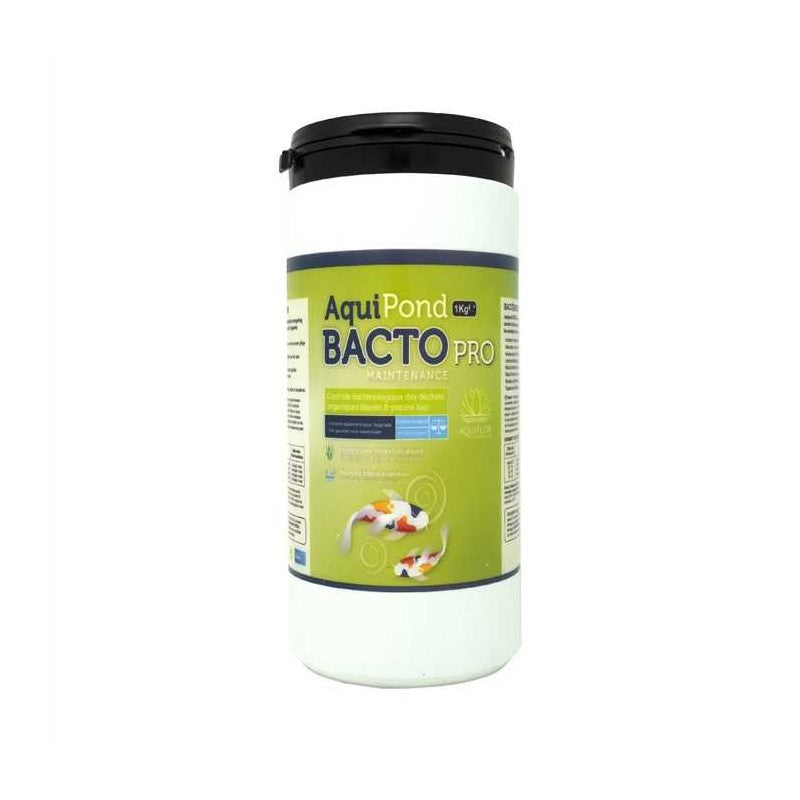
To work on the organic fraction of sediments in a maintenance program, Aquipond Bactovase is another option. Its role differs from that of the vacuum: it assists biological degradation, with results depending on conditions and the deposit. It does not remove sand and does not replace emergency aeration.
Before application, check the manual and the pond's conditions. An oxygen crisis is treated first by restoring favorable respiratory conditions, without piling on products.
Protecting the filter and providing shade
Plants offer refuges and can shade part of the surface. Also maintain some open water and control their growth. A single percentage of coverage or a guaranteed drop of several degrees does not describe all ponds.
Preserve the operation of the biological filter. If seeding is justified after a disturbance or during startup, Aquipond NitriBoost is intended for this use. Follow its conditions for use and monitor the development of test results; its addition does not immediately make the pond capable of hosting more fish.
Before the next hot spell, keep a simple sheet: estimated volume, population, usual temperature, pump references, last maintenance, and water results. These are the pieces of information that allow you to choose a useful improvement, rather than a purchase decided solely because the thermometer is rising.
Prepare your pond for summer
Start with aeration and circulation, then organize the management of deposits. Compare equipment to your installation and reserve biological treatments for their intended use.
See the AquaOxy 1000 kit →
Discover Aquipond Bactovase for organic sediment maintenance →
Sources
- USGS — Dissolved Oxygen and Water: temperature and dissolved oxygen.
- University of Georgia — Oxygen Depletion in Ponds: variations and prevention of oxygen deficits.
- Warnell School, University of Georgia — Understanding Fall Pond Turnover and Fish Kills: stratification and layer mixing.
- UF/IFAS — Ammonia in Aquatic Systems: ammonia, pH, temperature, and biological filtration.
- Merck Veterinary Manual — Providing a Home for Fish: suitable water, filtration, and fish needs.
- Aquishop product pages for AquaOxy 1000, PondoVac 4, PondoVac 5, Bactovase, and NitriBoost: usage of presented products.