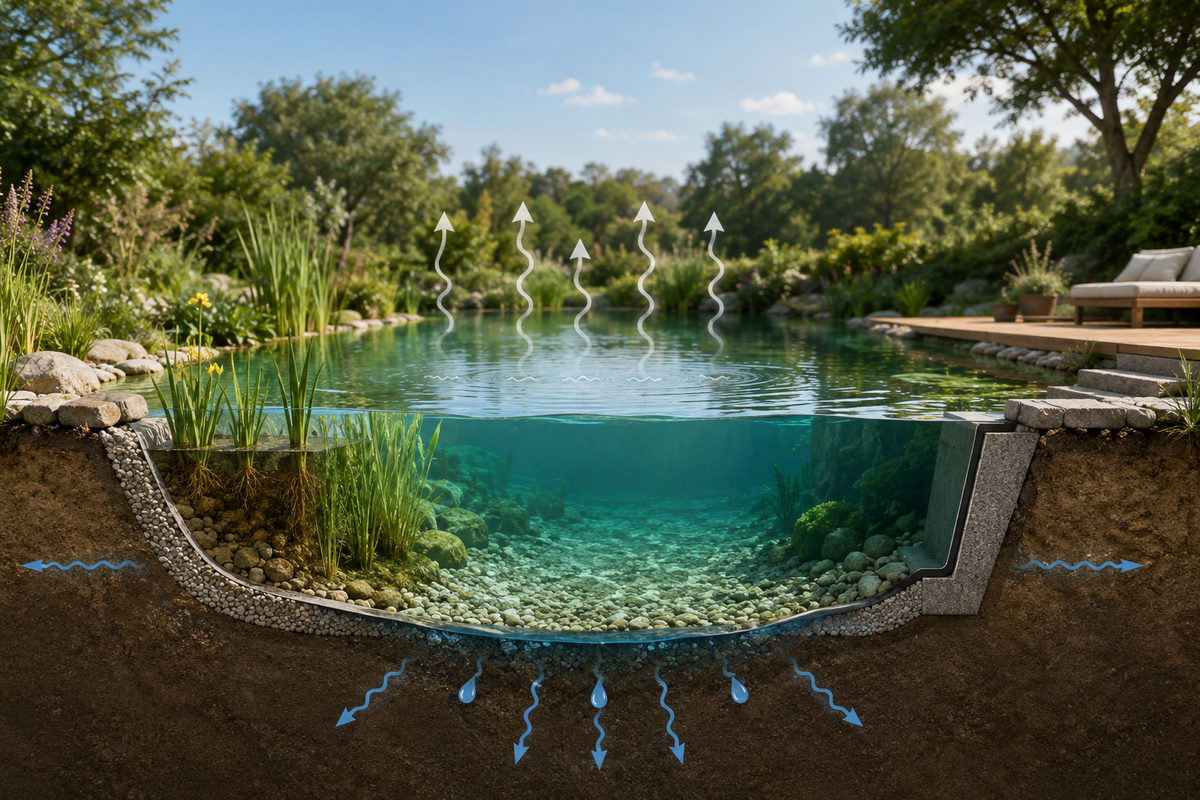
Do you notice that the water level in your natural swimming pool or pond is dropping by several centimeters in just a few days? The first reaction is almost always the same: "My liner is punctured!"
However, in our workshop and on-site, we see every week that the majority of water loss does not come from a leak in the EPDM liner.
Evaporation, capillary action, invisible overflow from the waterfall, filtration fittings, cracked hoses... there are many causes, and nine times out of ten, your liner is not the culprit.
In this guide, we provide the exact method our technicians use in the field to identify the source of water loss, avoid unnecessary work, and — if a leak is indeed real — repair it permanently in a few minutes rather than replacing everything.

Can a natural swimming pool lose water normally?
Yes, and it is even inevitable.
All natural swimming pools, garden ponds, and water features naturally lose a certain amount of water, mainly due to:
- evaporation;
- wind;
- sunlight;
- waterfalls and streams;
- fountains;
- high temperatures;
- aquatic plants, which naturally transpire.
During summer, an evaporation rate of 3 to 8 mm per day is perfectly normal. During a heatwave, with strong wind and a large waterfall, this value can be even higher.
However, a loss greater than one centimeter per day deserves further investigation.
Evaporation or leak: the first tell-tale signs
| Symptom | Evaporation | Leak |
|---|---|---|
| Loss is the same day and night | ❌ | ✅ |
| Loss is greater when the pump is running | ❌ | ✅ Often |
| Level always stabilizes at the same height | ❌ | ✅ Very common |
| Damp ground around the pond | ❌ | ✅ Possible |
| Waterfall splashing droplets outside the pond | ✅ | ❌ |
The behavior of your installation tells you a lot already. Now, let's move on to the step-by-step method.
The lagoon plants also consume some of the water
In a natural swimming pool, evaporation is not the only phenomenon responsible for a drop in the water level. The lagoon plants also contribute to the natural water cycle through a mechanism called transpiration.
Like all plants, irises, cattails, pickerelweed, rushes, sedges, or reeds draw water through their roots to support their growth. A large part of this water is then released into the atmosphere as vapor through their leaves. The higher the temperatures, the stronger the sunlight, and the more developed the vegetation, the more this consumption increases.
In the middle of the season, a well-established lagoon can account for significant water consumption, which adds to the natural evaporation from the swimming surface. This is, incidentally, one of the principles that allows wetlands and lagoons to contribute to the natural cooling of their environment.
However, this consumption remains gradual and perfectly normal. It never causes a sudden drop in water level in a few hours. If your natural swimming pool loses several centimeters per day, it is better to continue checks to rule out a leak, a discreet overflow, or significant water splashing from a waterfall, stream, or water jet.
Step 1: Check for capillary action (the #1 cause of "false leaks")
This is probably the most frequent cause of water loss, far ahead of an actual puncture.
When the EPDM liner is in contact with the lawn, roots, soil, mulch, moss, or overhanging plants, the water gradually wicks up into these materials through capillary action. This is called a wicking effect.
Result: the soil continuously absorbs water from the pond, without any hole being present. A few centimeters of grass in contact with the liner can make several tens of liters of water disappear per day.
👉 Go all the way around your pond and ensure that the liner remains completely isolated from the surrounding terrain.
Step 2: Inspect the entire filtration system
If the loss increases only when the pump is running, the liner is likely not the cause. Check:
- PVC fittings;
- glued joints;
- wall pass-throughs;
- buried pipes;
- filters, UV lights, and pumps;
- valves and seals.
Some micro-leaks remain invisible because the water seeps directly into the surrounding soil.
Step 3: Carefully observe your waterfall
A waterfall that looks perfect can, by itself, explain significant loss. A few millimeters of permanent overflow is enough.
Most frequent causes:
- a stone that has shifted;
- filter foam diverting the flow;
- leaves or a root;
- ground settling.
Observe the waterfall for several minutes: even a light trickle behind a stone can represent several hundred liters lost per week.
Step 4: The pump test
The test we systematically recommend at Aquiflor and Aquishop.
Day 1 — Stop the pump, waterfall, and water features completely. Measure the water level precisely. Wait 24 hours.
Day 2 — Turn everything back on. Measure the loss again.
If the difference between the two days is clear, the problem is most likely in the hydraulic circuit or the waterfall, and not the liner.
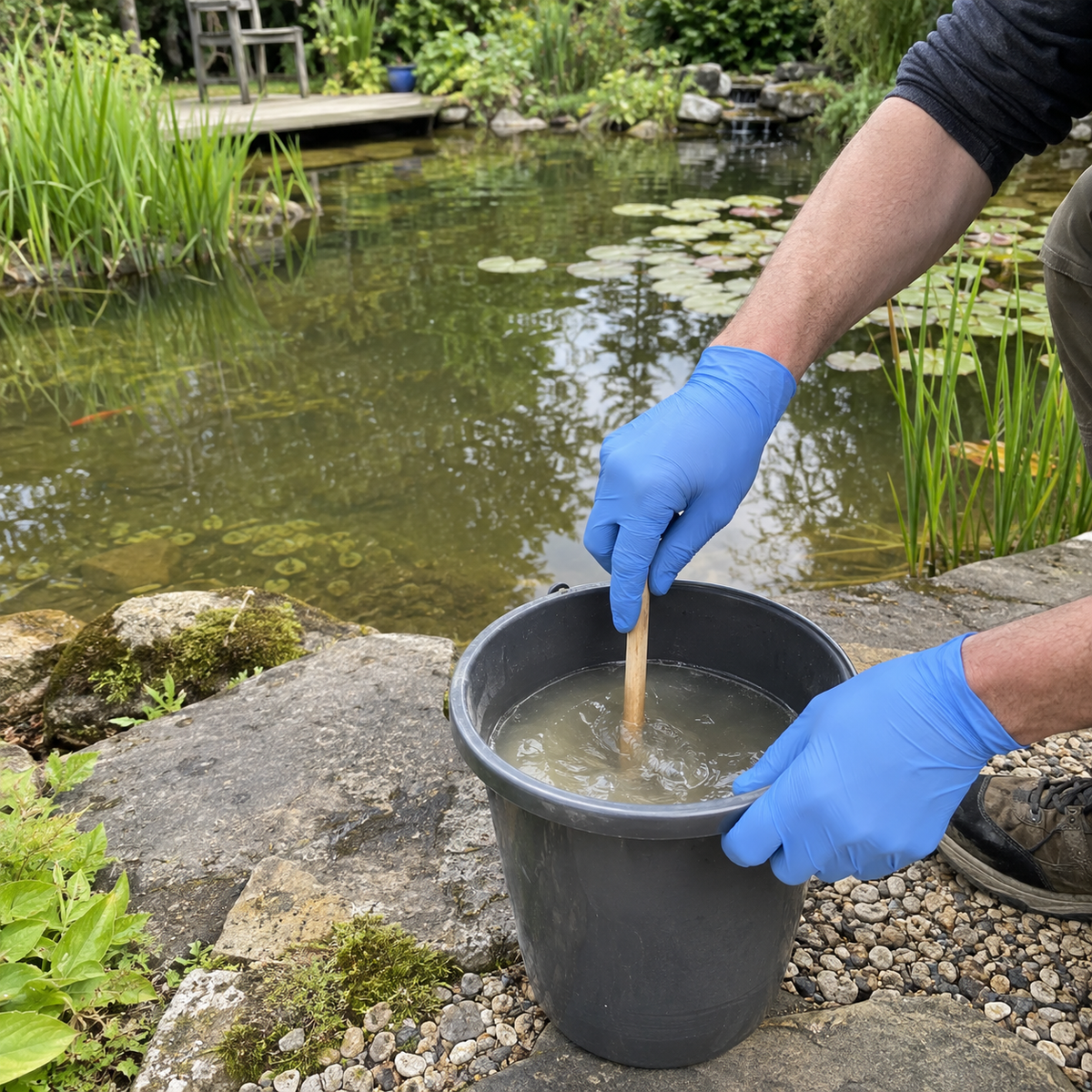
Step 5: The bucket test (the most reliable method)
This is the gold-standard method for distinguishing a leak from simple evaporation.
- Fill a bucket with water.
- Place it in the pond so that the water in the bucket is the same temperature as the pond water.
- Mark the level in the bucket and the level of the pond.
- Wait 24 to 48 hours.
If the pond level drops more than the bucket level, you very likely have a leak. If both levels drop by a comparable amount, it is simply natural evaporation.

Does the level always stop at the same height? It's a valuable clue
When the water systematically stops dropping at a specific level, the leak is usually located just above that height. Then, thoroughly check:
- the folds of the liner;
- wall penetrations;
- skimmers;
- decorative stones;
- pipe passages.
If you locate the area in question, the good news is that a targeted repair is sufficient in the vast majority of cases — no need to change the entire liner. Our repair department includes the products our technicians actually use in the field for this type of intervention.
Is my EPDM liner really punctured?
Contrary to popular belief, EPDM liner is an extremely resistant material, and punctures remain relatively rare. The most frequent causes are:
- a tool forgotten during construction;
- a sharp root or angular stone;
- mechanical intervention;
- animal bites;
- accidental cuts.
Before considering a complete replacement — which is expensive and rarely necessary — a precise inspection is always the best first step.
How to repair a punctured EPDM liner?
Good news: a small puncture absolutely does not mean your pond is a loss. There are now professional solutions that allow for an extremely durable repair, without complete draining or replacement.
At Aquishop, we particularly recommend professional mastic sealants like Innotec Adheseal, highly valued for their excellent adhesion on damp materials and their long-term flexibility — a real advantage on a submerged liner.
👉 Find all these solutions in our EPDM liner repair for ponds and natural swimming pools section: the products most used by our teams and many professionals in the sector for durable repairs, without replacing everything.
The goal remains the same: repair intelligently before replacing unnecessarily.
Can we limit natural evaporation?
Yes. Even without a leak, certain best practices significantly reduce water loss:
- avoid unnecessary splashing;
- regularly check the waterfall;
- eliminate any contact between the liner and vegetation;
- limit water features during heatwaves;
- maintain balanced vegetation around the pond;
- check all hydraulic fittings every year.
These few actions often save several thousand liters of water over a season.
The most frequent mistakes
❌ Immediately blaming the liner.
❌ Looking for a hole before having checked the filtration.
❌ Forgetting about capillary action.
❌ Neglecting waterfall splashing.
❌ Constantly adding water without looking for the origin of the problem — and therefore never solving it.
Our method, in summary
After accompanying several thousand pond and natural swimming pool owners, we always observe the same scenario: in the vast majority of cases, the EPDM liner is not responsible.
A logical diagnostic method generally allows for finding the origin of the problem quickly. Always start with the simplest causes:
- vegetation;
- capillary action;
- waterfall;
- filtration;
- only then, the liner.
You will save precious time and most often avoid unnecessary work — and unnecessary expense.
FAQ
What is the normal water loss for a natural swimming pool? In summer, a loss between 3 and 8 mm per day is generally normal, depending on temperature, wind, air humidity, and water movement.
Does a waterfall increase evaporation? Yes. A waterfall, fountain, or stream greatly increases the surface area for exchange with the air and promotes evaporation, as well as water splashing.
How do I know if my liner is punctured? The best indicator remains a methodical diagnostic: bucket test, stopping filtration, observing the stabilization level, and inspecting equipment.
Can an EPDM liner be repaired without replacing the entire pool? In the vast majority of cases, yes. A localized puncture can be repaired durably with suitable products and proper surface preparation — discover our solutions by clicking here to repair your pond or natural swimming pool.
Need a personalized diagnosis?
Are you unsure about the source of your water loss? Send us a few photos of your pond or natural swimming pool, accompanied by a description of your installation (filtration, waterfall, dimensions, rate of water loss...). Our specialists will help guide your diagnostic and choose the most suitable repair solution in our dedicated liner repair space.
Because a leak doesn't always come from the liner... but a good method almost always allows you to find its origin — and a good repair allows you to forget about it for the long term.