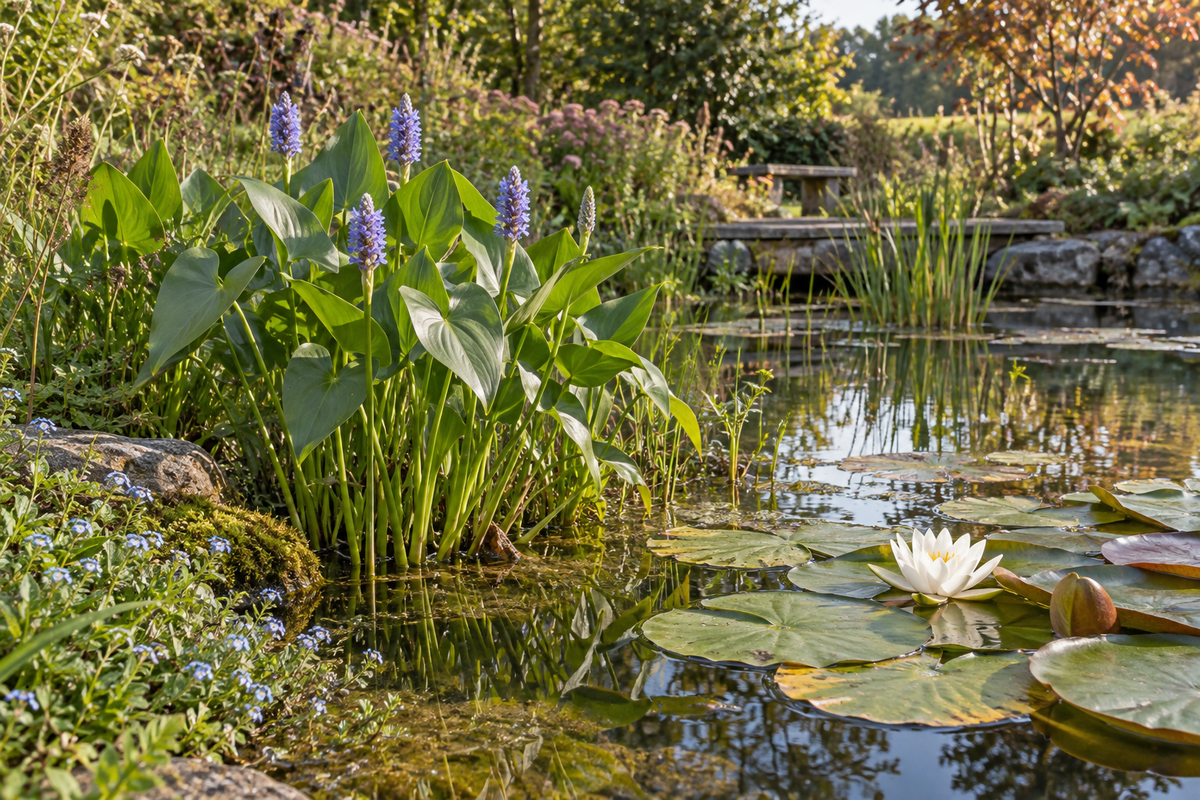
September still holds beautiful blooms in the water garden. Pickerelweed spikes extend the colors of summer, some water lilies open their final flowers, and Hesperantha take over on the damp banks.
To enjoy this period, choose plants as much for their location as for their color. A damp bank species and a plant installed underwater do not have the same needs. Here are four ways to prolong the interest of the pond, with references offered on Aquishop and tips for preparing for the following seasons.

Why a flowering period remains a reference point
A fact sheet indicating "June to September" describes a typical period, not a promise of a plant covered in flowers for four months. The variety, sunlight, weather, and installation influence the result. A young plant recently moved does not always behave like a well-established clump.
In your garden, note the dates of the first and last flowers. Add the exposure and water level. After one or two seasons, this little log will help you fill in the times when the pond lacks color.
Also look at the foliage. A plant whose flowering is coming to an end can still provide a useful silhouette for the composition. Spikes, broad leaves, and low clumps provide depth even when flowers become less numerous.
1. Pickerelweed: bluish spikes above the water
Pontederia cordata combines upright leaves with spikes of small, purplish-blue flowers. The Aquishop fact sheet indicates a flowering period from June to September; the RHS highlights its appeal in late summer.
Install it in a shallow area compatible with its fact sheet. Depth is read in relation to the indicated planting point, not simply the bottom of the pond. Check the actual water height above the basket, especially when the level fluctuates.
A sunny position suits this plant well. Reserve enough space for it to form a clump and prevent a more vigorous neighbor from covering it. Its vertical flowers are particularly visible when an area of open water is behind them.
Pickerelweed is an interesting ornamental option. If your project favors a pond composed exclusively of local native species, check this criterion in your selection: the Aquishop fact sheet does not classify it as native.
2. Water forget-me-not: low and light flowering
The water forget-me-not brings small blue flowers to the immediate vicinity of the bank. Its fact sheet announces a flowering period from May to September and a height of about 20 cm. It lends itself to a gentle transition between the water and taller plants.
Choose a damp area adapted to its needs, in sun or partial shade depending on the garden's conditions. Its low growth allows you to keep a view of the pond, provided you follow its progress and maintain useful pathways.
The aquatic forget-me-not also helps structure shallow depths. The RHS cites this type of vegetation among the habitats useful to small pond fauna. Therefore, one should not judge its interest solely by the number of flowers visible in September.
In a small composition, pair it with a single taller plant rather than several vigorous species crowded into the same basket. Each will retain a space that is easier to monitor.
3. Water lilies: extending flowers to the surface
Depending on the variety and the season, water lilies can still bloom in September. Their leaves occupy a different level than the bank plants and allow for balanced views from a terrace or path.
The fact sheet for the white water lily in a 3-liter pot offered on Aquishop indicates a flowering period from June to September and a sunny exposure. Since plants are sold by color, ask for confirmation if you are looking for a specific cultivar or very compact growth.
The RHS recommends choosing a water lily according to the size and depth of the pond. A vigorous variety installed in a small volume can quickly take up too much space. Planting depth also counts for its installation and growth.
Remove faded flowers and degraded leaves when they are accessible without disturbing the whole plant. If flowering was weak during the summer, examine the exposure, the crowding of the basket, and the variety before adding fertilizer. A late season is not automatically corrected by fertilization.
4. Hesperantha: the bank relay in autumn
Hesperantha coccinea is still often offered under its old name, Schizostylis coccinea. Its flowers appear in late summer and autumn. The RHS describes a plant for damp but drained soil, appreciating a sunny and sheltered situation.
On Aquishop, the reference Schizostylis coccinea ‘Major’ is presented with red flowers and a flowering period from August to November. This period can be shortened by cold and local conditions.

Place this plant on the edge, with sufficient humidity and a position compatible with its crown. It is not treated like an immersed water lily or pickerelweed. For winter, take into account the exposure and hardiness indicated for the chosen plant.
A selection to distribute by zone
| Plant | Interest at the end of the season | Location to prepare |
|---|---|---|
| Pontederia cordata | Purplish-blue spikes and upright foliage | Shallow zone, according to the planting sheet |
| Water forget-me-not | Small blue flowers and low vegetation | Damp edge or suitable shallow depth |
| Water lily | Flowers and leaves on the surface | Depth corresponding to the variety |
| Hesperantha coccinea | Late summer and autumn flowering | Damp bank, without deep immersion |
Depths must be verified on the fact sheets of the purchased references. Measure the position of the crown or the top of the basket according to the indicated convention, in order to avoid confusion between pond depth and water height on the plant.
How to compose a pond that is still pleasant in September?
Start with the main view: the window, the terrace, or the bench from which you look at the water. Place tall plants to frame the scene, with openings toward the surface. A well-placed clump of pickerelweed can be enough to provide height.
Add a low presence on the bank, then a surface plant if the volume allows. You get several levels without having to fill every space. Plants must be able to grow, and maintenance areas must remain accessible.
Then choose a simple palette. The blue of the forget-me-not and the violet of the pickerelweed can be accompanied by a white water lily. A red Hesperantha placed on another portion of the bank adds a bolder accent at the end of the season. These combinations are starting points for composition, to be adjusted to the available space.
Can you buy and plant in September?
The answer depends on the species, the climate, the packaging, and the condition of the plant. A plant in flower purchased in September does not guarantee immediate flowering once installed. Check the planting calendar and the nursery's recommendations before moving or dividing a clump.
The RHS places many aquatic plant propagation operations in the spring and summer. For water lilies or major divisions, prepare the project at the right time rather than intervening only because the pond lacks flowers in the autumn.
September remains very useful for observing gaps, measuring levels, and preparing a selection. Keep the exact names of the selected plants and check availability when ordering.
Maintenance tasks that accompany the end of flowering
Gradually remove leaves that are degrading in the water and monitor inputs from trees. Keep parts that are still healthy and bank structures that remain useful to wildlife. Sector-based maintenance avoids turning the whole pond into a single intervention.
Limit fertilizer application to identified needs and products intended for this use. A plant that is ending its seasonal cycle does not necessarily have a deficiency. Also observe the water level: a drop can leave a damp root ball in conditions that are too dry.
The pond thus retains its interest until autumn, then prepares for its recovery. Flowers count, but their place in a whole of foliage, open water, and well-designed banks makes all the difference.
Choose plants for your locations
Measure the available zones and exposure, then compare the growing guides before composing your selection.
Discover pickerelweed →
See Hesperantha ‘Major’ →
See water forget-me-not →
Sources
- RHS — Pontederia cordata: flowering and cultivation.
- RHS — Hesperantha coccinea: botanical name and plant needs.
- North Carolina State University — Myosotis scorpioides: flowering and growing medium.
- RHS — Growing water lilies: choice, depth, and maintenance.
- RHS — Propagating aquatic plants: intervention calendar.
- RHS — Pond in September: monitoring vegetation and water.
- Aquishop fact sheets for the four plants linked in the article: flowering periods and characteristics of the offered references.