To choose a pond waterfall pump, look for the flow rate it can provide at the actual height of your installation. The maximum flow rate displayed on the box does not describe what will happen at the top of the stream after it has passed through several meters of hose, a filter, and a few fittings.
The right choice also depends on the pump's role. Powering only a decorative waterfall allows for more flexibility than simultaneously running the filtration system for a fish pond. Here is how to prepare a coherent selection.

Decide what the pump needs to power first
In a first setup, a pump draws water from the pond, sends it to the filter, and the filtered return reaches a waterfall. The decorative result then depends on the flow rate compatible with the filter and its outlet configuration.
In a second setup, the filtration system has its own pump, and the waterfall runs on an independent circuit. Its setting can be more flexible, but the installation includes more equipment to maintain and power.
A third possibility consists of distributing water across several branches. It requires knowing what portion passes through the filter and what portion feeds each water feature. A splitter does not add any available flow rate.
Before buying, draw the path of the water. This sketch helps identify constraints that the simple volume of the pond does not reveal.
Define the desired water effect
Do you want a gentle trickle, a steady sheet, or a more generous fall? The required flow rate changes with the width, the shape of the spillway, and the chosen effect.
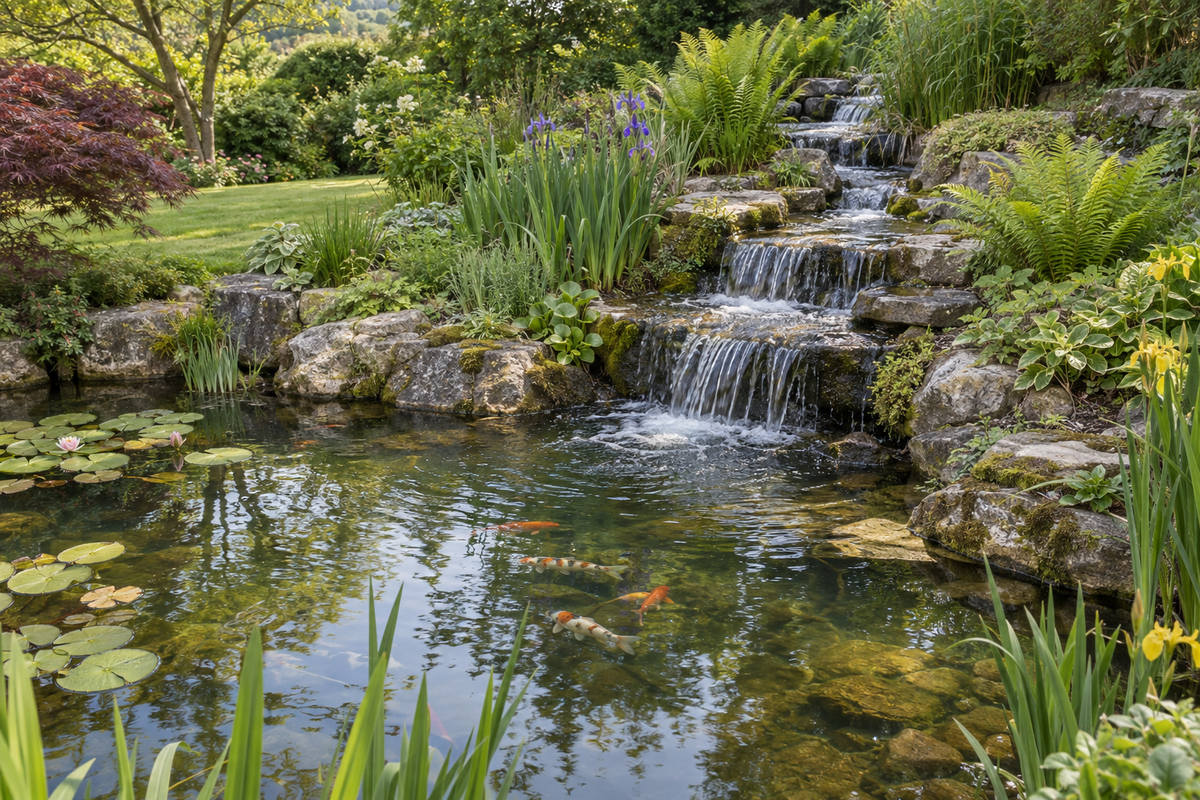
On a natural waterfall, stones can distribute or concentrate the water. A slightly irregular stone sometimes creates several small trickles rather than a uniform sheet. Adding ever more power does not necessarily correct this geometry.
For a manufactured water blade, consult the model's recommendations. OASE, for example, pairs its Waterfalls with pump choices depending on the width and installation height. You still need to compare these indications with the actual path of the hoses.
The sound also deserves a test. A beautiful waterfall seen up close may become too loud from the patio. Plan for an adjustable method if you want to be able to fine-tune the result.
Take measurements that change the choice
| Measurement or information | How to record it |
|---|---|
| Lift height | Vertical difference between the pond surface and the upper outlet of the open circuit. |
| Hose length | Actual path, including detours to the top. |
| Inside diameter | Useful hose diameter, distinct from the outside diameter. |
| Fittings and devices | Elbows, valves, splitters, filter, and UV units passed through by the water. |
| Waterfall width | Width of the water passage at the spillway which determines the desired effect. |
| Pond and fish | Volume, stocking level, and existing filtration equipment. |
The depth at which a submersible pump is located should not be automatically added to the height located above the pond surface. For an open return, the water level serves as a reference for the static lift.
Horizontal distance matters in a different way: it increases the length of the hose and therefore its losses. A waterfall located several meters away may require a more careful study than a waterfall of the same height located right at the edge.
Understand total dynamic head
The total dynamic head corresponds to the height to be overcome, added to the losses produced by the circuit at the intended flow rate. It allows you to compare the required work against the pump curve.
The OASE sizing guide presents this process: set a desired flow rate, calculate the losses of the pipes and fittings, add the lift, then check the pump's performance.
The maximum flow rate and maximum head are two ends of the curve. A pump advertised with a maximum head of 3 meters does not provide its maximum flow rate at 3 meters.
Reasoning example: your outlet is 1 meter above the water. If the circuit study results in 0.6 meters of losses at the sought flow rate, the selection is made around 1.6 meters of total head. These losses are an illustrative hypothesis; they must be calculated for your installation.
Request the curve for the exact model. A maximum value without a curve only allows for an initial comparison, not a final selection.
Check the hose before choosing a larger pump
A hose that is too narrow or kinked can severely limit the result. Unnecessary fittings and long narrow sections also add losses.
It may be more relevant to review the path or the diameter than to increase the power. This reflection is particularly useful when you replace an old pump while keeping plumbing designed for a lower flow rate.
Stepped hose adapters require preparation in accordance with their instructions. The remaining passage must correspond to the connection used. Keep access open to disassemble and check the connections.
The Aquascape support sheet on low flow rates also reminds you to check the strainer, the filter, and the impeller. If a waterfall worked correctly before, first look for an obstruction or a lack of maintenance.
If the waterfall shares the filter pump
Check the permissible flow and pressure of the filter, as well as the recommendations for any UV unit. The sizing must satisfy the entire chain.
An open filter with gravity return does not push water toward a point higher than its outlet as a pressurized circuit would. Its location and the slope of the return are therefore decisive. The outlet must remain free and sufficiently dimensioned.
A pressure filter can be integrated into another type of path, within the limits provided by its manufacturer. However, it creates resistance that the pump must be able to overcome.
If the flow rate required for filtration makes the waterfall far too strong, a dedicated pump or a properly designed distribution system may be preferable. The solution must preserve the circulation the filter needs.
Two families of pumps to compare on Aquishop
A classic model for a defined need
The AquaMax Eco Classic 8500, reference 51099, is one of the pumps intended for filtration and waterfalls. The Aquishop page indicates a maximum flow rate of 8,300 l/h and a maximum head of 3.20 m.
It can be preselected if its curve matches your circuit. It must not be associated with a generic electric dimmer to adjust the flow. This point should be taken into account from the moment of selection.
A model allowing a compatible electronic adjustment
The recent generation AquaMax Eco Premium 9000 has an OASE Control interface and electronic adjustment with the appropriate control equipment.

This possibility is useful for refining the result after installation. Check what is supplied with the pump and what needs to be added. A control interface does not mean that phone control works without an accessory.
These two examples do not constitute a universal recommendation. A small waterfall may require a more modest model; a significant lift may require another pump family.
Compare consumption over your usage duration
The power absorbed and the number of hours of operation determine the energy consumed. As an example, a device consuming 60 W for 24 hours uses 1.44 kWh per day. Then multiply by your rate to estimate the cost.
Compare pumps with equivalent service: providing the useful flow rate at your height. Two devices displaying a similar maximum flow rate may have different curves and consumption levels in your circuit.
When the pump also powers the filtration, its operating time meets the biological needs of the pond. Do not plan daily shutdowns just to reduce the noise of the waterfall without examining the consequences.
Plan for maintenance and testing
The pump must be removable without dismantling the entire decor. Provide accessible fittings and suction protection consistent with the model.
Before finishing the surroundings, run the installation and observe the water returns, splashes, and any overflow areas. Also check what happens when it shuts down and restarts.
A waterfall pump moves water and, depending on its design, certain particles. It is not a vacuum cleaner intended to remove a layer of sludge. If organic deposits accumulate, targeted maintenance with a PondoVac 4 can be considered separately.
Finally, prepare for winter storage according to the manual. Resistance to cold varies between ranges. Do not transfer the features of a Premium to a Classic with a similar name.
Data to gather to choose your pump
Note the height, the fall width, the hose length and diameter, then the filter and UV references. Add a sketch and the desired water effect.
View the AquaMax Eco Classic 8500 →
Compare with the AquaMax Eco Premium 9000 →
Sources
- OASE — Choosing a pump and calculating total dynamic head: flow, losses, and curves.
- OASE — Waterfall 30: recommendations specific to a waterfall element.
- OASE — AquaMax Eco Premium 9000: control and characteristics of the model.
- OASE — AquaMax Eco Classic manual, hosted by Fishkeeper: use, setting, and maintenance.
- Royal Horticultural Society — Choosing a pond filter: functions of filtration.
- Aquascape — Troubleshooting low waterfall flow: maintenance and circuit obstacles.
- Aquishop product sheets for the pumps and PondoVac 4 linked in the article.