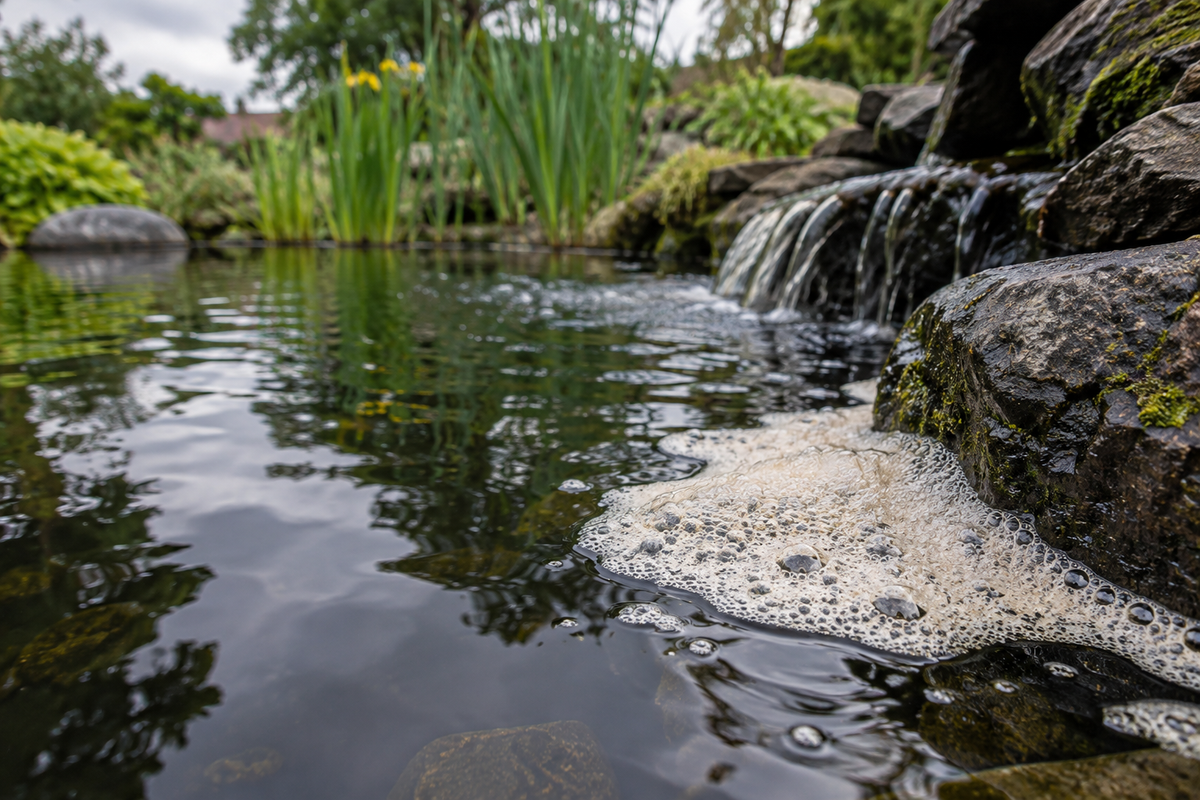
A whitish foam accumulates under the waterfall. You remove it, and then it returns to the same spot. The foam warrants an observation of the pond, but it does not, on its own, allow for the diagnosis of pollution, overpopulation, or a lack of bacteria. Natural organic matter, water agitation, feeding, and certain recent events can explain its appearance.
A good starting point is to note three things: how long the foam has been present, what has changed in the pond, and how the fish are behaving. You can then choose between simple monitoring, targeted maintenance, or a more urgent water check.
Why does the water form foam?
Substances present in the water can alter its surface tension and make bubbles more stable. These are called surfactants. They can come from natural organic materials, particularly decaying vegetation; they are not all detergents added from the outside.
The waterfall, pump return, wind, or waves introduce air and collect the bubbles. The foam then becomes visible in a corner, under a waterfall, or along a bank. Environmental agencies in Michigan and Maine also describe this phenomenon in natural waters.
Persistent foam does not provide a measurement of proteins, ammonia, or nitrites. There is no reliable diagnosis based solely on its duration or color. These clues are useful for describing the situation, but must then be compared with the context and laboratory tests.

Six avenues to examine in your pond
1. Recently disrupted filtration
Has the pond just been restarted? Have the biological media been replaced or deep-cleaned? Has a pump been left off? These events justify checking the filter operation and water parameters. Foam can accompany an imbalance without proving that nitrification is the cause.
Note the intervention precisely: emptying a mechanical basket and disinfecting an entire filter are not equivalent. This distinction avoids systematic re-seeding after every maintenance task.
2. Overly generous or changed feeding
Look at the food actually consumed, leftovers, and recent changes to the ration or the feed itself. If foam appears after meals, this timing is worth noting. However, it is not enough to automatically blame the food.
Adapt portions to the fish, temperature, and food instructions. Remove accessible leftovers. If multiple people feed the fish, agree on a common tracking method: unintentional double feeding is easy to miss.
3. A larger population
Fish grow and can reproduce. Your installation may now be carrying a load quite different from what was initially planned. Count the individuals, estimate their size, and compare this population to your filtration and aeration capacities.
Avoid formulas that add up centimeters of fish without taking into account the species and adult size. An analysis of the entire pond is more useful for deciding on an expansion, an adjustment of the equipment, or rehoming some fish.
4. Accumulated leaves, plants, and deposits
Inspect areas under trees, plant baskets, and places where the current gathers debris. Decaying materials can contribute to the organic compounds present in the water. Start with large, accessible waste before considering work on the entire bottom.
Brown water, an odor, or black sediment provides additional information but does not on its own determine the composition of the sludge. Do not massively stir up an invisible bottom just to verify a hypothesis.
5. A new pond or a seasonal event
In a recent installation, monitor the settling of the filter without assuming all foam is necessarily a normal phase. Aquiflor also cites episodes related to pollen or fish spawning periods. The date, visible inputs, and observed behaviors help to examine these leads.
Photograph the foam in the same place for several days if the fish are doing well. A brief episode and an accumulation that increases week after week do not call for the same follow-up.
6. A recent product or external input
Gather the names of treatments, conditioners, and cleaners used recently. Also consider work on the patio, furniture washing, or runoff. If a product could have reached the water, look up its exact reference and have the situation evaluated.
The white color does not prove it is a detergent, but an identified entry must not be ignored. Avoid contact with suspicious foam and prevent pets from accessing it during the diagnosis.
The table to choose the first check
| Observation | Avenue to examine | First action |
|---|---|---|
| Foam after meals | Ration, feed, and leftovers | Note distributions and observe consumption |
| Foam after filter cleaning | Change in operation | Check flow rate and tests |
| Abundant debris and deposits | Organic inputs | Remove accessible waste and assess the bottom |
| Episode during pollen or spawning | Seasonal input | Document evolution and monitor fish |
| Water runoff from a cleaned area | Possible contamination | Identify the product and seek quick advice |
| Fish in distress | Water issue or other urgent cause | Check equipment, aeration, and have water tested |
Choosing maintenance adapted to the cause
For organic matter on the bottom
A PondoVac 5 or a PondoVac 4 can be used to remove accessible deposits, in small areas. Plan for the discharge and monitor the drop in water level. The goal is to remove an identified source of material.
Aquipond Bactovase should be considered to assist in the degradation of the organic fraction of the sediment. Its use depends on the state of the bottom and the conditions of the pond. It does not constitute a universal treatment for all foam, especially when external contamination is suspected.
To support filtration that needs restarting
Aquipond NitriBoost is offered for seeding and biological restarting. It can be part of a response once the need has been identified, with monitoring of the conditions of use. An application cannot guarantee the disappearance of foam within a fixed timeframe.

If the filter remains too small or receives too little water, start by addressing this point. Bacteria need adapted conditions; they do not compensate for a circulation failure.
To recover floating waste
A skimmer such as the SwimSkim 25 collects impurities at the surface. By regularly removing leaves and debris, you limit a portion of the materials that would otherwise end up on the bottom. Check its placement and empty the basket depending on the accumulation.
A surface skimmer should not be confused with a protein skimmer. It does not automatically remove all dissolved compounds responsible for foam. Its value lies in the waste it actually collects.
Why does the foam return after cleaning?
Look at what continues to enter the pond. If leaves are still falling, if rations remain excessive, or if an edge allows water from a flower bed to flow in, removing the foam is not enough. A photograph of the return point and a note after every rain can reveal a pattern.
A proper partial water change does not automatically destroy biological filtration, as the populations are primarily settled on the media. However, it must be reasoned based on the quality of the replacement water and the problem observed. Avoid repeated drains done solely to make a visual sign disappear.
Frequently asked questions
Should I turn off the waterfall so I don't see bubbles?
Eliminating agitation may hide the phenomenon while altering oxygenation. Maintain operation suited to the fish and search for the cause. Do not turn the appearance of the surface into the sole criterion for decision-making.
Is natural foam necessarily harmless?
Its origin and the general state of the pond still need to be examined. The absence of external products does not guarantee that all parameters are satisfactory. Conversely, foam does not prove a dangerous concentration of nitrites.
What information should I send to Aquishop?
Prepare the volume, population, a general photo, a view of the foam, the references of the filter, and the products used. Add the test results with their units and the timeline of the last few days.
Start with a precise assessment: a test kit adapted to the pond helps document the parameters it measures. Depending on the diagnosis, the avenues could be maintenance with a PondoVac, Bactovase for organic deposits, or NitriBoost for filtration. The choice becomes simpler when you know what you are trying to correct.
Sources and references
- Michigan EGLE — Foam: A naturally occurring phenomenon : organic matter, turbulence, and context of appearance.
- Maine Department of Environmental Protection — Foam : possible natural origin and distinction from external input.
- Aquiflor — White foam on a pond : maintenance avenues and seasonal events.
- Aquishop — NitriBoost, Bactovase, PondoVac 5 and SwimSkim 25 : uses of the presented references.