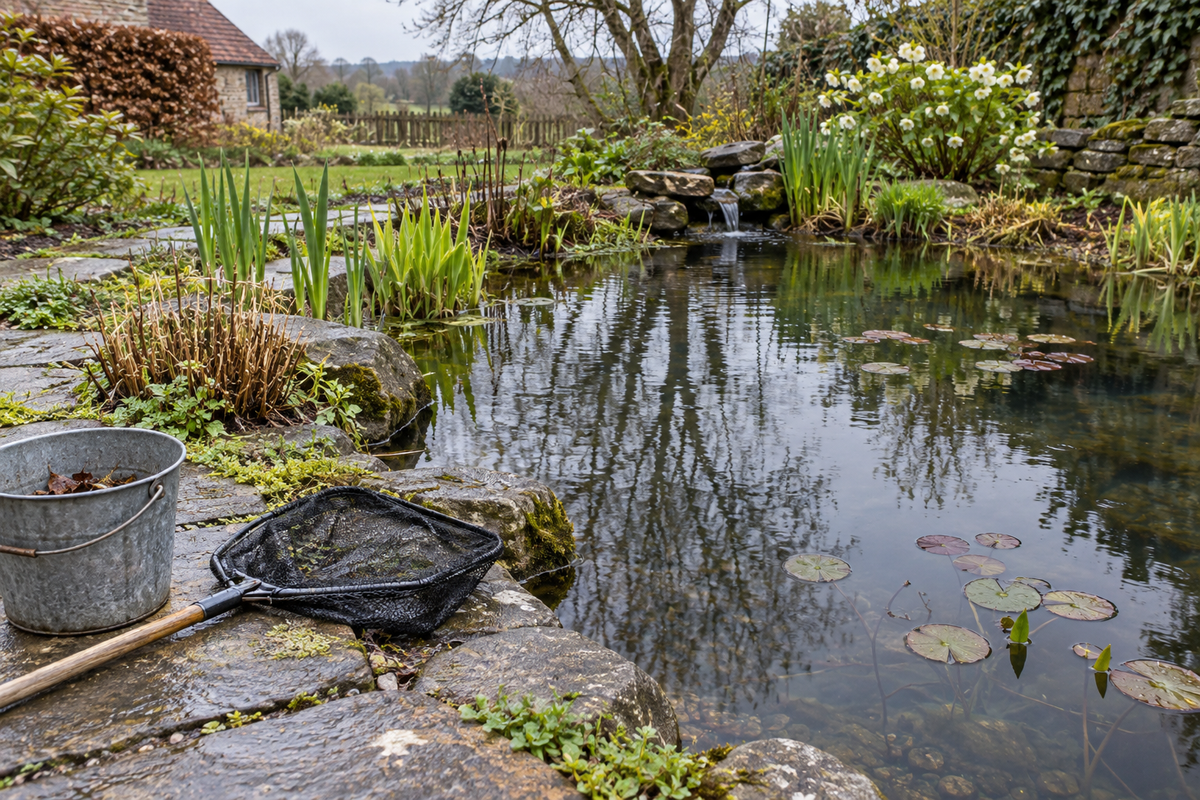
In spring, the pond water warms up, plants restart, and fish resume their activity. It is the time to check what winter has left behind: leaves, sediment, weakened fittings, or clogged equipment. A gradual approach to maintenance allows you to put the installation back in order while preserving its biological functioning.
The guide follows seven steps: observe, remove waste, check filtration, analyze the water, maintain plants, adjust feeding, and limit the causes of algae. You can spread these over several short interventions. The state of the pond and the actual water temperature matter more than a fixed date.

When to start spring maintenance?
Observation, removing a few accessible leaves, and checking faulty equipment do not require waiting for a single temperature threshold. For bacterial additions, plantings, and feeding, follow the requirements of the products and species concerned. A mild day does not mean the water has warmed up for good.
Monitor the temperature for several days in a row and check the frost forecast. If eggs, larvae, or abundant small fauna occupy an area, adapt your work. A natural pond generally requires less intervention than a pond heavily populated with fish.
Step 1 — Assess the state of the pond after winter
Before any intervention, take time to observe. Spot piles of leaves, new coloration, damaged plants, a drop in water level, and changes in fish behavior. A general photograph followed by a few shots of sensitive points will provide a baseline for comparison.
- Check the water level and signs of moisture around the edges.
- Check water flow at inlets, outlets, and waterfalls.
- Identify overturned baskets or areas where soil is entering the water.
- Observe the fish without chasing or catching them.
Then, prioritize your actions. A fish in distress or a pump that is no longer flowing takes precedence over an unsightly leaf. Note any anomalies and the operations performed: this will help to understand any subsequent changes.
Step 2 — Remove waste and treat sediment that needs clearing
Start with dead leaves, branches, and debris accessible with a net. For sludge, identify the areas involved and the nature of the materials. Loose organic sediment should not be handled like sand brought in by runoff. There is no need to systematically strip all the pond walls.
In an accessible garden pond, a PondoVac 4 or PondoVac 5 vacuum cleaner allows for localized suction. Prepare the discharge, keep an eye on the animals, and monitor the water level: the device removes water along with the sediment. Stop if the water becomes too murky to work properly.

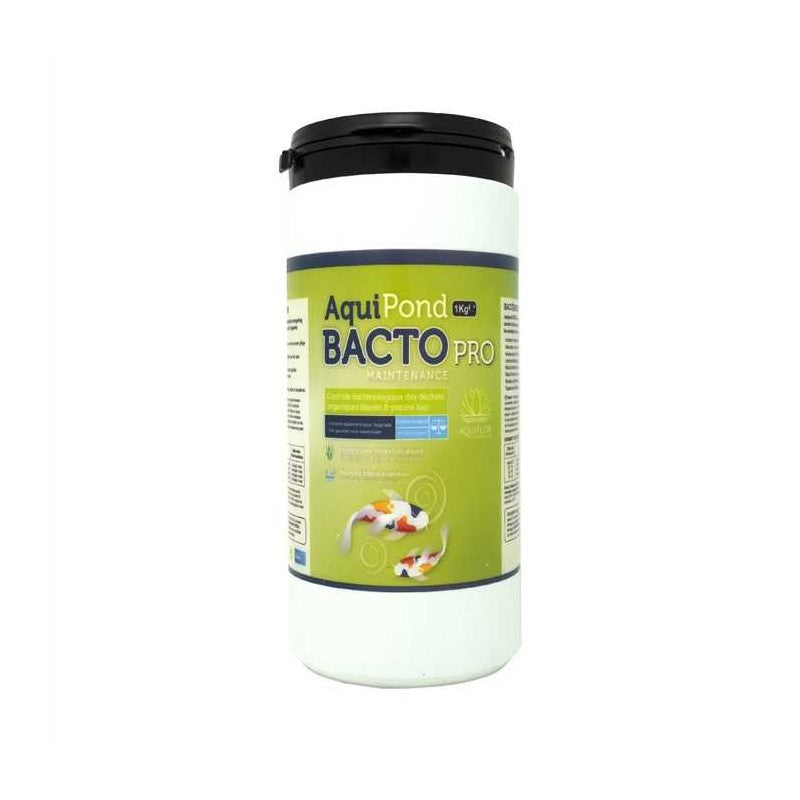
Aquipond Bactovase is another option to help reduce the organic fraction of pond sludge. It should be chosen based on the sediment, the surface area, and the conditions of the water body. It does not remove gravel or continuous soil runoff. A combination of targeted mechanical maintenance and biological monitoring can be considered.
Avoid scheduling a drain simply because spring has returned. A potential water renewal should be decided based on the problem and the quality of the replacement water. If major repairs are necessary, prepare them with a solution suitable for the fish and wildlife.
Step 3 — Check and restart filtration
Check hoses, fittings, seals, accessible outlets, and the water path. Any work on a device must be done according to its manual, with the power supply cut when required. After reassembly, observe the operation and any leaks before leaving the installation unattended.
Distinguish between dirty mechanical parts and colonized biological media. Clean according to the manual, preserving the latter as much as possible. When rinsing, use appropriate water free of residual chlorine, and avoid replacing all media at the same time unless necessary.
If the filter has remained off and contains stagnant, polluted water, clean it before returning the contents to the pond. Also, check the UV: lamp reference, usage time, quartz cleanliness, and maintenance recommended by the manufacturer. A visible lamp alone is not proof of sufficient efficiency.
For seeding, the Aquipond range offers NitriBoost. Its datasheet indicates optimal functioning at water temperatures above 10 °C and a pH between 6.5 and 8. An application helps with the restart; analyses then allow you to monitor the filter's capacity. A fixed waiting period of a few weeks is not, in itself, a guarantee that new fish can be introduced.
Step 4 — Analyze the water before correcting
Keep the results, their units, and the time of measurement. Temperature and pH are particularly relevant in interpreting ammonia levels. An isolated value must be correlated with the state of the fish, the food distributed, and recent interventions.
| Parameter | Why monitor it in spring |
|---|---|
| Temperature | Adapt actions, products, and feeding |
| pH and KH | Assess acid-base balance and buffering capacity |
| Ammonia/ammonium | Detect accumulation of nitrogenous waste and interpret with pH and temperature |
| Nitrites | Monitor a sensitive stage of biological filtration |
| Nitrates and phosphates | Document nutrients and their evolution |
The JBL Pro Aquatest Combiset Pond kit notably includes pH, KH, GH, ammonium, nitrites, and phosphates. Check the included parameters: not all kits contain the same tests. If a worrying result accompanies fish in difficulty, ask for professional advice quickly; do not put off the check until a 48-hour automatic deadline.
Step 5 — Restore aquatic plants
Remove dead parts that are accessible without uprooting young shoots. Examine clumps that have become too dense, the stability of baskets, and the condition of water lilies. The RHS advises dividing and replanting these when they show signs of growth.
When repotting, use a substrate intended for aquatic plants and contain it properly. A suitable layer of gravel on top of the basket can limit its dispersal by fish. Avoid introducing garden soil or rich potting soil that would spread in the water.
Think about the mature size of each plant. Keep areas of open water and access points for maintenance. Gradual plant cover can provide shade, but filling the entire surface is not a goal. In a pond, check for animals present before moving a basket or removing a clump.
Step 6 — Resume feeding by observing the fish
Needs vary according to species, temperature, and feed. Not all fish follow the same winter rhythm. For koi and goldfish, adapt the resumption of feeding to their activity levels and the usage range indicated on the chosen food.
Distribute a small amount, observe what is actually consumed, and remove accessible leftovers. Note the ration if you increase it gradually: this allows you to correlate a change in test results with a change in diet. A cold-water feed may be appropriate when its instructions match the measured conditions.
A wound, abnormal breathing, or persistent loss of appetite merits a diagnosis. Do not compensate for a fish that is eating little by distributing more to the entire pond.
Step 7 — Limit the causes of algae from the start
The appearance of algae in spring can accompany seasonal restarts. First, identify their form: uniformly green water, filaments, or deposits on the walls. UV is primarily for algae in suspension; it does not resolve all visible forms.
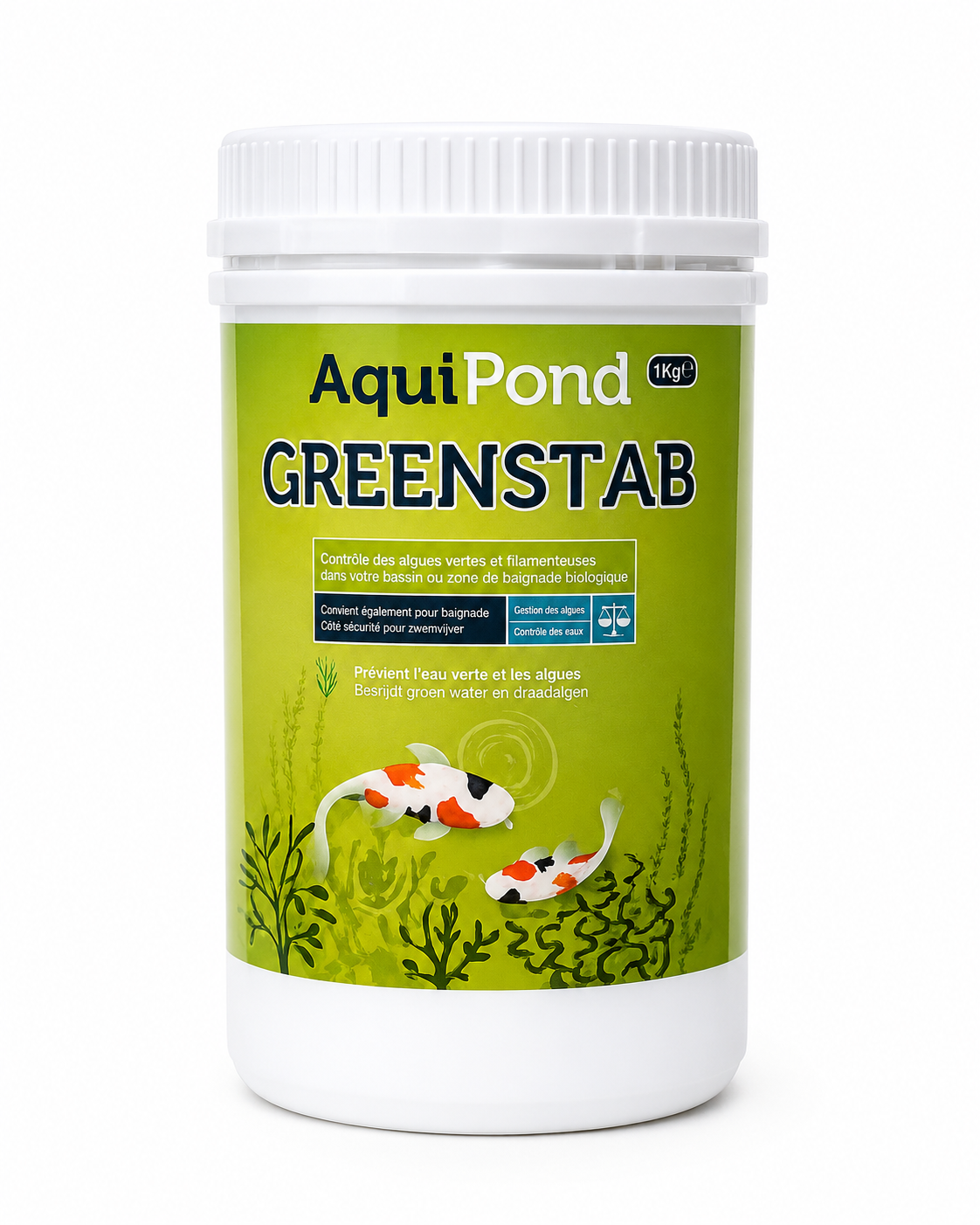
Look for nutrient input, leftover food, plant debris, and filtration problems. Maintain a fish population compatible with the pond. If an Aquipond product is considered, choose it for the specific problem identified after analysis, rather than piling up several preventive treatments.
The checklist to keep by the pond
- Observations and temperature noted.
- Accessible waste removed; decision made on sludge based on need.
- Pump, aeration, filter, fittings, and UV checked.
- Analyses recorded and results interpreted.
- Baskets and plants inspected while preserving fauna.
- Feeding adapted to fish and temperature.
- Next check set based on observations.
Prepare your maintenance with the right references: compare PondoVac models for suction, Aquipond Bactovase for organic deposits, and NitriBoost for seeding. With a photo of the pond, its volume, and the latest analyses, the Aquishop team can guide you more precisely.
Sources and references
- RHS — Pond maintenance in March and in April: seasonal observations, vegetation, and resumption of activity.
- RHS — Pond care: proportionate maintenance and habitat preservation.
- University of Florida, IFAS — Ammonia in Aquatic Systems: biological filtration and nitrogenous waste monitoring.
- Aquishop — Aquipond NitriBoost, Bactovase, PondoVac 4 and Combiset Pond: specifications and usage of cited products.