Two 20,000-liter ponds can require very different filtration systems. The first contains a few goldfish among the plants. The second houses koi that are fed daily. The volume is identical, but the amount of waste to manage varies significantly.
To choose a filtration system, match the actual volume with the population, feeding habits, and the time you can dedicate to maintenance. The type of installation comes next: pressurized, gravity-flow (open), or gravity-fed. Each solution imposes constraints that should be planned for before purchase.

Start with a pond profile
Gather the volume, depth, sun exposure, species, and size of the fish. Add an estimate of feeding in the peak season. If the population is expected to grow, the sizing must take this development into account.
Measuring via a water meter during filling provides valuable information. For an existing pond, a geometric calculation remains an estimate: use the average depth and take the shelves into account. Do not drain the pond just to get a more precise figure.
Also describe the desired result. A pond for biodiversity, with few or no fish, can function without technical filtration. A densely populated ornamental pond requires a different approach. The RHS links the need for filtration to the fish load and the pond's objectives.
Mechanical and biological: what the filter must achieve
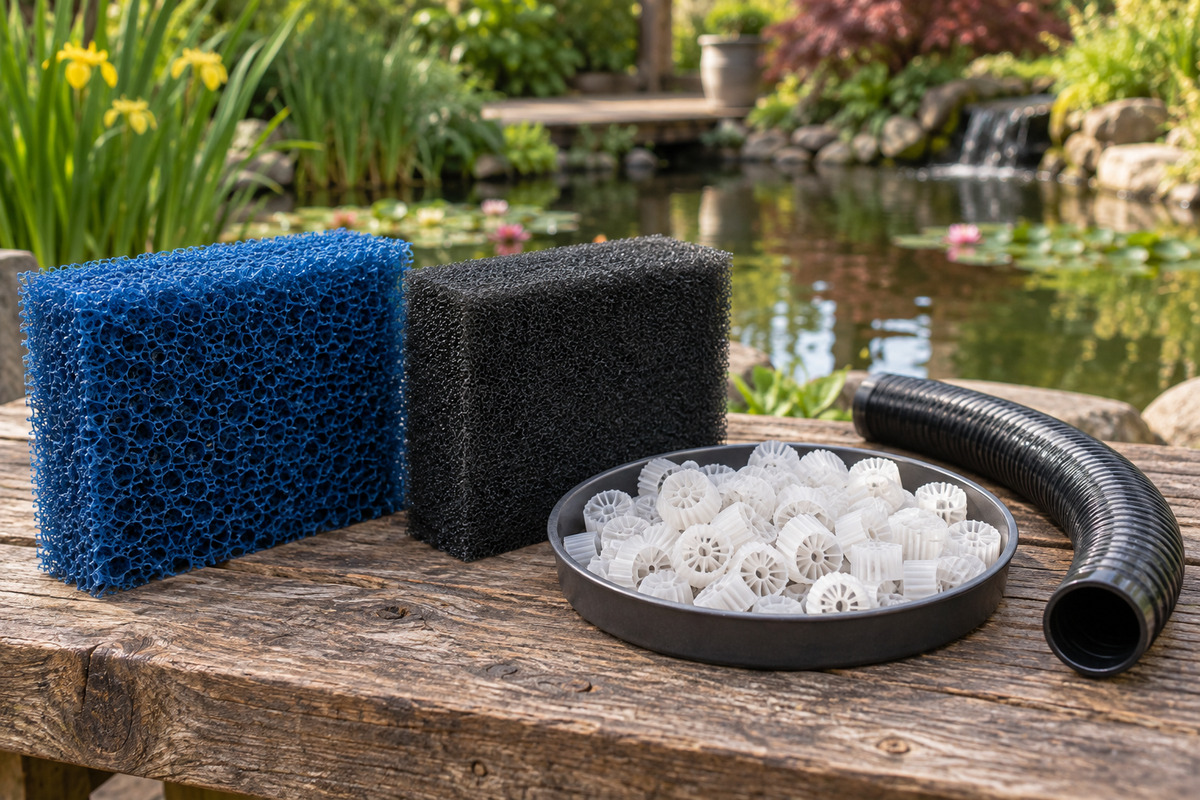
The mechanical component retains solid matter. It can use foams, brushes, a sieve, a drum, or other devices. Its efficiency also depends on the discharge: the captured waste must be removed from the system.
The biological component provides surfaces that can be colonized by micro-organisms. Under suitable conditions, nitrification converts ammonium into nitrites, and then into nitrates. This function requires time to become established and sufficient oxygen supply.
A UV clarifier can supplement the system against suspended microalgae. It does not on its own ensure the biological transformation of waste and does not replace the removal of particles. Water clarity is therefore not the only indicator of performance.
The pressurized filter: a compact setup
In a pressurized filter, water passes through a sealed container and maintains pressure, allowing for some water returns at height. This principle can facilitate integration near a waterfall, subject to the limits of the filter and the pump.
The OASE FiltoClear 19000 combines foams and an integrated UVC. Its controls are accessible from the top, and its cleaning system allows for routine maintenance from the outside. However, you must provide access to the lid, the dirty water discharge, and the periodic operations specified in the manual.

Discretion should not lead to burying connections without access or compressing hoses. Also check the maximum allowable pressure. A very powerful pump does not automatically improve the result.
Reading the advertised volumes: a telling example
The technical table for the FiltoClear 19000 distinguishes three indicative capacities: up to 19 m³ in its general category, 10 m³ with fish, and 5 m³ with koi. The name "19000" therefore does not mean that it is suitable for any 19,000-liter pond.
| Situation indicated on the data sheet | Maximum advertised volume |
|---|---|
| General category | 19 m³ |
| Pond with fish | 10 m³ |
| Pond with koi | 5 m³ |
These figures illustrate how to read a data sheet; they do not constitute a prescription for every population. The amount of food, exposure, and maintenance conditions may lead you to plan for a higher capacity.
The gravity-flow filter: planning for water return
An open filter can be fed by a pump and then allow the water to return to the pond by gravity. Its outlet must be positioned and sized to allow this flow. You cannot ask it to freely discharge to a point higher than its outlet level.
The BioSmart Set 36000 is an example of a kit combining a filter, a pump, and a UV unit. Its Aquishop product sheet notably features a Vitronic 36 W and an AquaMax Eco Classic 11500. Check the exact composition of the kit at the time of choice and the installation conditions.
This type of installation can facilitate access to filter media and drains. However, it requires a suitable space with a return path that does not cause overflow. Landscaping camouflage must leave enough space to open and maintain the filter.
A gravity-fed system: a different organization
The term "gravity-fed" can be confusing. In a gravity-fed system, water reaches the filter from the pond through suitable piping, often via a bottom drain or a skimmer. The pump is generally located after the filtration stages and returns the water to the pond.
The installation level of the modules is critical. This setup must be planned with piping, water levels, and a pump house. It is not enough to just place an open filter next to the pond to achieve this functionality.
OASE offers, among others, ProfiClear modular systems in pump-fed or gravity-fed versions. The choice of version and the organization of the modules must match the project. They are not interchangeable without studying the setup.
Drum and moving bed: what functions do they add?
A drum is a mechanical stage that separates particles through a sieve and evacuates them during cleaning. A moving bed is a biological stage in which media are kept in motion, usually through aeration.
These terms describe functions, not an automatic guarantee of suitability for all ponds. Examine the admitted feeding load when documented, the flow rate, media volumes, and air requirements.
Automated cleaning can lighten regular tasks, but it is still necessary to monitor the system, the discharge, and consumables. Also plan for the water and electricity requirements related to operation.
Matching the pump, filter, and UV
The useful flow rate is the one that actually travels through the circuit. Height, hoses, and devices reduce the maximum flow rate advertised by the pump. Check the operating point and the allowed range for each piece of equipment.
Excessive flow can exceed the hydraulic capacity of the filter or disrupt the intended treatment. A flow that is too low can leave some areas poorly circulated and reduce the amount of water treated. Arbitrarily increasing power does not replace this verification.
On an open filter, the return must be able to discharge the received flow. On a pressurized filter, respect the pressure limits. In both cases, think about what happens during a shutdown and a restart.
Choosing maintenance that you can realistically sustain
Before purchasing, imagine a routine operation: where do you stand, how do you open the filter, and where does the cleaning water go? If every maintenance session requires moving heavy stones or walking through a flower bed, it will be harder to keep up with.
Check the availability of foams, seals, lamps, and other spare parts for the reference. Also compare the expected frequency of maintenance according to your pond's load. A device that is easy to clean in your garden may be a better choice than a more ambitious but poorly integrated system.
The cost to plan for includes the filter, pump, fittings, potential UV, aeration, and consumables. Add the work required for installation: the price of a tank alone does not describe the budget of the installation.
Supporting the commissioning
A new filtration system must be monitored with water tests. Aquipond NitriBoost can support the seeding when its conditions for use are met, particularly regarding temperature and pH.
Increase the load gradually and monitor ammonium and nitrites. Adding bacteria does not immediately transform a new filter into a mature installation. Likewise, replacing an existing filter requires preserving as much of its useful biology as possible and monitoring the transition.
Compare the setups suitable for your garden
Prepare the volume, current and future population, photos of the location, and your maintenance constraints. The Aquiflor team will then be able to guide you toward a coherent system.
See the FiltoClear 19000 pressurized filter →
Discover the BioSmart Set 36000 →
Sources
- RHS — Choosing a Pond Filter: functions and choice based on fish stocking.
- OASE — FiltoClear 19000: setup and capacities based on population.
- OASE — ProfiClear Premium XL Gravity Fed: modular organization, drum, and moving media.
- University of Florida IFAS — Ammonia in Aquatic Systems: how nitrification works.
- Aquishop product sheets for the BioSmart Set 36000 and Aquipond NitriBoost linked in the article: kit composition and seeding conditions.