The bacteria in a pond contribute to the transformation of waste. An addition can support the start-up of a filtration system, its recommissioning, or the breakdown of organic deposits, provided that an appropriate preparation is chosen. A bottle intended for the filter and bacteria against sludge do not address exactly the same need.
Before ordering, formulate the problem in one sentence: "my filter is new," "my nitrites are increasing," "the bottom is accumulating organic matter." This small effort avoids treating the water's appearance without understanding what is happening. Here is how to position bacteria in pond maintenance and choose a consistent solution, particularly from the Aquipond range.
What are nitrifying bacteria used for?
Fish release nitrogenous compounds, mainly through their gills. The decomposition of leftover food and other organic matter also contributes to them. Specialized microorganisms transform ammonia and ammonium into nitrites, then nitrites into nitrates: this is nitrification. Nitrites remain dangerous for fish; their complete transformation is therefore just as important as the first step.
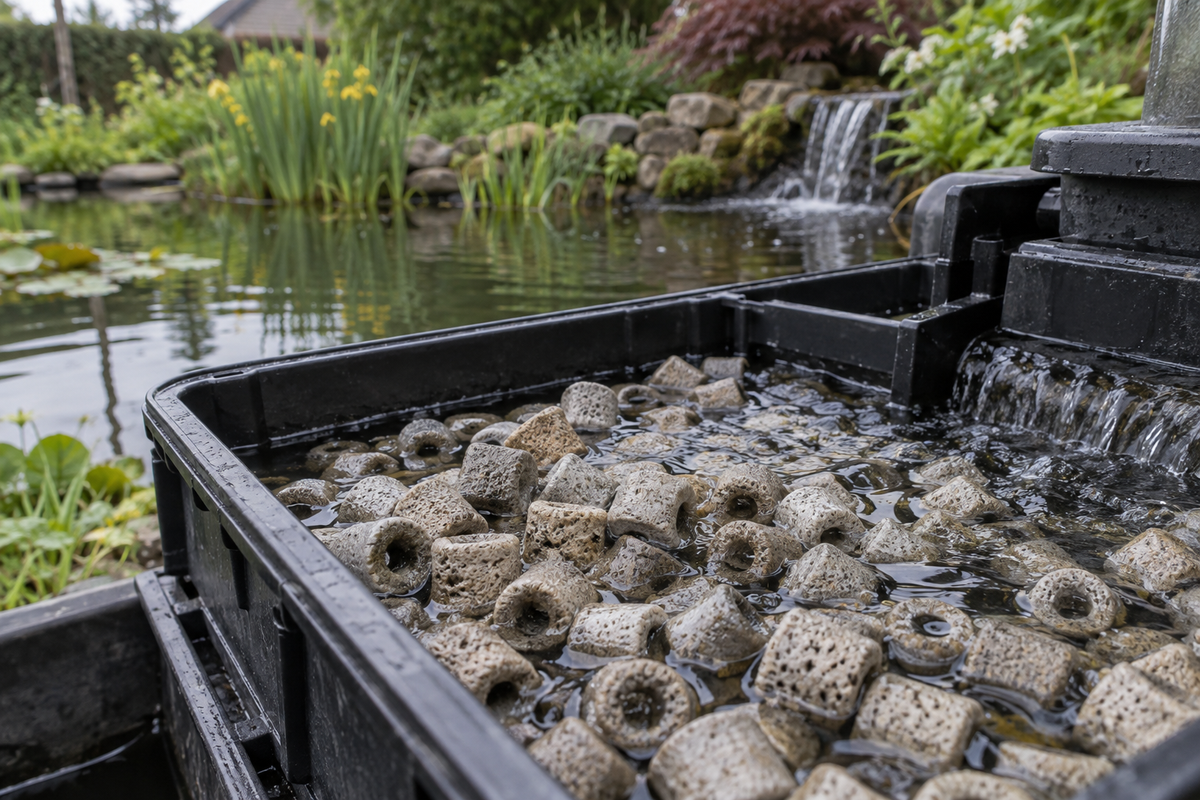
These populations mainly colonize surfaces: biological filter media, walls, gravel, plants, and biofilms. The circulating water provides them with the substances to transform. A biological filter is thus a living habitat, associated with mechanical filtration that traps solid waste. A rinse that removes visible dirt and a general disinfection do not have the same consequences.
Nitrates do not simply disappear because nitrification is working. Their fate depends notably on plants, water changes, and the operation of the installation. This is why "adding bacteria" never exempts you from monitoring water quality over time.

When can an addition be relevant?
At the start-up of a new pond
A running pump does not mean that a new filter is already capable of handling a full population of fish. Colonization takes time. A seeding preparation can accompany this phase, with monitoring of ammonia and nitrites. The introduction of fish must remain gradual and depend on the results obtained.
To prepare for your start-up, gather the actual volume, the filter model, and the planned population. Also note the date of filling. This information makes it possible to distinguish a brand-new installation from an already established pond to which equipment is simply being added.
After a major intervention
A deep cleaning, the replacement of a large portion of the media, a long interruption in circulation, or certain treatments can disrupt biological filtration. Start by identifying the intervention involved. An emptied pre-filter basket is not equivalent to replacing all the biological media.
Keep the names of the products used and their application dates. After a fish treatment, clarify its compatibility with the filter and the procedures for any potential restart. Pouring a new inoculum into still-unfavorable conditions can be disappointing, even with a good product.
During the spring restart
Spring invites us to review the entire operation: water flow, media, aeration, temperature, and the resumption of feeding. An addition is decided based on the state of the pond and the product's instructions. It is not necessary to multiply preparations simply because the calendar says March or April.
Oxygen, circulation, temperature: the conditions to check
Nitrification consumes oxygen and utilizes the water's alkalinity. Insufficiently oxygenated water or a buffer capacity that is too low can limit the filter's operation. pH and temperature also influence microbial activity. KH helps to monitor buffer capacity; it must be measured, it cannot be deduced from the transparency of the pond.
In the field, start with accessible checks: has the water return decreased? Is a foam pad clogged? Is air still reaching the diffuser? Is the thermometer accurately measuring the water? Record the results before the addition. If the filter is receiving little water, the first correction concerns this water flow.
Follow the ranges indicated for the chosen preparation. The Aquipond NitriBoost datasheet notably indicates water above 10 °C and a pH between 6.5 and 8 for its optimal use. These indications concern this product; they do not constitute a universal rule for all bacteria present in a pond.
Which Aquipond preparation to choose?
| Identified need | Reference to examine | Prior check |
|---|---|---|
| Seeding or restarting filtration | Aquipond NitriBoost | Filter in operation, temperature, pH, and analyses |
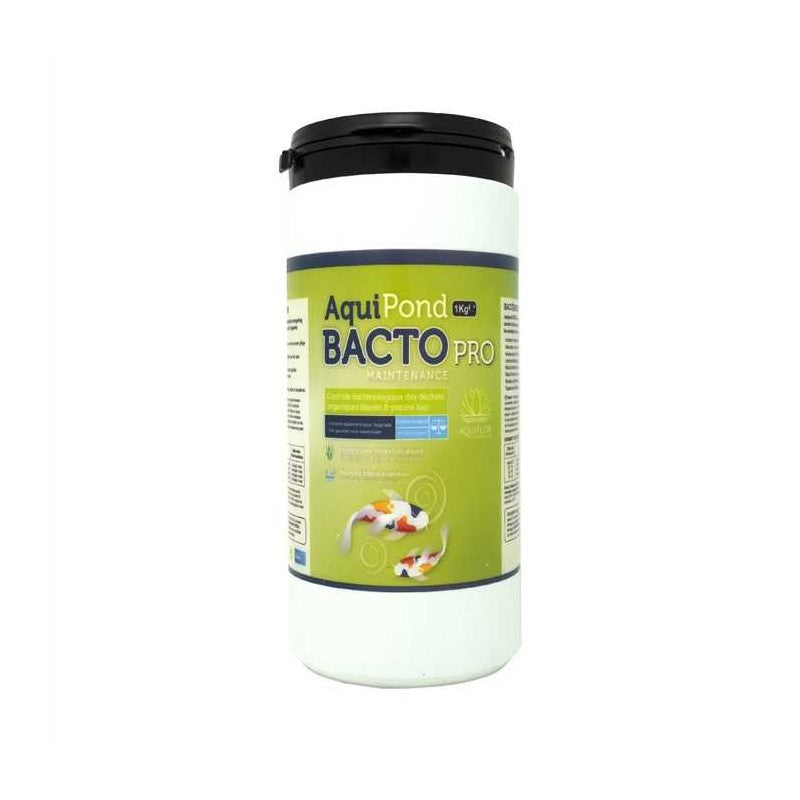
| Supporting organic maintenance | Aquipond Bacto Maintenance | Actual volume, product protocol, and waste inputs |
| Organic deposits at the bottom of a pond | Aquipond Bactovase | Nature of sediments and area to be treated |
This table guides the comparison. It does not suggest using all three products together. Each reference has its conditions of use; dosages and frequencies are not interchangeable.

Has your filter just been installed or put back into service? Consult the Aquipond NitriBoost datasheet with your pond volume and your latest analyses. The 1-liter reference indicates a base dosage of 1 liter per 10 m³; check the instructions on the packaging received before application.
For sludge, combine diagnosis, Bactovase, and mechanical maintenance
Aquipond Bactovase is intended for the organic fraction of deposits. An accumulation of decomposed leaves may therefore justify examining this option. A sand influx after each rain primarily requires fixing the runoff. What is on the bottom matters more than just its brown color.
A PondoVac 5 or a PondoVac 4 vacuum allows for the physical removal of accessible deposits. Bactovase should be considered for a gradual biological action, depending on the conditions of the water body. For a significant thickness, have the access, materials, and desired result evaluated before deciding on the method.
A good preparation consists of photographing several areas, identifying leaf inputs, and noting what has already been vacuumed. These elements will help compare progress. Waiting only for the water to "look better" provides information that is too vague regarding the sediments.
Should the UV be turned off when adding bacteria?
Some protocols require a temporary interruption of the UV during seeding. Respect the duration specific to the product and the equipment instructions. Do not automatically transpose instructions found on another bottle.
Also clarify which device you are ordering. On an installation combining several functions, cutting one plug might stop the pump along with the UV. Before application, identify the connection involved and organize the restart. Circulation and aeration must remain adapted to the pond's needs.
Preparing the addition in five steps
- Measure and record. Note the temperature and parameters useful for the observed problem; keep the units and the time of measurement.
- Check the installation. Verify the flow, the media, and the aeration before opening the product.
- Read the full instructions. Dosage, preparation, place of application, UV, and storage can vary between references.
- Apply an identifiable protocol. Note the product, quantity, and date, without adding several treatments as a reflex.
- Monitor the progress. Compare measurements and observations; adapt the follow-up to these results.
Frequently asked questions
Does clear water mean the bacteria are working well?
Transparency does not measure ammonia or nitrites. A pond can look crystal clear while still being unbalanced. During a start-up or after an incident, keep tests at the center of your monitoring.
Can a filter that is too small be compensated for with more bacteria?
An addition does not provide the surface area, circulation, or oxygenation that the installation lacks. If difficulties return despite consistent maintenance, re-evaluate the filter, the population, and the food distributed.
What if the fish are breathing at the surface?
Do not wait for the effect of a bacterial preparation. Immediately check the equipment, support the aeration, and have the water tested. Fish in distress require a quick response adapted to the cause.
To choose usefully, prepare your measurements and compare NitriBoost, Bacto Maintenance, or Bactovase according to your goal. The Aquishop team will be able to rely on concrete information to guide you.
Sources and references
- University of Florida, IFAS — Ammonia in Aquatic Systems: origin of nitrogenous waste, nitrification, and need for analysis.
- New Mexico State University — Important Water Quality Parameters in Aquaponics Systems: role of oxygen, pH, and alkalinity; biological principles, without transposing farming thresholds to all ponds.
- Aquipond — NitriBoost: purpose and conditions of use announced by the brand.
- Aquishop — Bacto Maintenance and Bactovase: references and uses of the proposed preparations.