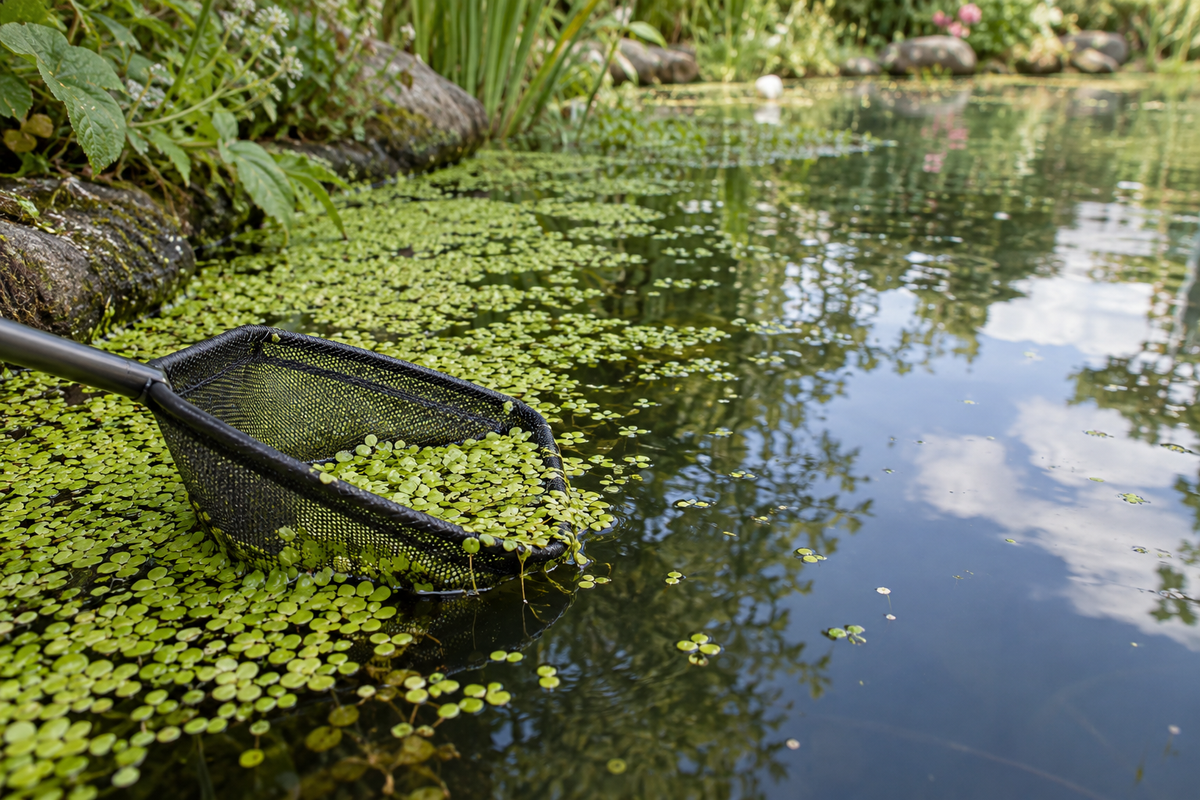
You use the landing net, the surface clears, then the duckweed seems to return immediately. Sometimes the wind has simply brought back those that remained between the plants. But, when conditions suit them, these tiny plants also multiply very quickly. To limit duckweed in a pond, combine regular harvesting with looking for the sources that fuel its growth.
The goal is to restore open water and manageable maintenance. A few duckweed plants in a living pond are not a catastrophe. However, an almost continuous cover that hinders other plants and complicates fish observation merits organized intervention.
Recognizing duckweed before choosing a solution
Look closely at the surface. Duckweed forms small floating units that you can distinguish from one another. Green water remains colored when you draw a glass of it; a mass of filamentous algae stretches into threads. These three situations can coexist, but they are not treated with the same equipment.
The RHS notably describes rounded fronds bearing fine submerged roots. Not all species look exactly the same, however: some are very small and others float just below the surface. To request an identification, photograph a few elements in a small bowl with a size reference, then add a general view of the pond.
A clear photo is better than a description like "green moss." Avoid immediately ordering an anti-algae product based on this phrase alone. Duckweed is an aquatic plant; the name of a product intended for algae does not prove that it corresponds to your problem.
Why do they cover certain ponds?
Penn State Extension describes them primarily in calm, nutrient-rich waters. Therefore, look at what is actually entering your pond: runoff water, planting soil, leaves, uneaten food, or inputs from the surroundings. Searching for these entry points helps explain why harvesting alone may need to be repeated endlessly.
Their presence can start discreetly with a new plant or shared equipment. The RHS advises observing newly received plants before introducing them. Inspect in particular the spaces between stems and the small surface areas of containers: a few elements are enough to go unnoticed during planting.
The wind, for its part, redistributes what is already floating. A corner covered after a windy night does not prove that the population has doubled. To track progress, look at the entire pond at comparable times and note if the wind has changed. This precaution prevents concluding too quickly that an intervention has failed.

Harvesting efficiently with a fine-mesh net
Prepare a container to receive the plants before starting. Work from a stable footing and take advantage, if possible, of a natural grouping near an accessible bank. Make slow and shallow sweeps. By sweeping through the entire depth of the water, you risk mainly moving the duckweed around and catching animals or plants that you wanted to keep.
The mesh matters more than the spectacular size of the net. A large fish net can let the smallest elements through. On Aquishop, the small OASE plant net is described with a 0.3 mm mesh and a fixed 88 cm handle. This is an option for areas near the bank; measure your access distance before choosing.

Empty the net regularly to maintain good maneuverability. Inspect its contents carefully and quickly return any small animals accidentally captured to the same pond. Move the harvested duckweed away from the bank so that wind or rain does not immediately bring it back into the water.
For a small accessible surface: check the dimensions of the OASE fine-mesh net. The right tool is the one you can move comfortably without leaning over the pond.
Creating a routine that lasts over time
An impressive operation followed by three weeks without monitoring often lets the problem return. Instead, organize a short session, then adapt its frequency to the regrowth observed. The RHS suggests weekly harvesting in summer; a small, very active area may justify closer monitoring.
Mentally divide the surface into areas that are easy to compare: patio edge, water lily bed, water inlet, end of the garden. A photograph taken from the same spot makes changes visible. Also note the time required for harvesting: maintenance that becomes faster is a concrete result, even if a few duckweed plants persist.
| To observe | What this may indicate | Action to try |
|---|---|---|
| Gathering always under the same bank | Effect of wind or circulation | Organize collection in this spot |
| Return after every heavy rain | External input to examine | Inspect inlets and runoff |
| Small reserves between baskets | Incomplete harvest in corners | Make a precise pass without moving plants |
| Lots of waste in the collector | Maintenance of the basket too infrequent | Shorten the monitoring interval |
Can a skimmer simplify the work?
A skimmer collects floating matter in the area it manages to draw in. For duckweed, its effectiveness therefore depends on water flow, pond geometry, and its ability to retain small items. A device placed behind a dense bed will not magically recover what remains isolated at the other end.
Before purchasing, draw the main obstacles and observe where the wind pushes the plants. Check installation depth, advertised surface area, operating conditions, and access to the basket. The product pages for the SwimSkim 25 and SwimSkim 50 allow you to examine two formats in the catalog; the choice then requires looking at your own setup.
During a trial, actually check the collected content. If the plants remain stuck against a border or bypass the suction area, first try to understand their path. Increasing power without looking at circulation may add expense without simplifying maintenance.
Reducing nutrient inputs: useful checks
Start with a tour of the pond after rain. Spot the places where water coming from the garden reaches the pond. Fertilized soil, a bare slope, or a poorly prepared basket constitute different leads. Take photos during the runoff: traces sometimes become less visible once the ground is dry.
Then examine maintenance habits. Are leaves removed before they sink? Is the distributed food actually being eaten? Does cleaning the filter unintentionally release loaded water into the pond? These observations target inputs that you can correct without transforming the entire garden.
Penn State emphasizes that physical harvesting exports the nutrients present in the removed plants. This explains the benefit of effectively removing the biomass. Pushing it from one end to the other temporarily improves the view, but does not remove it from the pond.
What aeration can provide
Surface movement can help gather floating plants and support the operation of an equipped pond. It must remain consistent with the fish, plants, and existing equipment. In a balanced natural pond, adding equipment is not an obligation: Natagora points out that such a pond can function without a pump.
The advice therefore depends on usage. For a fish pond, describe the volume, equipment, and low-circulation zones to your advisor. For a pond intended for wildlife, look first for gentle management of inputs and vegetation. The same green carpet does not justify the same layout in both cases.
Should you add fish to eat the duckweed?
This choice commits the pond for the long term. Penn State notes that herbivorous carp may consume other plants before duckweed and are not necessarily enough to control its development. Adding an animal to solve a single difficulty therefore requires considering its future size, needs, and effects on all the plants.
In a pond for biodiversity, maintain its purpose. Natagora recommends letting the fauna colonize it spontaneously. A landing net and a correction of inputs often constitute a simpler starting point than a permanent modification of the animal population.
The starting plan for your pond
- Confirm that it is indeed duckweed with a close-up observation.
- Photograph the entire surface and mark the accessible groupings.
- Harvest with a suitable mesh while watching out for small fauna.
- Inspect water inlets, leaves, and feeding practices.
- Evaluate after several sessions if a surface collector would facilitate maintenance.
To prepare your equipment, start with the distance from the bank and the surface to be maintained. Consult the fine-mesh landing net, then the collection solutions if manual harvesting becomes too time-consuming. An overall photo will allow Aquishop to guide the choice towards your actual pond.
Sources and references
- Royal Horticultural Society — Duckweed: recognition, introduction via plants, and regular maintenance.
- Penn State Extension — Duckweed and Watermeal: link to nutrients, harvesting, and limitations of using herbivorous fish. American phytosanitary prescriptions are not repeated here.
- Natagora — La mare naturelle: managing a pond favorable to wildlife and spontaneous colonization.
- Aquishop — OASE Small Net 36298: dimensions and mesh size of the product presented.