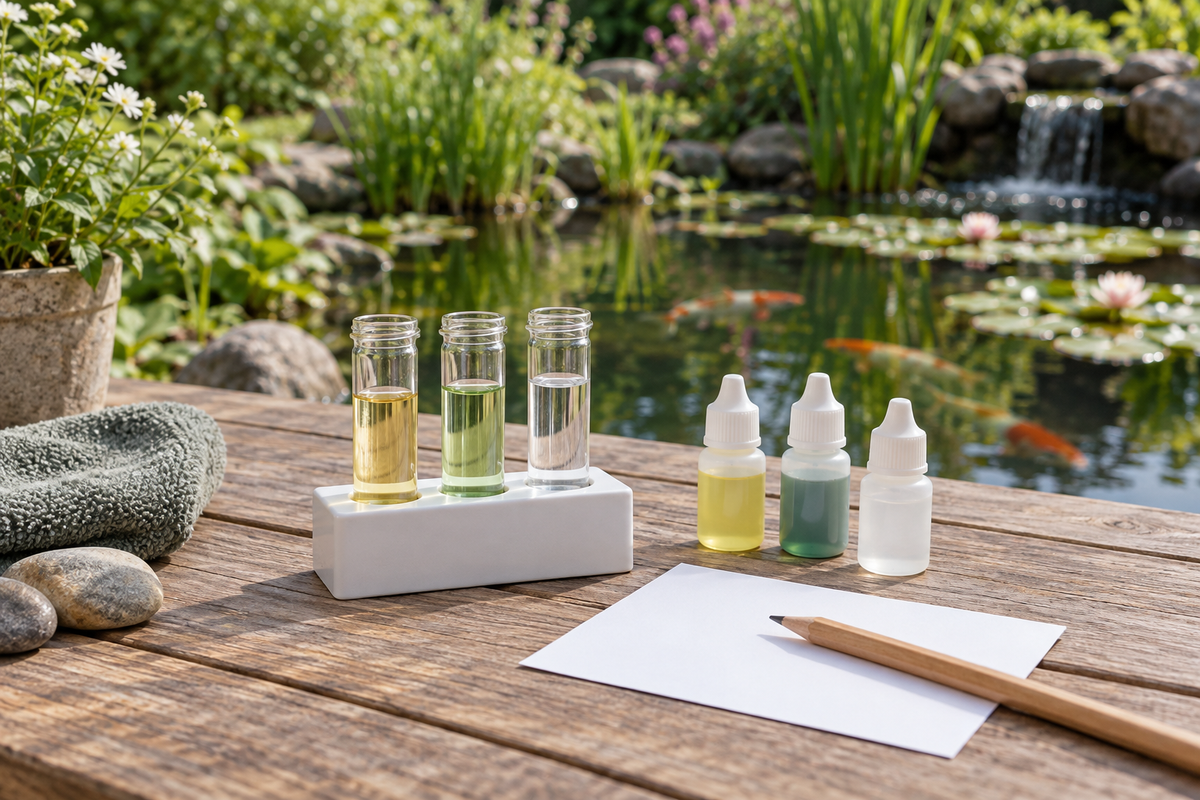
Transparent water can contain nitrites. Conversely, slightly colored water may have stable parameters. To understand what is happening in a pond, observing the fish and performing a few measurements complement each other.
pH, GH, KH, and nitrites provide four different pieces of information. Reading them together prevents correcting hardness when the problem stems from the filter, or trying to shift the pH without understanding its fluctuations. Here is how to go from a test result to a useful decision.

The four parameters at a glance
| Parameter | What it indicates | The question to ask yourself |
|---|---|---|
| pH | Acidic, neutral, or basic character | Is it suitable for the fish and does it remain sufficiently stable? |
| GH | Hardness related mainly to calcium and magnesium | Does the water have mineral levels suitable for the animals kept? |
| KH | Alkaline reserve evaluated by the test | Does the buffering capacity provide sufficient protection against pH fluctuations? |
| Nitrites, NO₂ | Intermediate in the nitrogen cycle | Is biological filtration correctly processing nitrogenous waste? |
Keep the kit's instruction leaflet. Units and precision vary depending on the test: a value without a unit, transmitted from memory, can be misinterpreted. Photographing the result next to the color chart also facilitates discussions with an advisor.
pH: monitoring its trajectory
pH indicates the acidity or alkalinity of the water. The scale is logarithmic: a change of one unit does not represent a small proportional difference. Therefore, avoid drastic corrections intended to quickly reach a figure read on the Internet.
In a planted pond, photosynthesis and respiration alter the amount of dissolved carbon dioxide. This can cause the pH to change throughout the day. Mississippi State University explains that these fluctuations become more pronounced when the buffering capacity is low.
If you suspect instability, take a measurement in the morning and then at the end of the day, using the same test, over several comparable days. Also note the temperature and weather conditions. An isolated result does not show this range.
Stability remains important, but it does not make just any value acceptable. The result must also be suitable for the species present. Before making a correction, check the KH and, in the presence of fish or a recently disturbed filter, check the ammonium/ammonia levels: a rise in pH can increase the proportion of toxic ammonia.
KH: understanding buffering capacity
In common pond parlance, KH refers to carbonate hardness. Standard tests primarily provide an indication of alkalinity, i.e., the water's capacity to neutralize an acidic input. Bicarbonates and carbonates play a significant role here.
A reserve that is too low may allow the pH to fluctuate more. The pond's biological activity, water inputs, and the characteristics of the source water influence this reserve. KH must therefore be monitored over time, especially when the setup changes.
Aquipond KH+ is intended to increase carbonate hardness. Its value is judged after measurement. It is not necessary to add it simply because the pond is approaching spring or because a neighbor uses the same product.
Calculate the actual volume involved, follow the packaging instructions, and check the trend after each addition. The correct amount depends on the measured deficit and the volume of water; it cannot be deduced from the surface area of the pond alone.
GH: information different from KH
GH measures total hardness, primarily related to dissolved calcium and magnesium. The USGS reiterates this definition: it is not a measure of all mineral substances present in the water.
GH and KH may evolve together in some waters, but they are not interchangeable. Water can have high alkalinity with relatively low hardness. Therefore, there is no universal rule requiring that GH must always be higher than KH.
Aquipond GH+ addresses the need for a GH correction. If the KH is already satisfactory, choosing the corrector corresponding to the deficient parameter avoids unnecessary intervention on the other.

The Aquipond GH+ data sheet recommends gradual additions and checking both GH and pH between applications. Maintain this logic of small steps: adding several correctors simultaneously complicates the interpretation of the results.
Nitrites: a result to be taken seriously
Nitrites appear during the transformation of nitrogenous waste. An established biological filter should normally transform them into nitrates. The practical goal is to keep nitrites undetectable with a suitable test, without confusing this reading with an absolute guarantee of total absence.
A spike can occur after starting the pond, excessive cleaning of biological media, a failure, the addition of many fish, or overfeeding. Piece together recent events: they often guide the diagnosis.
In case of an unusual result, check the measurement, the aeration operation, and the circulation in the filter. Reduce food intake depending on the situation and quickly seek appropriate advice if the fish are having difficulty breathing or change their behavior.
A partial water change can be part of the response, but the replacement water must be suitable and prepared if necessary. The proportion and frequency depend on the measurements, the fish, and the available water. An improvised complete draining can create other difficulties.
Finally, pay attention to units: some documents express nitrites as NO₂, others as nitrous nitrogen, NO₂-N. The figures cannot be compared directly. Always share the name of the test and its unit.
Three examples to choose the right action
Nitrites after a major cleaning
You rinsed all the filter media and nitrites became measurable a few days later. The priority is biological function, oxygenation, and waste load. Adding GH+ without a GH deficit does not address this cause.
Aquipond NitriBoost can assist in seeding the filter under its conditions of use. The data sheet specifies, in particular, a temperature above 10 °C and a pH of 6.5 to 8. You must continue the analyses: adding bacteria does not prove that the filter is immediately operational.
A low GH with a satisfactory KH
Confirm the result and compare it to the water used to fill the pond. If a correction is necessary for the species kept, Aquipond GH+ corresponds to the parameter to be raised. Then track the trend after water changes to understand why the deficit returns.
A very variable pH and a low KH
Compare morning and evening measurements and check the reliability of the KH test. A gradual correction of alkalinity may be relevant. Also examine the vegetation, algae, and overall functioning: the corrector does not replace the need to understand the observed fluctuations.
How to obtain comparable measurements?
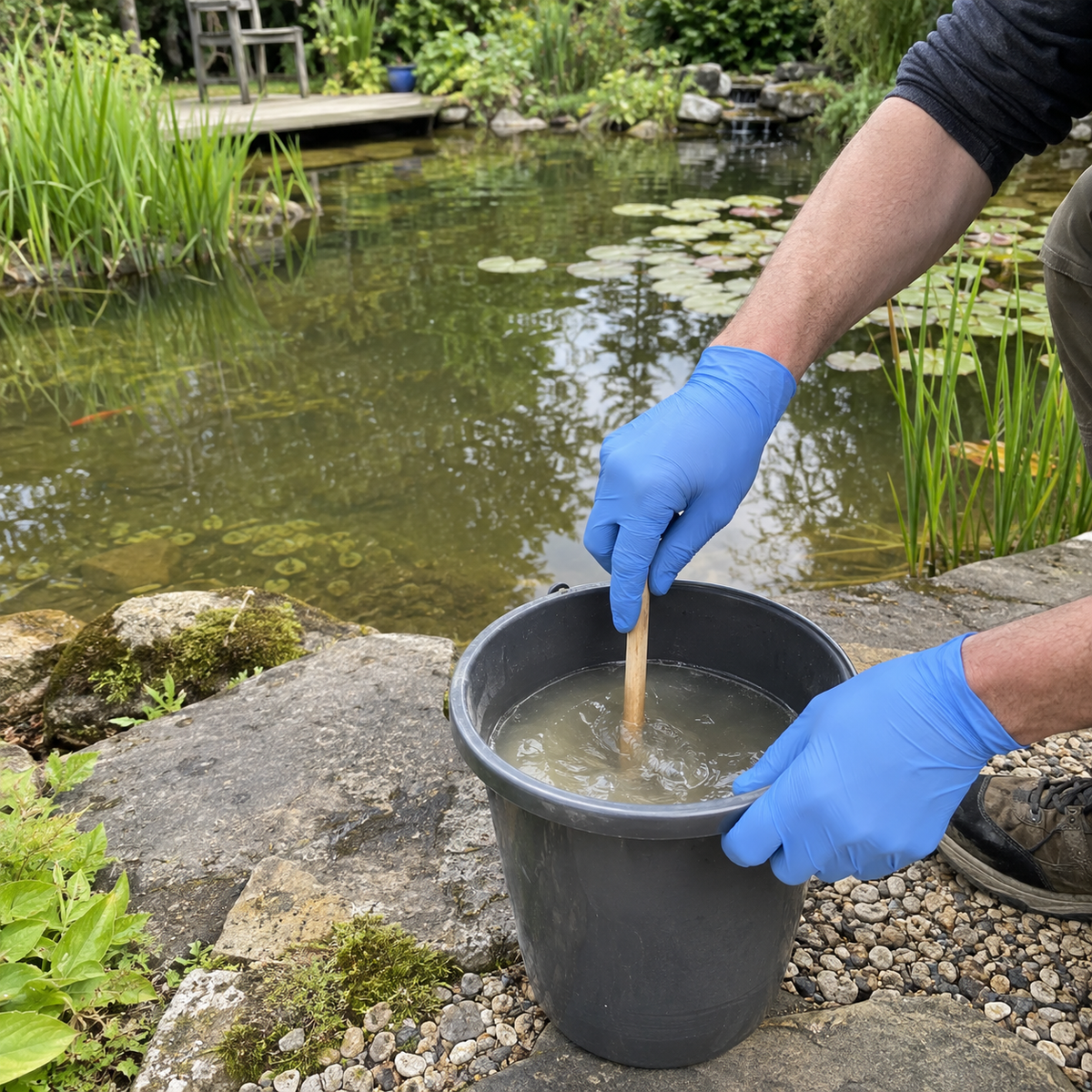
Use a clean container, free of soap or household product residue. Follow the sample volume, the number of drops, the order of the reagents, and the waiting time. Dirty test tubes and expired reagents can distort the reading.
Read the color chart under the conditions indicated by the manufacturer. For titration hardness tests, the color change marks the result according to the kit's method. Do not apply the instructions of another brand.
The JBL ProAquaTest CombiSet Pond includes pH, KH, GH, ammonium, nitrites, and phosphates. It does not include a measurement of dissolved oxygen or nitrates: these checks require additional tests.
When to repeat the tests?
The key moments for your monitoring remain the spring restart, a major water change, filter maintenance, the arrival of new fish, and any unusual behavior. During a correction or startup, perform checks more frequently based on the observed risk.
A simple notebook is enough: date, time, temperature, results, amount of water renewed, and action taken. This will show you whether a result is an isolated incident or a trend. At Aquiflor, this information provides a much more useful basis for advising a treatment than a description limited to "the water looks clean."
Measure before correcting
Start with an analysis, then choose the product corresponding to the parameter to be adjusted.
View the pond analysis kit →
Discover Aquipond GH+ →
Discover Aquipond KH+ →
Sources
- USGS — Hardness of Water: definition of hardness.
- Mississippi State University — pH and Alkalinity: daily variations and buffering capacity.
- Mississippi State University — Total Alkalinity: distinction between alkalinity and hardness.
- University of Florida IFAS — Ammonia in Aquatic Systems: nitrogen cycle and relationship between pH and ammonia.
- Merck Veterinary Manual — Management of Aquarium Fish: biological filtration and water quality.
- JBL — Why test the water?: checks and measurement methods.
- Aquishop data sheets for Aquipond GH+, KH+, NitriBoost, and the JBL kit, linked in the article: uses and conditions specific to the products.