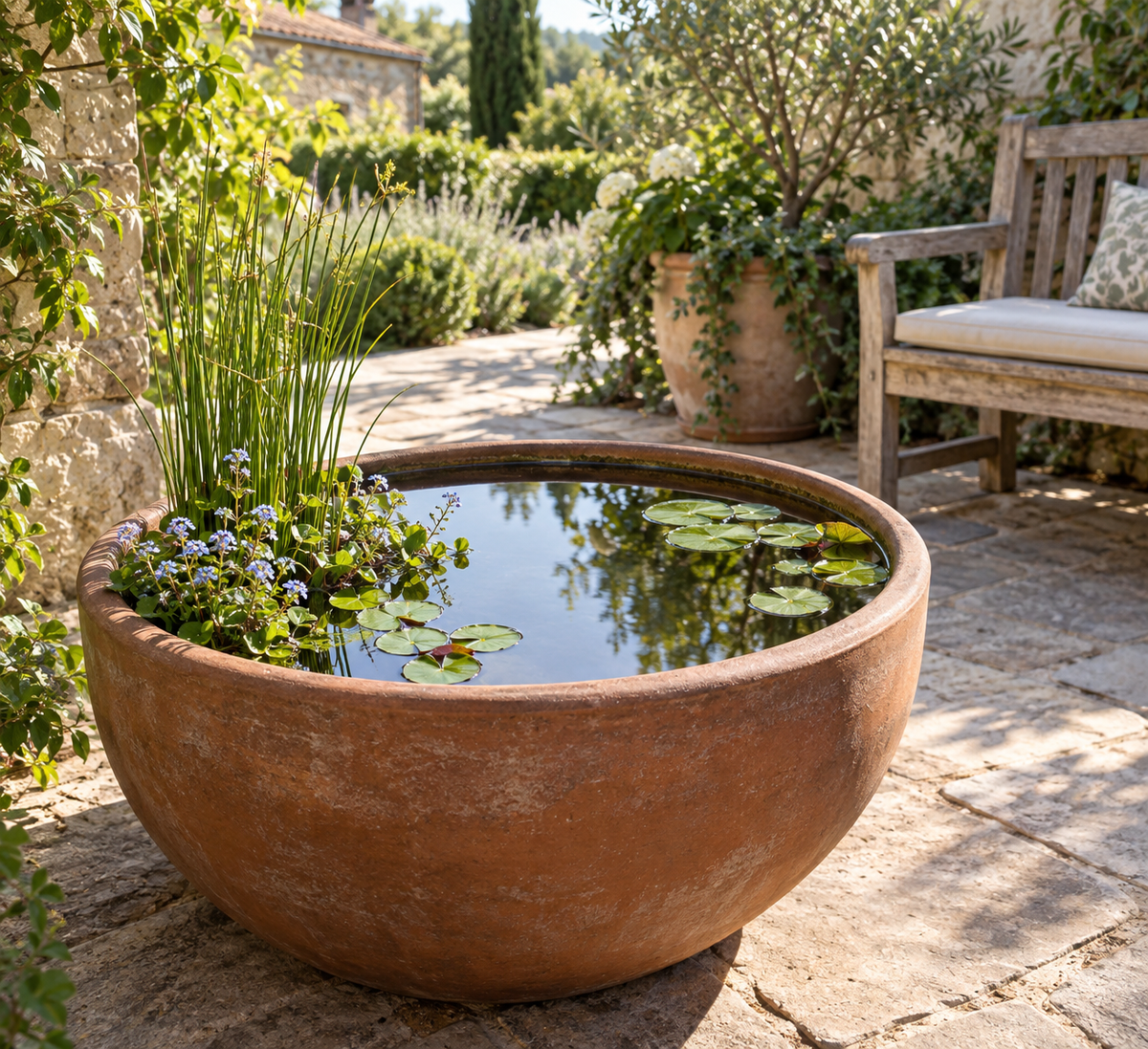
A patio pond is a small water garden installed in a container on a terrace or in a courtyard. A few plants, a reflective surface, and a well-chosen location are enough to change the atmosphere of the space. Its appeal lies in this proximity: you can observe the leaves, flowers, and insects from the place where you sit every day.
It does not necessarily require digging or adding fish. To start, a planted setup remains a simple option. The project nonetheless deserves to be planned: weight, exposure, volume, and plant requirements determine its success much more than the number of accessories.

Finding its place on the terrace
Start with existing uses. Where do you pull the chairs? What path do you use with a tray or a watering can? The pond must remain visible without blocking an essential route. A composition placed right next to a bench can be more pleasant than a large container in the middle of the space.
Also observe the view from inside. In winter or during rainy weather, the patio pond continues to be part of the decor through a window. Its container and the silhouettes of the plants then count just as much as the summer flowers.
Keep a working area accessible on at least one side. You will need to reach the baskets, remove leaves, and check the level. A corner completely filled with pots quickly becomes difficult to maintain, even if the composition looks attractive on the first day.
Choosing the container for its function and style
A round shape softens a very geometric terrace. A rectangular container can complement a low wall or define a space without adding extra curves. A container with windows showcases what is happening underwater more effectively. First, choose a shape compatible with the space, then look at the materials and equipment.
The container must be able to withstand water and outdoor conditions over the long term. A terracotta pot that is not suitable may be porous or suffer from frost. A metal container requires compatibility with aquatic use. Old tanks that have contained chemical products should be ruled out.
A preformed pond for in-ground use is not necessarily self-supporting. Check this point before installing it freely on tiles. For a solution designed to remain above ground, the Half Moon Mocha is a benchmark in the catalog to consider, along with its manual and the exact content of the proposed version.
Checking the weight before filling
The weight of water is easy to underestimate. One hundred liters is about one hundred kilograms; you must also add the tank, baskets, supports, and stones. Abundant mineral decor can significantly increase the load while reducing the usable volume.
On a ground-level terrace, prepare a stable, level base according to the container's specifications. On a raised terrace, roof, or balcony, have the structure checked by a competent person. The load is not just an average weight calculated across the whole terrace: the support points and placement are important.
The pond must be installed in its final position before filling. Do not use casters or a mobile support without explicit validation for the load and this usage. A filled water garden should be treated like heavy equipment.
Composing with three visual elements
For a first patio pond, think of three elements: a plant that provides height, a lower-growing plant near the surface, and an area of open water. The latter really counts. It catches reflections and prevents the container from quickly looking like an overcrowded planter.
Place tall plants at the back if the pond is observed from only one side. If you walk around it, offset the main clump instead to maintain multiple points of view. Design the composition with adult dimensions in mind, not just those of the starter pots.
Water lilies can be suitable for certain containers, provided you choose a cultivar that is truly compact and compatible with the depth. The word "water lily" alone is not enough: a vigorous variety can cover a mini-pond far too quickly.
Luminous foliage: Acorus gramineus ‘Ogon’

The Acorus gramineus ‘Ogon’ is a great option for adding structure without choosing a large marsh plant. Its place is in a damp zone adapted to its needs, not at the bottom of the container under a great depth of water.
The water forget-me-not can complete the composition at a shallow depth. If you choose water mint instead, provide an accessible container to control its spread. These species do not automatically go at the same level.
Use baskets and stable supports to achieve proper immersion. A different basket height changes the depth at the crown. Take measurements once the water level has stabilized, then adjust without putting the plant under stress.
Still water or a little movement?
A planted patio pond can be designed with still water. If you are mainly looking for sound, a small fountain adapted to the volume can be considered. The effect must remain proportionate: a jet that is too high sprays water onto the tiles and requires frequent topping up.
The pump is chosen according to the effect, the height difference, and the accessories used. Its presence does not automatically constitute complete biological filtration. If the container houses fish, their treatment and oxygenation requirements require a separate study.
Electricity must be planned before filling, with equipment intended for this environment. Follow the instructions for the pump, its power supply, and connections. Extension cords or power strips left near a damp area are not a durable installation solution.
Making room for small wildlife
Even a small water feature can attract insects. For animals reaching the container from the ground, a smooth, high wall is an obstacle. Provide a stable exit from the water and an external access point when the project also aims to support terrestrial wildlife.
A rough ramp must remain functional when the water level drops. Check that it does not tip over and that it does not create a drainage path out of the container. The stones used as support must be stable and compatible with the tank.
Let colonization happen naturally. Do not add animals or water collected from another pond to speed things up: this can transport undesirable organisms and diseases. A planted patio pond is already alive without buying fish.
Plan for a light and regular routine
Short, frequent observations allow you to spot a drop in water level, a plant that has come loose, or leaves that are accumulating. Remove accessible debris, check circulation if a pump is running, and clean parts according to their manuals.
In summer, monitor heating and evaporation. Partial shading can be useful depending on the plants and exposure. Top up with appropriate water without causing sudden changes, especially if animals are present. Rain does not guarantee that the water level and quality will always remain correct.
In autumn, avoid leaf accumulation. Before winter, check the container and equipment guidelines. A hardy plant installed in damp ground does not experience the exact same conditions in a small above-ground pot exposed to frost.
The project to prepare before buying
Note the available dimensions, type of support, hours of sun, and desired plants. Decide whether you want just a water garden or a system with movement and equipment. This list reduces the risk of buying a container that is too small or a plant that is too vigorous.
Send a photo of your terrace and these few measurements to support@aquiflor.com. You will be able to choose a patio pond that is pleasant to look at and accessible enough to remain simple to maintain throughout the seasons.