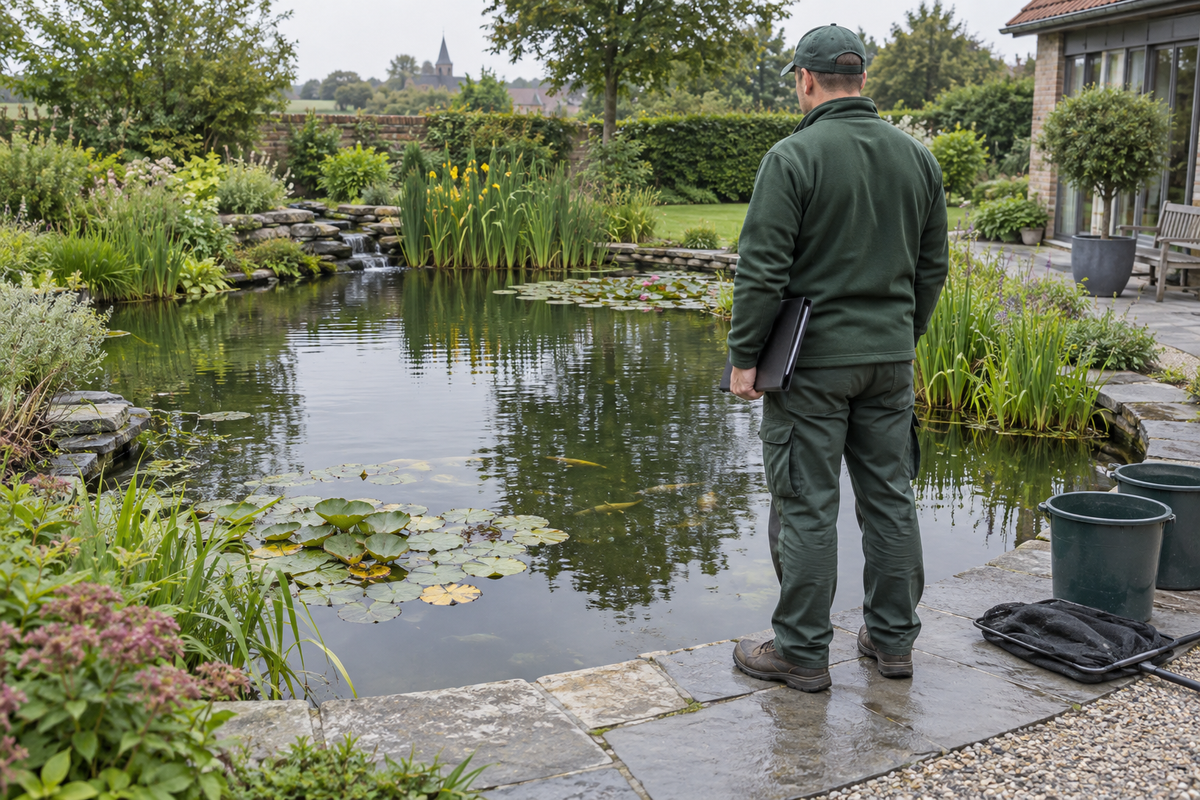
Your pond is getting dirty faster than before, filter access is complicated, or you simply lack the time for seasonal maintenance. Calling in a company can help get the installation back in order and help you understand the steps to take between visits.
Good service begins with an assessment and a clear scope of work. Routine cleaning, sludge vacuuming, technical restart, and complete renovation are different types of jobs. Before comparing quotes, specify the expected result and your garden's constraints.

When should you request an intervention?
Professional maintenance can be useful when the pond is too large or too deep to be maintained comfortably from the banks. It is also helpful when devices are difficult to dismantle or when deposits exceed what routine maintenance can handle.
After buying a house equipped with a pond, a visit helps identify circuits, valves, and equipment. This step avoids handling an installation whose operation is not yet known.
Water quality that deteriorates despite several treatments calls for a diagnosis instead. Repeating a cleaning without examining the fish population, flow rate, or waste input risks leaving the root cause intact.
Finally, a rapid drop in water level, a circulation failure, or fish in distress require reporting the emergency upon initial contact. A scheduled maintenance visit does not replace handling an immediate problem.
What services can be provided?
The content depends on the company and the installation. Aquiflor notably offers services for seasonal maintenance, leaf and sludge vacuuming, equipment checking, winterization, and on-site water analysis.
Ask what is actually included in your proposal. A check-up visit might identify a worn rotor without including its replacement. Bottom suction may require a disposal solution that must be planned for separately.
| Need | Points to clarify in the quote |
|---|---|
| Routine maintenance. | Waste removed, plants involved, equipment cleaned, and final checks. |
| Sludge management. | Areas targeted, method, estimated volume, water removal, and disposal destination. |
| Restart. | Circuit check, condition of parts, filtration and water monitoring. |
| Winterization. | Equipment involved, possible disassembly, storage location, and monitoring instructions. |
| Diagnosis. | Planned measurements, hypotheses examined, and expected report. |
Preparing information before the first exchange
A few well-chosen photos allow for a more useful initial discussion. Take a general view, access points, the filter, the pump if visible, pipes, and problem areas.
Add approximate dimensions, depth, and the known volume. If the volume is estimated, state so: this difference matters for treatments and for organizing any potential water renewal.
Indicate fish species, their approximate number, the age of the pond, and recent maintenance. Mention all recently added products, with their application dates.
For a level problem, attach dated readings. For cloudy water, specify how long it has been changing and what happened just before: rain, planting, cleaning, filter stoppage, or the addition of fish.
Site access influences the work
The distance between parking and the pond, stairs, the width of a passage, and the slope of the terrain can alter the organization. A photo of the gate or side access is sometimes as useful as a photo of the water.
Specify available water and electricity points, as well as areas where equipment can be placed without damaging plantings. Point out fragile banks, unstable slabs, or old surfaces.
Also discuss waste removal. Loaded water and sludge must have a destination adapted to their nature; deciding to discharge them into a drain at the last minute is not an option.
Is it mandatory to empty the pond?
No. Routine maintenance can often be performed with the pond full. Localized suction, equipment cleaning, and removal of accessible waste are enough to handle many situations.
The Royal Horticultural Society notes that a complete cleaning heavily disrupts a pond's ecosystem and must meet a real need. Zonal intervention can preserve more habitats.
Draining may nevertheless be necessary for certain repair or renovation work. In this case, the quote must explain how fish will be housed, how filtration will be managed, and under what conditions the pond will be put back into service.
Also ask what water monitoring will be advised after the job. Refilling does not mean that all biological functions immediately return to their previous level.
Sludge: combining mechanical removal and biological maintenance
For accessible deposits, the PondoVac 4 and PondoVac 5 vacuums illustrate the solutions usable for a landscaped pond. The choice depends notably on depth, discharge, and the scale of the work.

Aquipond Bactovase can be considered to support the degradation of the organic fraction of sediments. It does not remove mineral soil or gravel.
For a large pond, analyzing the nature and distribution of sludge helps choose between biological maintenance, vacuuming, or a more substantial project. A promise of total disappearance without assessment should be viewed with caution.
Questions to ask before accepting a quote
- What problem is the intervention intended to solve and how will the result be verified?
- Which devices will be cleaned, disassembled, or replaced?
- How will the fish, plants, and small wildlife be preserved?
- How much water could be removed and how will it be replaced?
- Are products, parts, travel, and disposal included?
- What additional work will require a separate agreement?
- What instructions and report will be provided after the visit?
Compare offers on this common basis. A lower price may correspond to fewer cleaned areas or a service without disposal. Conversely, a more extensive intervention is not automatically necessary.
Planning follow-up between visits
Ask for a short list of checks you can perform yourself: level, flow rate, skimmer basket, fish behavior, and water parameters to monitor.
Note the normal positions of valves and keep the references of replaced consumables. Photos after the intervention will help you find the setup during a future maintenance.
The frequency of visits should follow the pond's needs. A pond under trees does not require the same attention in the fall as a clear pond; a heavily stocked installation may require closer technical monitoring.
Contacting Aquiflor for maintenance
To prepare for an intervention, Aquiflor invites you to send photos and a description of the need to support@aquiflor.com. Feasibility, travel, and schedule are to be confirmed for your address.
State your priority from the start: restoring correct flow, reducing deposits, understanding a water problem, or organizing for the seasons. This allows for the construction of a proposal corresponding to your pond.
Prepare your maintenance request
Gather photos, dimensions, and equipment references before the first exchange.
Discover the Aquiflor maintenance service →
Request a pond diagnosis →
Sources
- Aquiflor — Pond and pool maintenance: services presented and first contact.
- Aquiflor — Pond consultancy: on-site diagnosis and quote request.
- Aquiflor — Bacteria for natural ponds: water and sediment diagnosis.
- Royal Horticultural Society — Pond care: precautions regarding complete cleaning.
- OASE — PondoVac 5: suction principle and equipment characteristics.