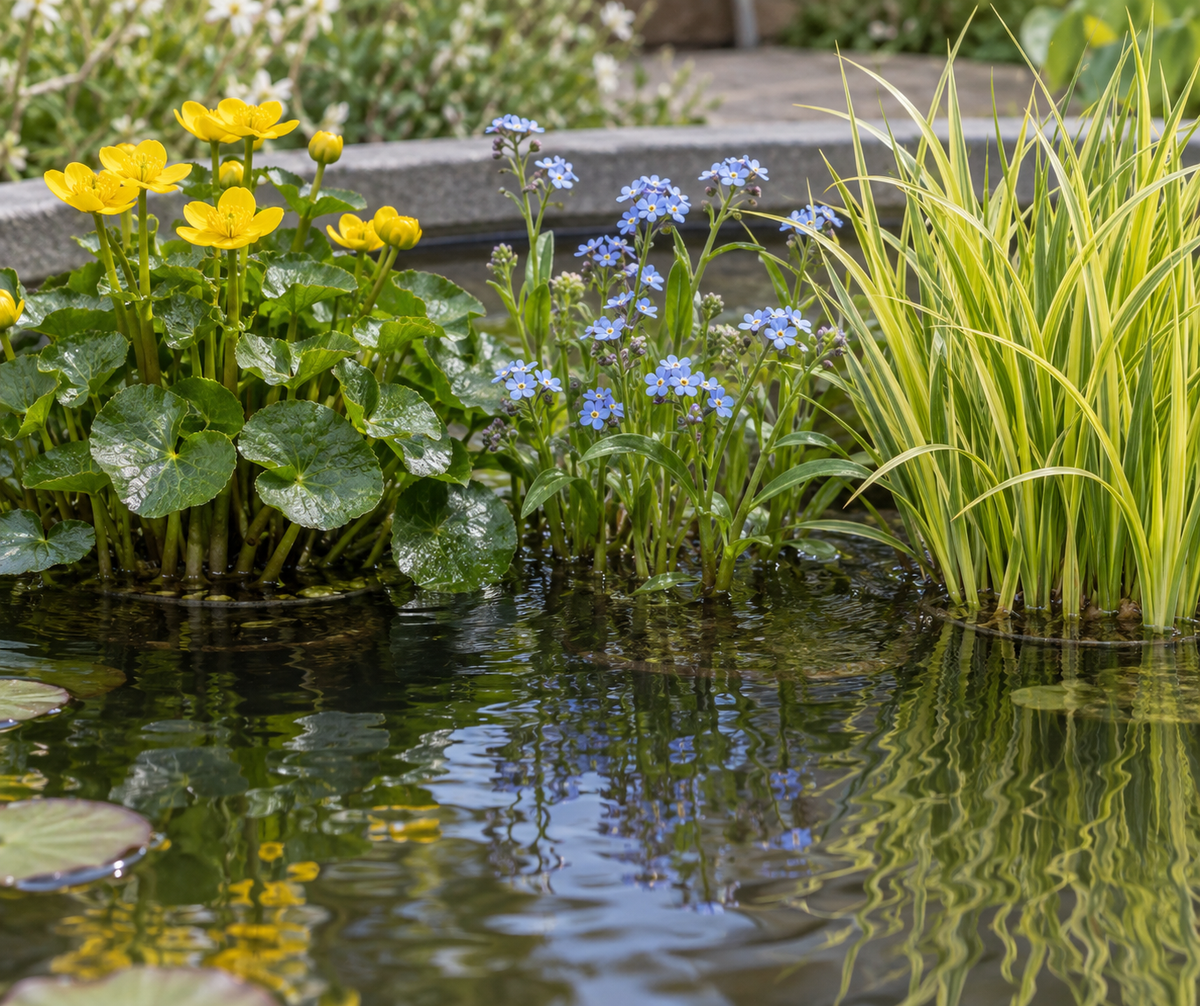
For a patio pond, choose plants whose mature size and planting depth truly match the container. A small plant in a pot can become a large clump; a species sold among aquatic plants might simply need damp soil. These two checks prevent most disappointments.
The simplest approach is to start with a few complementary plants: foliage that provides structure, a flowering plant, and, if space allows, a submerged plant. Keep some open water for reflections and to observe what is happening in the pond.

Measure before choosing your plants
Note the available water depth and the interior dimensions of the container. Add the height of the baskets and any potential supports. The useful depth for a marginal plant is generally measured to the crown, at the junction between the roots and the aerial parts, according to the indications on its spec sheet.
For example: in a container filled to a height of 35 cm, a 20 cm basket placed on the bottom might leave about 15 cm of water above its top. This is not a shallow immersion for all marginal plants. You may sometimes need to elevate the basket on a stable support or choose a different species.
Also note the sunlight received in spring and summer. A patio shaded by a building facade, a south-facing terrace, and a container under a tree require different choices. Depth cannot compensate for an unsuitable exposure.
Six avenues to explore for a small water garden
| Plant | Appeal | Caution in a container |
|---|---|---|
| Water forget-me-not | Small flowers and low border | Damp to very shallowly submerged zone; monitor its spread |
| Caltha palustris | Yellow spring blooms | Reserve enough space for the clump and respect its crown |
| Acorus gramineus ‘Ogon’ | Fine variegated foliage | Suited for damp soil, without improvised deep immersion |
| Mentha aquatica | Aromatic foliage and flowers | Vigorous species that must be contained in small volumes |
| Ceratophyllum demersum | Submerged vegetation | No true roots; thin out if the underwater growth becomes too dense |
| Compact cultivar water lily | Floating leaves and flowers | Confirm the cultivar, its mature spread, and depth requirements |
This selection provides possibilities, not a list to be purchased in its entirety. The volume of open water, access to baskets, and future growth matter more than the number of species present at the start.
Water forget-me-not for a delicate border
The water forget-me-not is offered in the catalog under the name Myosotis palustris, also associated with the botanical name Myosotis scorpioides. It provides low-growing vegetation and small blue flowers. It should not be confused with an ordinary garden forget-me-not chosen without verifying the species.
The Aquishop sheet places it around the water level, with very shallow immersion possible. An accessible basket makes it easy to monitor its spread and divide it. It can accompany vertical foliage without masking the entire surface.
Marsh marigold for the first flowers

The Caltha palustris features rounded leaves and yellow blooms. The Aquishop sheet indicates a height of about 30 to 40 cm and a position ranging from a damp bank to shallow immersion, up to about 10 cm at the crown.
It therefore deserves more space than a simple small pot placed in a corner. Combine it with foliage that remains interesting after its flowering period. In a very small container, a beautiful, properly installed clump is better than a collection that is too crowded.
‘Ogon’ sweet flag to structure the composition
The Acorus gramineus ‘Ogon’ is appreciated for its fine, variegated leaves. The catalog describes it as a plant reaching about 30 cm in height at maturity, suitable for damp soil and sun or partial shade.
Its role in this selection is primarily visual: it provides a low, bright silhouette. Do not assign it a filtration capacity in liters. Above all, do not install it under deep water just because the container is deep; prepare a damp zone that suits it.
Water mint, choose if you have space
The water mint provides a generous presence to the border. It is suitable for a project where you are prepared to control its growth. In a small pond, its spread can compete with other plants and quickly reduce the amount of visible water.
Install it so that you can intervene without dismantling the setup. A basket facilitates certain operations but does not prevent all stem or root spreading. Observe the plant and divide it when its growth requires it.
Hornwort for the submerged part
The submerged hornwort provides fine ramifications under the surface. It has no true roots and does not require the same setup as a marginal plant rooted in a substrate. A small amount can structure even a small volume.
Its growth must be monitored to maintain open water and clear space around equipment. Remove excess growth with care if animals frequent the pond. So-called oxygenating plants also breathe: they do not guarantee good oxygenation at all times on their own.
A water lily, only with the right name
To choose a patio water lily, ask for the cultivar name and its recommended depth. A color indication does not sufficiently inform you about its vigor. The pot sold may be small while the adult plant will cover a large surface area.
Also check the sunlight required for flowering and the placement of the basket. A jet of water placed right above the leaves can disrupt the desired effect. Leave a calm zone and adapt your choice to the container, rather than trying to force a large variety into too little water.
Three compositions to start with
For a spring scene: a marsh marigold and a forget-me-not, each at its own depth, with a free surface area maintained. This combination highlights the flowers and remains easy to observe if the baskets are accessible.
For a foliage display: an ‘Ogon’ sweet flag in a suitable damp zone and a limited amount of hornwort in the water. Check that the container truly allows for these two positions; it is not enough to simply place both plants at the same level.
For a pond centered on a flower: a compact identified water lily, supplemented only if the remaining space allows. Simplicity makes adjusting the depth and controlling growth easier here.
Planting neatly and maintaining gradually
The planting baskets help organize a small pond and move the clumps around. Use a growing medium adapted to the species and the system. Rich and loose garden soil can cloud the water and provide too many nutrients.
Do not fertilize the entire container as a general rule. Needs vary according to the plants and conditions. If an addition is necessary for a specific plant, choose a suitable product and method, keeping animals and the small volume in mind.
Remove accessible dead leaves, check the level, and thin out gradually. Before winter, check the needs of the plants and the durability of the container. The hardiness of a plant does not automatically protect a small container exposed to frost on all sides.
Avoid purchases that complicate the mini-pond
Discard plants whose identity is uncertain, species too vigorous for your surface area, and those whose sale or possession is restricted in your region. A photo found on a foreign website is not enough to validate a purchase.
Keep plants and removed fragments away from natural environments. For a mini-pond focused on local biodiversity, ask for a selection of native species derived from cultivation and adapted to your space.
Send the water depth, container dimensions, and exposure to support@aquiflor.com. With these benchmarks, the choice of plants becomes precise, and the composition can evolve without being completely redone.