You may have heard of "AquaClear Ubbink" to help clear your water, but search results show either a bottle or a device connected to a hose. This difference is worth clarifying before choosing a product.
At Ubbink, Aqua Clear refers to a liquid pond water treatment. AlgClear refers to a range of UV-C clarifiers. These similar names refer to two different solutions. The reference number found on the packaging or the device's label will allow you to identify exactly which one you have.

Aqua Clear: a liquid product, identified by its label
The supplier’s safety data sheet identifies "UBBINK Aqua Clear 500 ml" as a mixture intended for water treatment. It is therefore a bottled product, not an electric filter.
The document consulted was revised in 2015. It confirms the identity of the described product, but it is not sufficient to establish the current composition of a bottle sold today or its instructions for use. To use a product you already own, consult its full label and request the documentation corresponding to its specific reference number.
This point is particularly useful for an old bottle found in a garden shed. A label that has become illegible, unknown storage conditions, or an expired date cannot be compensated for by using the dosage of another brand.
The trade name alone does not provide information on compatible animals, required parameters, or filter-related instructions. This information must be verified before application.
AlgClear: a UV-C clarifier connected to the circuit
The Ubbink catalog presents AlgClear products as UV-C devices. The water circulates through a housing equipped with a lamp, integrated into a system that includes a pump and filtration.
They are primarily used for suspended microscopic algae responsible for certain green water issues. The lamp acts within the device; the debris must then be handled by the filtration system. A UV-C unit does not remove a layer of silt deposited at the bottom and does not vacuum up leaves.
The range includes several power levels and indicative capacities. The catalog distinguishes between ponds with plants but no fish and those containing fish, and provides flow ranges adapted to the models. Therefore, the number in the name should not be read as a universal capacity for any population.
Before replacing a device or its lamp, note the exact reference number. Dimensions, base type, power, and electrical compatibility are all criteria; simply choosing "a Ubbink lamp" is not enough.
How to recognize what you have in front of you?
| Observed element | What to note | Usage to verify |
|---|---|---|
| Aqua Clear bottle | Full name, volume, batch, label, and instructions | Water treatment according to product directions. |
| AlgClear housing connected to hoses | Model, power, label, and manual | UV-C clarification in a compatible circuit. |
| Device with only a similar name | Manufacturer and exact reference | Identification necessary before any conclusion. |
A photo of the overall setup accompanied by a close-up of the label is often the simplest way to clear up any doubts. Also keep the dimensions of the fittings and the pump reference if your inquiry concerns an existing installation.
Before seeking clear water, understand what is clouding it
A pond can become opaque for several reasons. The Royal Horticultural Society distinguishes between suspended algae and blanket weed, and emphasizes the management of nutrient input and decomposing matter.
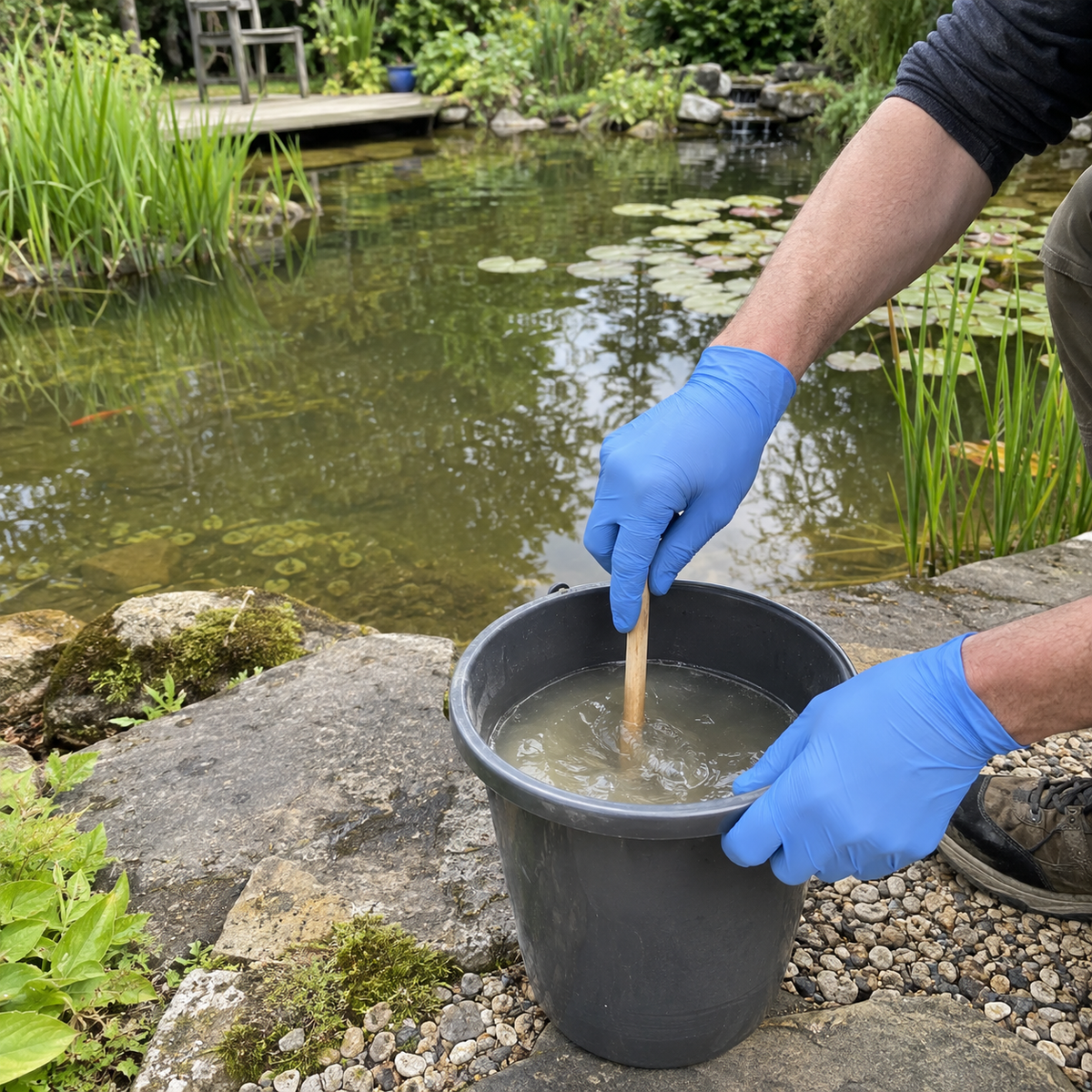
Observe a sample in a clean, transparent container. A fairly uniform green coloration suggests the presence of microscopic algae. Particles that settle to the bottom may point to re-suspended sediment. This initial examination does not replace an analysis, but it helps to define the problem.
Also look at the context: heavy rain, dirt washed in from the lawn, fish digging in a basket, recent maintenance, filter failure, or accumulation of leaves. Two visually similar ponds may require different interventions.
Avoid choosing a treatment based solely on the promise of "clarity." The concrete goal might be to trap particles, correct a filtration defect, reduce waste input, or control suspended algae.
Useful water checks before treatment
Start with pH, KH, and GH, then the relevant nitrogen parameters, especially ammonium/ammonia and nitrites in a fish pond. Note the temperature and any unusual behaviors.
The JBL ProAquaTest CombiSet Pond kit allows you to perform several of these measurements. It does not include dissolved oxygen or nitrate tests: these parameters require additional testing if the situation demands it.

Transparent water can hide an invisible chemical problem. Conversely, slight coloration does not automatically mean an emergency. The results and the state of the fish help prioritize actions.
If the fish are breathing with difficulty or gathering at the surface, treat the situation as a water quality problem to be assessed immediately. The pursuit of an aesthetic effect comes after their well-being.
What is the role of Aquipond solutions?
A maintenance range is most useful when each product addresses a measured need. Names and dosages are not interchangeable between brands.
- Insufficient KH: Aquipond KH+ targets carbonate hardness and is used while monitoring pH.
- Insufficient GH: Aquipond GH+ addresses a different mineral need, to be confirmed by analysis.
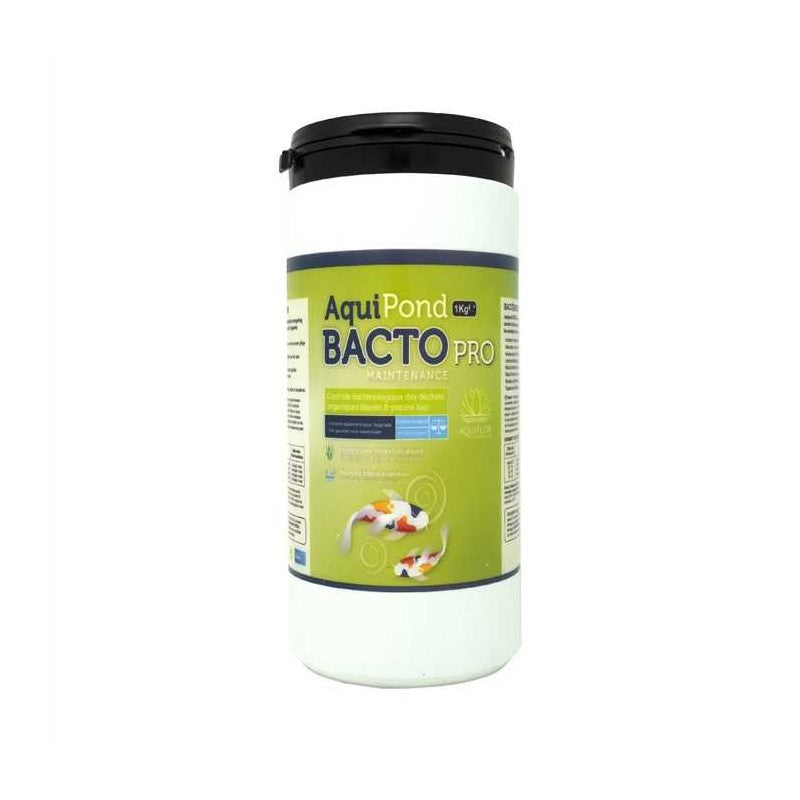
- Organic maintenance: Aquipond Bacto Maintenance is part of biological maintenance, following its conditions of use.
- Organic sediments: Aquipond Bactovase targets the organic fraction of pond silt.
These references do not constitute a program to be applied all at once. A pond with an already adequate KH does not need a KH corrector just because of simple green water. Choose an action motivated by observation and verify its result before adding another.
If the problem is primarily deposits
Sediments stirred back into motion can make water cloudy even if the UV-C installation is working. Examine areas where fish swim and the position of the pump, without unnecessarily stirring up the entire bottom.
A PondoVac 4 or PondoVac 5 allows for targeted mechanical removal. The choice depends on depth and the necessary drainage. Monitor the level and adapt the method to the presence of plants and animals.
Aquipond Bactovase can complement the management of organic matter. It does not remove gravel, sand, or a continuous inflow of soil from the bank. Reducing the source of deposits avoids having to repeat the same maintenance too often.
When to review the UV-C installation?
If you have an AlgClear, start with its history: age of the lamp, maintenance of the quartz sleeve, actual flow rate, and filtration performance. A glowing lamp alone is not proof of sufficient UV-C performance.
Turn off the power before maintenance and follow the manual. Never look at a UV-C lamp that is turned on outside of its protective housing. Have the replacement reference confirmed before disassembling a fragile part or ordering a component.
For a complete replacement project, the OASE Bitron C 24 W illustrates another clarification solution. Its compatibility must be verified based on volume, population, flow rate, pressure, and fittings. It is not an automatic replacement for just any AlgClear unit.
The right benchmarks for a sustainable decision
Keep the equipment references, analyses, and dated interventions in one folder. You will be able to distinguish a lasting change from a temporary improvement after cleaning.
When asking for advice, indicate what you want to resolve first: green water, particles, blanket weed, or bottom deposits. Add the volume and equipment details. This description allows for choosing an adapted solution without being guided solely by similar names.
Start with a simple pond assessment
Identify your Ubbink product, observe the cloudiness, and check the water parameters. You will have the useful information needed to choose the right maintenance and track its effect.
See the pond analysis kit →
Discover Aquipond Bacto Maintenance →
Sources
- Aquarium Münster — Safety data sheet UBBINK Aqua Clear 500 ml, revision April 20, 2015: identification of liquid treatment, without extrapolation to a current formulation.
- Ubbink / Outside Living — Pond Catalog, presentation and table of the AlgClear UV-C range.
- Royal Horticultural Society — Pond algae and blanket weed: types of algae and environmental maintenance.
- OATA — How to look after pond fish: water quality and monitoring.
- Aquiflor — UV lamps for ponds: maintenance of UV clarification.
- Aquishop product sheets for the items mentioned: analysis, Aquipond maintenance, PondoVac vacuums, and Bitron C.