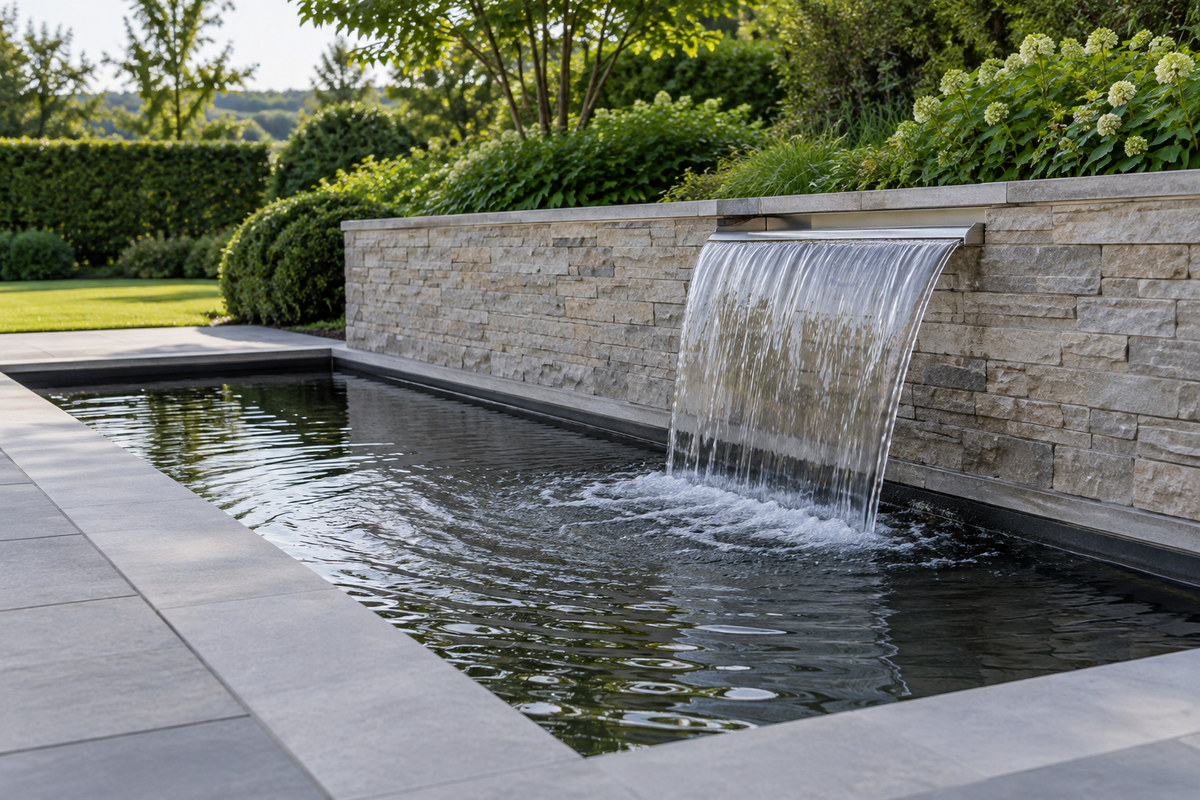
To design a pleasant pond waterfall, start with the desired flow and work your way back to the pump. The drop height, width, receiving area, and hose path form a complete system. Buying a pump based solely on its maximum flow rate often leads to discovering difficulties once the water is turned on.
This method helps you turn a garden pond waterfall idea into a project that can be adjusted, cleaned, and operated without any unpleasant surprises. It applies to an ornamental pond; an installation intended for swimming requires a specific design.

1. Describe the expected result
Do you want a discreet trickle, a steady sheet of water, or a more lively cascade? Are you mainly looking for movement seen from the house or the sound heard from the terrace? A clear answer helps avoid a waterfall that is too large for the space where it will be used.
Place a marker at the intended location and look at it from your main viewpoints. Also check for access: you will need to be able to remove leaves, clean the spillway, and inspect the connections. A decorative feature built in an inaccessible corner rarely ages well.
To compare shapes before deciding, discover our pond waterfall examples. Then, keep one dominant intention for your project: a few well-proportioned elements are easier to refine than an accumulation of drops.
2. Take useful measurements
Measure the height difference between the pond water surface and the top outlet of the waterfall. Note the actual length of the hose, its path, the bends, and the equipment it passes through. The depth at which a submersible pump sits does not simply add to the lift height measured from the surface.
Note the spillway width and the width available to receive the water separately. A free-falling drop can splash outward as the flow increases. Add the effect of wind and spray: the receiving area must catch more than just the thin ribbon visible at low flow.
Prepare a side view and a top-down view drawing. Even if hand-drawn, they avoid confusion between hose length, drop height, and pond depth. Also indicate the maximum acceptable water level when the pump stops.
3. Size the pump at the operating point
The pump must provide the desired flow despite the height and resistance of the circuit. We refer to pressure losses for resistance related in particular to hoses, fittings, and equipment. An inner diameter that is too small or an unnecessarily long path can significantly reduce the flow reaching the top.
Manufacturers provide curves that allow you to read the available flow according to the operating height. The maximum flow and maximum height indicated on the box correspond to different situations. A pump capable of lifting water several meters does not simultaneously provide its maximum flow at that height.

The AquaMax Eco Classic 8500 lists a maximum flow of 8,300 l/h and a maximum head of 3.20 m. This is a reference to study for certain filtration and stream circuits, not an automatic answer for every waterfall. It is not electronically adjustable according to its technical data sheet.
Request a selection based on the height and circuit you have measured. If you want several flow intensities, choose an adjustment solution compatible with the equipment from the start. Do not connect a generic dimmer to a pump not designed for this purpose.
4. Design an easily adjustable circuit
Prioritize a clear pipe route and accessible fittings. The hose must remain properly supported, without kinking or being crushed under a stone. Plan for diameter changes in the right places, while also checking the internal passages of the fittings.
A diversion can be used to distribute water between two uses if the assembly and the pump allow it. The OASE Y-distributor is an example of an accessory to examine, along with its dimensions and adjustment possibilities. Its installation does not exempt you from verifying that each branch receives the necessary flow.
When the waterfall shares the filtration circuit, the decorative setting must not compromise the filter flow. Biological filtration intended for fish must continue to operate according to its design, even if you wish to reduce the sound of the waterfall at certain times.
5. Build a seal that handles the unexpected
Water seeks the easiest paths. It can follow a stone underneath, bypass a spillway, or be diverted by a pile of leaves. The liner and raised edges must capture these possible paths, with seams executed according to the system's instructions.
The substrate must be stable before placing the decor. Stones that settle can change the slope and create an overflow a few weeks after a successful first trial. Protect the seal against sharp edges and keep roots or absorbent materials out of areas where they could draw water toward the garden.
For a wall blade like the Waterfall XL 60, take care with the level of the spillway and the accessibility of the supply. Permanently closing the wall before a full trial makes every correction much more expensive.
6. Also test the pump shutdown
A waterfall contains water in its hoses, ledges, and sometimes an upper basin. Part of this water returns to the bottom when stopped. The receiving basin must have a sufficient reserve to accommodate it without overflowing.
Perform several start-ups and shutdowns under supervision. Observe the low level during operation, then the high level after stabilization. Do not systematically fill the basin to the brim while the upper circuit is full: you risk exceeding the admissible level at the next shutdown.
Identify the operating levels and verify that the pump remains properly supplied with water. Dry-run protection does not replace a properly sized reserve and regular monitoring.
7. Adjust the sound from the places where you live
The sound depends on the height, the flow, and the surface onto which the water arrives. A drop into a deep area does not sound like a trickle over a slanted stone. Move temporary elements in small steps and listen after each change.
Test from the terrace, an open window, and near the boundaries of the garden. In the evening, other noises diminish and the water can become more prominent. If a scheduled shutdown of the decor is desired, plan for operation independent of the equipment necessary for the fish.
8. Organize simple maintenance
A drop in flow does not immediately justify buying a more powerful pump. First check the intake screen, the hose, the spillway, and any filters. Disconnect equipment before intervention according to the manuals, and avoid working on slippery surfaces.
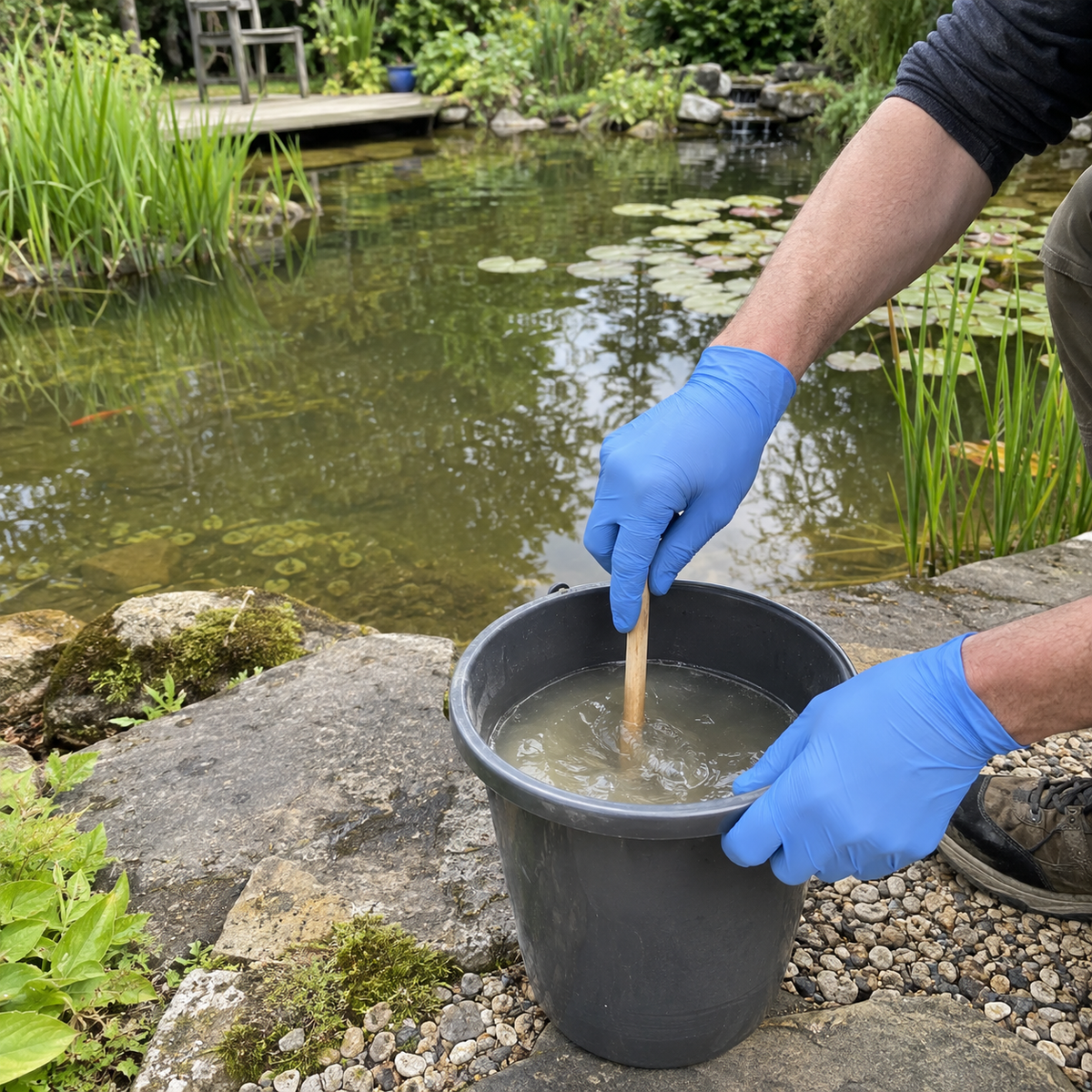
Remove leaves before they clog the passages. For deposits in the receiving basin, a PondoVac 4 can facilitate targeted cleaning. Aquipond Bactovase can help reduce organic matter according to its instructions; a pile of sand or pebbles requires mechanical removal.
During frost, watch for water diversion caused by ice. The choice to keep the waterfall running or stop it depends on its location and the pond. Prepare this decision before winter, along with the filtration and aeration needs of the fish.
Your project sheet in five lines
- Type of flow and desired sound level.
- Width of drop and elevation from the pond surface.
- Length, diameter, and path of the piping.
- Volume available in the receiving area when stopped.
- Cleaning access and desired winter operation.
Send these details with a photo to support@aquiflor.com. They allow us to verify the consistency of the pump, hose, and spillway before moving on to installation.