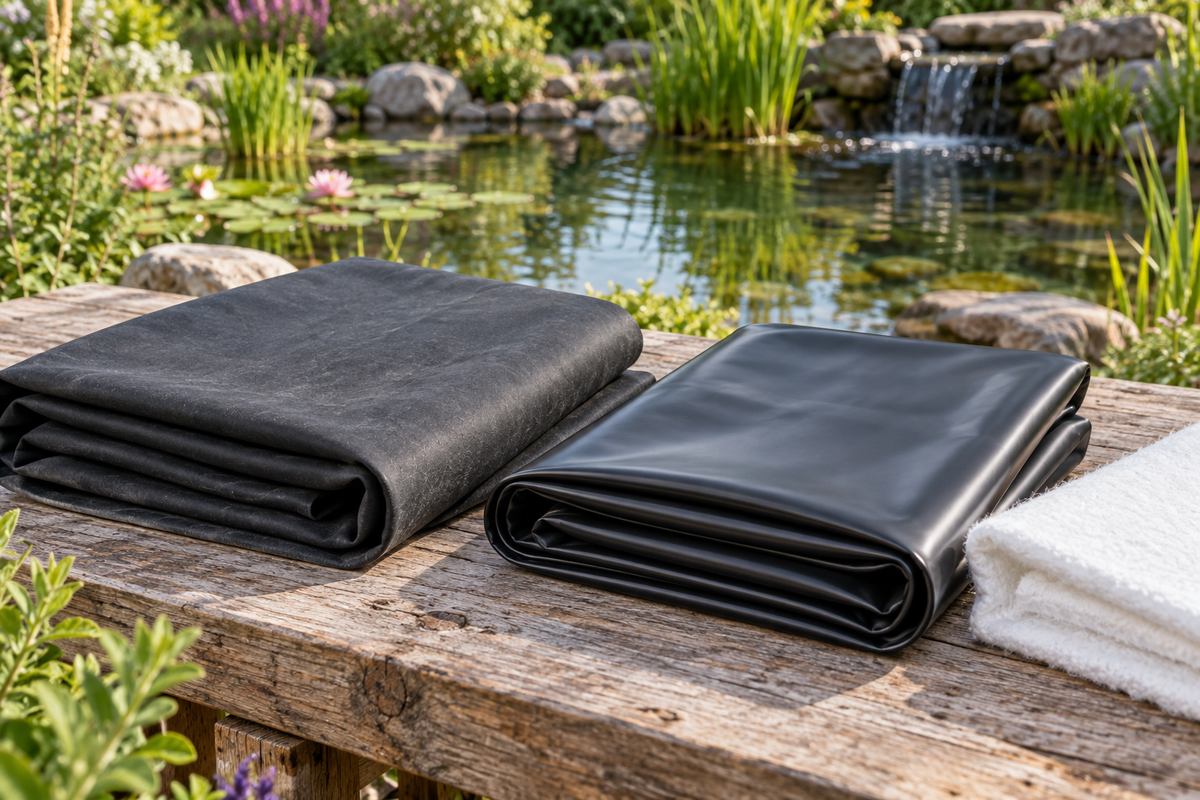
The liner largely disappears under the water and finishing touches, yet it remains one of the most important choices of the project. Once the plants, stones, and equipment are installed, replacing the waterproofing becomes much more restrictive.
For a durable pond with ledges and irregular shapes, EPDM is often a practical choice thanks to its flexibility and elasticity. Pond PVC can also be suitable for a well-dimensioned project. The decision must be based on specific product references, their installation method, and the complete budget.

EPDM and PVC: what materials are we talking about?
EPDM is a synthetic rubber. Membranes intended for ponds are valued for their ability to follow the contours of the terrain and remain flexible. PVC is a plastic material also used for waterproofing liners, with formulations and thicknesses adapted to different uses.
In both cases, choose a reference explicitly intended for a pond and compatible with fish and plants if the project will house them. A construction liner, agricultural film, or roofing membrane is not automatically used under the same conditions.
The name of the material does not describe the full quality of the product. The characteristics of the membrane, the manufacturer's quality controls, and the consistency of the installation system also count.
Criteria to compare before buying
| Criterion | EPDM for pond | PVC for pond |
|---|---|---|
| Installation behavior | Useful flexibility and elasticity for irregular contours | Flexibility to be checked according to the reference and installation conditions |
| Formats | Large widths, cuts, and predefined formats according to product lines | Rolls or pre-cut pieces according to product lines |
| Assembly | Compatible accessories, often with primer and dedicated tape | Gluing or welding adapted to the product and procedure |
| Repair | Patch and preparation compatible with the system | Kit or method provided for the relevant PVC |
| Ground protection | Prepared terrain and adapted protection | Prepared terrain and adapted protection |
| Budget | Compare the required piece, the geotextile, and assembly details | Compare the same perimeter, with the same installation requirements |
This table provides a logic for comparison. The technical data sheet of the chosen reference remains decisive for dimensions, installation, and usage limits.
Why flexibility matters in a tiered pond
A membrane must descend along the banks, follow planting terraces, and cover the bottom. Folds are prepared so that the liner rests on the support without being stretched between two points.
Elevate describes the flexibility and elasticity of PondGard EPDM as assets for complex shapes and substrate movements. OASE also highlights the extensibility of its OaseFol range for irregular bottoms.
This capability does not allow you to order a piece that is too small or leave a sharp stone under the membrane. Ground preparation remains essential. Water exerts a significant load, and stresses concentrate on areas that do not bear weight well.
Thickness: useful, but insufficient to judge alone
A 0.5 mm membrane and a 1.1 mm membrane do not have the same thickness. However, this is not enough to calculate their relative resistance or lifespan. The material, the formulation, and the support protection also come into play.
The Aquitechnics EPDM liner offered on Aquishop is announced with a minimum thickness of 1.1 mm and a smooth finish. The AlfaFol 4 × 5 m PVC reference presented here has a thickness of 0.5 mm.
Compare these products for the planned pond, taking into account its size, depth, technical details, and the terrain. For a swimming project or a specific structure, have the entire waterproofing solution validated.
Resistance to sun and cold: read the product range data
PondGard and OaseFol EPDM data sheets highlight resistance to UV and ozone. The AlfaFol PVC range is also presented by OASE as resistant to UV and cold. It would therefore be inaccurate to consider all pond PVC as lacking protection against the sun.
Service life depends on the product and its implementation. Commercial warranties, where they exist, must be read with their conditions; they do not constitute a certain forecast of the lifespan of each installation.
A well-designed edge, careful interventions, and adapted mechanical protection help preserve the waterproofing. Avoid sliding stones or tools directly over the membrane during work.
Protective geotextile is part of the choice
Regardless of the material chosen, prepare the ground carefully. Remove aggressive elements and provide an adapted geotextile. The latter limits abrasive contacts and certain pressure points; it does not replace the correction of unstable ground or sharp obstacles.
The Aquitechnics Premium 400 g/m² geotextile is offered in a 2 m width, sold by the square meter. Its footage must include the distribution of strips and installation overlaps.
The Aquitechnics EPDM and geotextile pack allows you to prepare these two elements together. However, check the dimensions of each part and the needs of the banks before confirming the order.
Repairs and connections: plan for a compatible system
If an EPDM membrane is punctured locally, a repair may be possible with a compatible patch and adapted preparation. For OaseFol Flashing accessories, the Aquishop data sheet specifies the use of OaseFol Primer. Other systems have their own products and procedures.
PVC also has dedicated gluing and repair accessories. A glue intended for one material must not be transposed to the other without validation. Junctions, penetrations, and flanges require special attention from the design phase.
To limit installation complexity, look for a format that covers the pond with the necessary reserves. A single large piece can avoid several on-site connections. Transport and handling must then be anticipated.
The relevant cost is that of the complete project
Two prices per square meter are not enough to compare the budget. You must know the surface area actually purchased, which depends on the widths offered and the margins. Add the geotextile, accessories, fasteners, transport, and any potential services.
A pre-cut piece can be practical if its dimensions correspond to the profile. A more suitable roll width may, in another case, limit waste. Do the math for both options before concluding.
Also consider future accessibility. If a large terrace, heavy stones, or significant plantings cover the surroundings, repairing the membrane later will represent more work. This constraint deserves its place in the initial decision.
Two options available on Aquishop
Aquitechnics EPDM: choose a width and order by the m²
The product page offers several widths and asks for a quantity expressed in square meters. Measure the pond profile, add the finishing reserves, then match the chosen width to the required length.
Consult the Aquitechnics EPDM liner →
AlfaFol PVC: a 4 × 5 m pre-cut format
This OASE reference is a PVC pond membrane supplied in a defined format. Check that the 4 × 5 m covers the depth, ledges, and margins, in addition to the visible water surface. A pond measuring 4 × 5 m at the surface would require a larger piece.

Which option should you choose for your project?
For a permanent pond with several ledges and significant finishing work, examine an adapted EPDM membrane as a priority: its flexibility and the available formats can simplify the project. For a build whose dimensions correspond to a PVC format dedicated to ponds, compare this solution with the same care.
In both cases, the right choice combines a documented reference, a sufficient format, support protection, and a mastered installation method. A dimensioned sketch allows the Aquiflor team to help you verify these points before ordering.
Sources
- Elevate — PondGard EPDM: nature of the material, elasticity, and applications.
- OASE — OaseFol EPDM: properties of the range.
- OASE — AlfaFol PVC range: material, resistance, and assembly.
- OASE — Geotextiles and membranes: role of protection.
- Aquiflor — Protective geotextile: installation preparation.
- Aquishop data sheets for the Aquitechnics EPDM, the AlfaFol 4 × 5 m, and the cited accessories: characteristics of the proposed references.