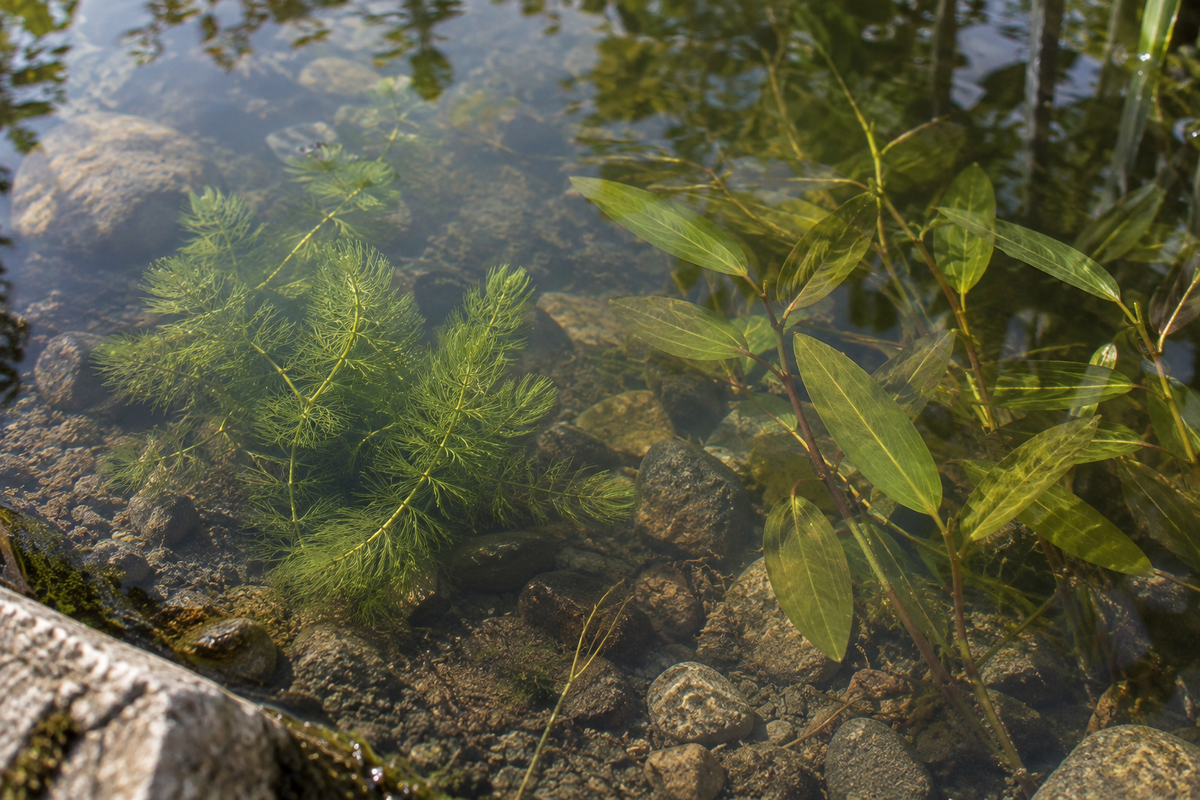
Oxygenating plants have an interesting role in a pond: they vegetate the water, provide refuges, and contribute to its biological functioning. However, their name can lead one to believe that they provide oxygen constantly, like a device you plug in. That is not the case.
To choose oxygenating plants, consider the depth, the light, the available space, and the presence of fish. Hornwort and shining pondweed are two options to explore. Their installation must be accompanied by measured maintenance and, in some ponds, supplemental aeration.

How does an oxygenating plant act in the water?
In the light, a plant performs photosynthesis and produces oxygen. It also breathes, day and night. When light is lacking, photosynthesis stops while respiration continues to consume oxygen.
In a pond, fish, bacteria, and other organisms also consume it. Dissolved oxygen is therefore the result of several phenomena: exchange with the air, plant activity, temperature, circulation, and biological consumption.
Penn State Extension points out that values are often at their lowest before daybreak. Seeing beautiful vegetation in the sun, therefore, does not allow one to conclude that the fish will have enough oxygen at the end of the night.
Hornwort: a plant without standard roots
The Ceratophyllum demersum, called hornwort, has fine foliage arranged around its stems. It can grow freely in the water, without standard planting in the bottom.
It is an interesting option when you want to add vegetation to a pond without soil or add submerged refuges. Its growth can, however, become dense. Keep the stems away from intakes and plan to remove excess amounts when they impede circulation or take up too much space.
The Aquishop data sheet indicates a maximum depth of 120 cm for the offered plant. Adapt its position to the available light and the pond's situation. Water that is already very murky may limit the light reaching submerged plants.
The RHS describes a seasonal cycle with a regression of foliage in winter and a resurgence from specialized buds. A winter decrease in vegetation does not automatically mean the entire plant is lost.
Shining pondweed: a rooted submerged plant

The Potamogeton lucens has broader leaves than hornwort. Pondweeds create underwater meadows anchored in a substrate and can provide supports for small aquatic fauna.
The Aquishop data sheet lists planting between 30 and 120 cm underwater, in full sun or partial shade. This range provides a selection framework; it does not replace the need to check water clarity, the size of the plant received, and the recommended planting method.
Provide a container or planting area compatible with its growth. For a small pond, ask if this species will remain easy to manage in the available space. The term "oxygenating" does not provide information about the future vigor of the underwater meadow.
Other species exist, but the exact name counts
The RHS cites milfoils like Myriophyllum spicatum and M. verticillatum, mare's tail Hippuris vulgaris, or water crowfoot Ranunculus aquatilis among the plants used in ponds. They do not all have the same habit or the same installation requirements.
A genus name is not enough to make a purchase. "Milfoil" can refer to different species, some of which are regulated. Similarly, a bank buttercup is not interchangeable with a submerged water crowfoot.
Ask for the full botanical identity and check the official lists applicable in Belgium. Do not collect plants from a natural pond to supplement your own: you could disturb the environment and transport unwanted organisms.
Which criteria to compare before buying?
| Criterion | What to check |
|---|---|
| Depth | Position actually suited to the species and the plant received |
| Light | Sun exposure, shade from floating leaves, and water transparency |
| Growth mode | Free-floating, rooted, or partially emergent plant |
| Space | Mature development and access for removing excess growth |
| Fish | Risk of rooting or consumption, pond load, and aeration needs |
| Maintenance | Possibility of controlling the meadow without dismantling the entire setup |
The small pots or bunches sold initially do not correspond to a final volume of vegetation. An appropriate quantity must take into account the size of the plants, the species, and what is already growing in the pond.
Install the plants without stifling them
Keep the instructions for the chosen reference. A plant that floats freely in the water does not have the same needs as a rooted species. Do not systematically bury all stems in potting soil.
For plantings that require it, a suitable aquatic basket facilitates control and movement. The substrate must correspond to the species and stay in place. Avoid adding rich potting soil or garden fertilizers intended to "make things grow faster."
Choose an area where the plants will receive enough light without interfering with equipment. If the pond is full of algae or particles, first examine what is limiting clarity. Adding more plants to water where they are withering will not address the cause.
How many oxygenating plants are needed?
There is no specific number of bunches that can guarantee oxygen for every pond. The size of the bunches varies, plants develop differently, and oxygen consumption depends largely on the inhabitants and organic matter.
Prepare an initial planting consistent with the surface area and other plants, then observe its growth. Keep some open water and passages between the plant beds. If the stems form a very dense mass, remove a portion gradually rather than waiting for it to decompose.
Do not calculate a fish population based on the number of plants purchased. For fish, the volume, filtration, aeration, and water monitoring remain the determining factors.
Do plants replace an air pump?
A pond for wildlife can function without a permanent device under suitable conditions. A fish pond, especially during hot periods or with a high biological load, requires different vigilance.
The Oase AquaOxy 1000 kit is an example of aeration to consider depending on volume and population. Its two diffusers and its advertised maximum airflow of 1,000 liters per hour are not a guarantee for just any pond: depth, layout, and actual needs must be examined.
If several fish are searching for air at the surface, do not count on buying plants to solve the situation immediately. Quickly reinforce aeration, check circulation, and monitor water quality. Professional advice is useful if signs persist or are accompanied by other abnormalities.
Maintain the plant beds while preserving their value
Remove parts that are withering and any excess growth that has become a nuisance. Vegetation removed from the pond takes away some of the nutrients contained in its tissues. Identify species before cutting: some can multiply by fragments.
Work in small areas to preserve refuges. Observe the removed vegetation and carefully return any small animals spotted to the water. Then, dispose of the waste in a way that avoids its return through runoff or its dispersal into another aquatic environment.
To choose suitable oxygenating plants, contact the Aquiflor team with the depth, sun exposure, fish present, and a photo of the pond. We will be able to guide you toward a planting scheme and, if necessary, an aeration system matching your situation.
Sources and useful reading
- RHS — submerged plants and choosing species.
- RHS — Ceratophyllum demersum ; RHS — Potamogeton lucens.
- Penn State Extension — dissolved oxygen and day/night variations.
- Penn State Extension — removing vegetation and managing fragments.
- SPW — regulated invasive alien species.
- Aquiflor — presentation of oxygenating plants, for vegetation forms; Aquishop data sheets for the two plants, the basket, and the aerator cited.