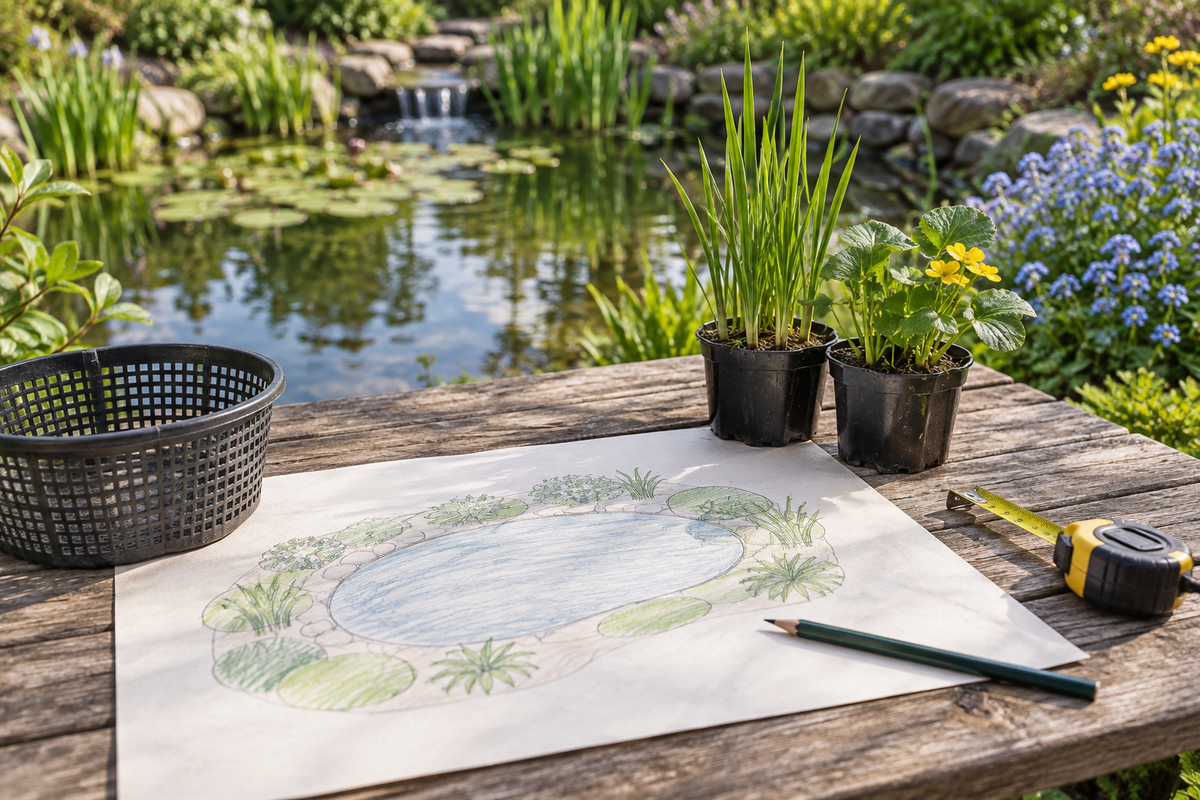
To find plants for a pond, start with an aquatic nursery capable of advising you on depths and the development of the species. You can prepare your search in the Aquishop selection, then have the references confirmed by the Aquiflor team in Nodebais.
The most useful step before purchasing is to turn your pond into a small list of locations. A plant must have a planned spot, a compatible depth, and a role in the composition. This method helps complete an existing pond, organize a first planting, and avoid buying too many plants at once.

Start with what is already there
If the pond has been there for several seasons, take inventory before ordering. Some plants seem absent in winter but take up a lot of space in the spring. A photo taken in summer can avoid filling a spot that will soon be occupied.
Note the clumps to keep, those to divide, and the areas that remain empty. Also, identify technical access points: pump, skimmer, overflow, and passage edges. These must remain usable once the vegetation has grown.
If a plant is growing poorly, first look for the reason why. Replacing it with a new one without correcting excessive depth, lack of light, or an unstable basket risks repeating the same problem.
Draw four types of locations
On a simple plan, separate the damp bank, shallow submerged shelves, deep water, and areas to be kept clear. Add the shade from trees, walls, and large neighboring plants.
The bank outside a liner is not necessarily damp. Conversely, a basket placed on a deep shelf may put the plant's crown near the surface. Therefore, measure the actual conditions rather than relying only on the appearance of the edge.
| Location to be defined | Measurement or observation | Consequence for purchase |
|---|---|---|
| Border visible from the terrace | Shallow depth and desired height | Choose a low plant that maintains the view |
| Background | Available width and light | Plan for a taller clump without shading the entire pond |
| Submerged shelf | Water height above the future crown | Check the species and the basket together |
| Open water | Surface to preserve and circulation | Limit leaf spread and keep access to equipment |
Give each plant a function
A pleasant composition combines several interests: hiding an edge, providing flowering, creating verticality, partially shading the water, or offering shelters. Plants also contribute to the pond's functioning, but no single species fulfills all these functions in all situations.
For a pond intended for small wildlife, focus on diverse vegetation and accessible banks. For a koi pond, take into account plants that fish may forage on or consume, as well as the protection of the baskets.
In a vegetated filtration zone, the plants must integrate with the hydraulic system. Their purchase comes after defining the system: surface, supports, circulation, and maintenance. An assortment does not replace this design work.
Some references to build your list
A low border: the marsh forget-me-not

Myosotis palustris is suggested for a position close to the water level, from -5 to +5 cm from the planting zone according to its datasheet. Its announced height is about 20 cm, with flowering from May to September.
It can therefore be part of a selection to soften a visible edge. However, check the actual moisture of the support and leave room for its development.
Vertical foliage: the soft rush
The Juncus effusus brings upright stems. It allows for varied silhouettes alongside shorter plants or floating leaves. The datasheet announces a height that can reach about 80 cm and exposure to sun or partial shade.
Place this type of vegetation taking into account the viewpoint: a large clump immediately in front of the terrace can hide the surface. Have the appropriate depth confirmed before installation.
A summer bloom: the pickerelweed
The Pontederia cordata can complete a shallow area with its heart-shaped leaves and mauve spikes. Its datasheet indicates planting under 10 to 30 cm of water. It therefore requires a different location than a simply damp border.
These examples illustrate a selection approach; they do not constitute a pack to be reproduced in all ponds. The available space and the possible choice of native species may lead to other references.
Calculate quantities without filling every empty space
The number of pots is decided according to the species, its starting size, and its development. A small root ball does not have the same immediate effect as a large pot, but it can become voluminous after installation.
Ask for a planting distance adapted to each reference, then apply it to the plan. For a narrow border, also check the lateral spread: available length alone is not enough to determine the number of plants.
Keep a margin for growth and maintenance. If you are hesitant between two quantities, a measured first planting followed by observation can be easier to manage than a clump that is immediately tight. Excess plants then require work to be divided or removed.
Plan the full planting budget
The shopping list includes the plants, but also the containers, adapted substrate, any support materials, and transport. Compare packaging for equivalent needs, not just the price displayed for a reference.
The square aquatic plant basket is available in several sizes. Note the required format for each location and check its height: it changes the depth of immersion of the plant.
A basket that is already too small may require rapid repotting. Conversely, a very large container will not be useful if it does not fit on the shelf or becomes impossible to move. Also, plan for accessories according to the recommended planting method, without automatically adding fertilizer.
Organize your visit or order
Aquiflor is located at Rue de la Liberté 22, 1320 Nodebais. To prepare for your visit, check the updated opening hours and have the desired plants confirmed if your selection is precise.
Remotely, send your sketch, photos, and provisional list. Indicate your municipality and the desired period. Some plants are preferably picked up in-store; delivery can be studied depending on the references and the project.
Upon receipt, keep the names of the plants and their instructions. Labeling your plan is useful for recognizing clumps in the spring, tracking their growth, and knowing which ones to divide.
After planting: observe before completing
Take an initial photo, then observe new shoots, surface occupancy, and equipment access. Remove accessible faded leaves and intervene gradually if a species grows too much.
Do not judge the entire composition after a few days. Recovery depends on the season, the plant, and its installation. In case of wilting, first check depth, light, and stability, then ask for advice with a photo.
To have your selection reviewed, contact the Aquiflor team with your plan and constraints. You will thus be able to order the plants and accessories corresponding to the available locations, then complete the pond as it evolves.
Sources and useful reading
- RHS — choosing plants according to pond size and depth.
- RHS — containers and planting aquatic plants.
- RHS — vegetation monitoring and pond maintenance.
- Aquiflor — contact details and opening hours; ordering aquatic plants.
- Aquishop datasheets for the marsh forget-me-not, soft rush, pickerelweed, and the cited baskets.