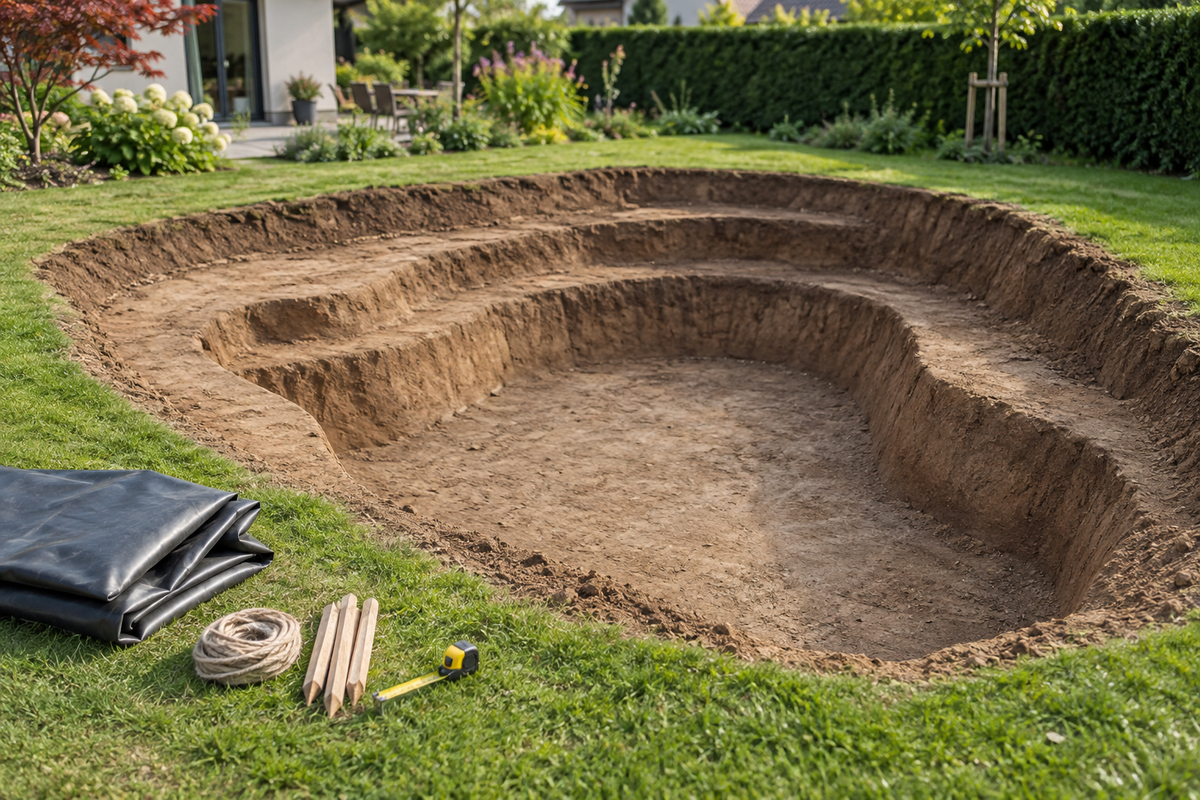
Before digging a pond in your garden, decide what it is intended to house. A pond for amphibians, a plant basin, and a pond with koi carp require different setups. This decision influences the depth, the banks, the filtration, the budget, and the time spent on maintenance.
The best starting point is a simple plan, accompanied by a few observations of the terrain. You can then choose a waterproofing method, organize the construction site, and buy the materials in the correct order. Here are the steps to build a coherent project without discovering too late that there is not enough room for the filter or an exit for small wildlife.

Choosing between a natural pond and a fish pond
For a pond intended for biodiversity, shallow areas, accessible banks, and water low in nutrients are priorities. The absence of fish particularly favors amphibians and numerous invertebrates. It is not necessary to add fish to make the water "alive."
An ornamental pond with fish requires a different approach. The adult population, the food provided, and the waste produced must be compatible with the volume, aeration, and filtration. The number of fish you wish to purchase should not be decided solely based on their small size at the time of sale.
If you are planning to swim, have an installation designed for this purpose right from the start. Clear water in an ornamental pond does not demonstrate its health quality for bathers.
Observing the location for several days
Identify sunny areas, the shade of trees, and the direction of water flow after rain. Avoid unintentionally collecting runoff from a fertilized lawn, a dirty driveway, or a storage area. A low spot that is convenient to dig may be a poor location if it receives all the water from the garden.
Proximity to the house facilitates observation and maintenance. However, foundations, underground networks, and existing walkways must be taken into account. Identify pipes and cables before starting. For unstable ground, a steep slope, or a nearby water table, ask for a professional assessment.
Think about daily movement: can you move around the pond, take out the pump, and transport a wheelbarrow without crossing planting areas? Also, reserve a spot for equipment if the project involves any.
Checking procedures before earthworks
Present your layout to the municipality's urban planning department. The rules depend on the Region, the dimensions, the work involved, and the constraints specific to the plot. A small pond or a layout described as natural is not automatically exempt from all procedures.
Prepare the dimensions, distances to boundaries, changes in relief, and auxiliary equipment. In Wallonia, the official portal recommends checking with the municipality before work begins, even when you think you are entitled to an exemption. In Flanders and Brussels, consult the local contacts and applicable rules.
Drawing the volume, tiers, and exits
Trace the outline on the ground with a rope or a flexible hose. Look at it from the terrace and windows, then simulate the width of the banks. The outer contour does not entirely correspond to the open water surface: tiers and finishing touches take up space.
Adapt the depths to the intended uses and plants. A single identical step around the entire pond limits the choice of plants. Planning for several levels allows plants to be placed according to the immersion of their root crown, while maintaining the necessary open spaces.
In a pond for wildlife, create exits with a gentle slope. Natagora recommends varying the profiles and allowing amphibians to leave the water. Entirely vertical banks can trap small animals. The safety of children and visitors must also be provided for, regardless of the ecological objective.
Choosing the appropriate waterproofing
A flexible membrane allows for varied shapes. A preformed shell imposes more of its dimensions and tiers, but can simplify certain small projects. Clay soil alone does not guarantee a watertight pond: its composition, implementation, and moisture variations require a specific study.
For a membrane, the preparation of the base is just as important as the material chosen. Remove sharp elements, stabilize fragile areas, and lay down compatible protection. A geotextile fleece does not turn unstable ground into a foundation and does not exempt you from removing protruding stones.

The Aquitechnics EPDM pack with fleece allows you to combine membrane and protection. Check the dimensions of the cut and the quantity actually needed before ordering. The surface area of the liner exceeds the mere water surface area viewed from above.
Measuring the membrane on the actual profile
For an initial estimate, add twice the maximum depth to the length and width of the pond, then add the planned bank margins. This approach is used to prepare the budget. After earthworks, measure the actual profile with a flexible tape measure, following the tiers and the bottom.
An example explains the difference: a 3 m by 2 m pond with a maximum depth of 60 cm cannot be covered with only 6 m² of membrane. The slopes, the bottom, and the anchors significantly increase the surface area to be provided. The widths of available rolls also influence the final cut.
Do not cut the excess at the edges immediately. Let the membrane settle into place during gradual filling, without putting it under tension, then finish the banks according to the instructions of the chosen system.
Organizing the site and debris
Before a machine arrives, check access, the load-bearing capacity of the passage, and the destination of the soil. Apparently simple earthworks can become expensive if the debris has to be transported by hand over a long distance. Separate the costs of rental, removal, and garden restoration in your budget.
The walls must remain stable during the work. Do not leave an excavation accessible without protection and do not work under soil that is likely to collapse. Deep structures, retaining walls, and utility passages require appropriate skills.
Regularly check the levels of the banks. The lowest point often determines the maximum water level: a subtle difference when dry becomes very visible once the pond is filled.
Installing the circuit before finishing the decor
If the pond includes filtration, draw the path of the water and plan access to the connections. Choose the pump based on the flow rate actually required and the losses in the circuit. The filter must be adapted to the fish load, with a reasonable operating margin.
Have the power supply validated and install the devices according to their manuals. Cables must not be stretched, pinched under stones, or left in a walkway. Test everything, including stopping and restarting, before finishing the final touches.
Planting and letting the pond evolve
Choose plants based on their needs, their adult development, and the depth available. In an ecological pond, favor local species from nurseries. Do not go and take plants or animals from a natural environment to accelerate colonization.
For a shallow wetland area, Caltha palustris can provide spring blooms. Water mint is suitable for other borders, provided you monitor its spread. A basket makes it easier to control vigorous plants in a small ornamental pond.
If fish are planned, their arrival should wait for the preparation of the water and the biological operation of the system. A freshly filled pond is not ready simply because it looks clean. Analyses, maturation, and gradual introduction count for more than a date set in advance.
Information to provide for useful advice
Gather a plan, photos, dimensions, depths, intended use, and terrain constraints. Add your budget and the portion of the work you will perform yourself. These elements allow for choosing the equipment and identifying the steps that require a professional.
Prepare your project with Aquiflor: send this information to support@aquiflor.com or consult the support services. A pond that is well thought out before the first shovel hits the ground will be more pleasant to live with on a daily basis.