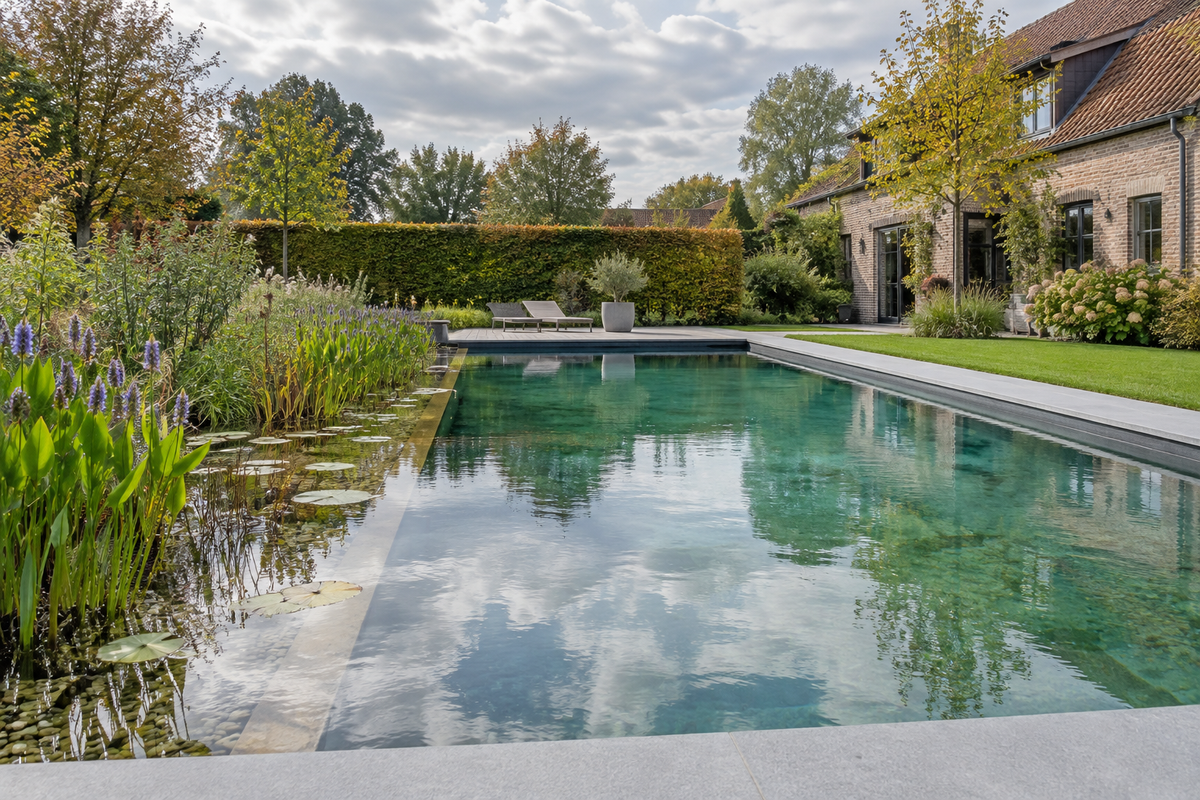
A natural swimming pool project in Belgium begins with three decisions: where to install it, how to treat the water, and what level of maintenance you are willing to accept throughout the seasons. The shape of the basin comes next. A sloped garden, a nearby water table, or difficult access for machinery can weigh more heavily on the construction than a few extra square meters of swimming area.
Here is a method for preparing a concrete dossier, communicating with your municipality, and requesting comparable quotes. It is suitable for both an initial installation and the transformation of an old pond, with one essential caveat: an ornamental pond does not become a swimming pool simply because its water looks clear.

Define the swimming pool you actually need
Do you wish to swim several laps, cool off with your family, or enjoy a water garden with an occasional swimming area? These uses do not impose the same geometry. Usable length counts for swimming; ease of entry, visibility, and access around the water take up more space in a family project.
Also note the usual number of users, periods of absence, and the presence of children. Plan from the start for fall protections, non-slip surfaces, and access that allows you to get out of the water easily. Vegetation does not replace adequate protection. Safety equipment must remain compatible with the shape and surroundings of the pool.
Choosing between a planted zone and a more compact treatment
A natural swimming pool can combine a swimming area with a planted regeneration zone. Other systems use more technical biological filtration and nutrient management, with a smaller vegetated surface. The right choice depends on the available space, the desired look, and the precise operation proposed by the designer.
Plants contribute to the operation of the whole, but they do not in themselves constitute a sanitary guarantee. A serious project explains the water flow, waste removal, biological supports, and maintenance operations. Ask for a readable diagram: you must understand where the leaves go, where the material settles, and how each element is accessed.
Check the rules in the right Region
There is no single permit rule applicable to all Belgian natural swimming pools. The Region, local regulations, the land, and the project characteristics all count. The word "natural" does not automatically exempt you from procedures. Have the complete plan examined before ordering the earthworks.
| Location | First point of contact | Document to prepare |
|---|---|---|
| Wallonia | Municipal urban planning department, with current CoDT rules | Layout, dimensions, relief, distances, and ancillary equipment |
| Flanders | Municipality and regional information on the omgevingsvergunning | Complete project, including existing exterior landscaping |
| Brussels-Capital | Municipal urban planning department or urban.brussels | Garden plan, planned works, access, and impacts on the plot |
Possible exemptions are subject to cumulative conditions. A surface area found in an article is therefore not enough to conclude that your construction project is exempt. Also check the constraints specific to the property: subdivision, heritage protection, proximity to a watercourse, or special regulations. Keep the response received and update the file if the project changes.
Read the land before designing the coping
Observe the garden after heavy rain. Where does the water come from? Where does it stagnate? Runoff water loaded with soil or coming from a fertilized area must be kept away from the swimming pool. Installing the pool at the lowest point without examining these flows often leads to difficulties.
The professional must also evaluate the nature of the soil, the stability of the walls, and the risk associated with groundwater. A waterproof membrane does not cancel out the pressures that can be exerted around a structure. Structural or drainage solutions are decided on-site, taking into account the terrain and applicable rules.
Finally, measure the site access: width of the passage, turns, steps, overhead lines, and the possibility of storing excavated material. Ask who is responsible for removing the soil and restoring the garden. These items deserve a separate line in the quote.
Prepare the water, circulation, and electricity
Indicate the planned source of the refill water. An initial analysis helps the designer anticipate the settings and nutrient management. Rainwater, well water, and municipal water are not interchangeable without examination. Common pool tests provide certain chemical parameters; they do not prove the absence of microbiological contamination.
The pump is chosen based on the flow rate actually required in the installation. The length of the pipes, their diameter, height differences, and filters reduce the available flow. A pump advertised with a maximum flow rate does not provide that flow in all configurations.

See the OASE AquaMax Eco Premium 12000 12 V pump. Its choice and installation must respect its manual as well as the electrical and hydraulic design of the pool. The transformer and connections also require appropriate installation. Have the setup validated by a competent professional.
Anticipate the four Belgian seasons
In spring, the system gradually regains its seasonal operation. In summer, usage, heat, and external inputs can increase the load to be treated. In autumn, leaves become a regular task. In winter, equipment operation depends on the system, its installation, and the manufacturer's instructions.
Ask for a written calendar rather than a promise of a maintenance-free pool. It must specify the frequency for checking baskets, cleaning filters, pruning plants, and managing deposits. Plan an accessible path to the technical room, even in wet weather.
To remove deposited material, an OASE PondoVac 4 vacuum can be included in the maintenance equipment if the depth, access, and surfaces allow it. A product intended to break down pond sludge should not be automatically applied to swimming water: have its compatibility with the system and its use confirmed.
Compare quotes based on the total cost
Request separate items for studies, earthworks, soil removal, structure, waterproofing, piping, treatment, electricity, planting, and surroundings. Add commissioning, maintenance explanations, and any subsequent interventions. Two global amounts are only comparable if these services are.
Include operating expenses. As a calculation, 100 W equipment running non-stop consumes 876 kWh over a 365-day year. This figure illustrates the method; it does not describe the consumption of the pump presented above. Multiply the actual projected consumption by your rate, then add the consumables and maintenance of the chosen system.
Prepare for your meeting at Aquiflor
Bring a dimensioned plan, some photos, the location of known utility lines, and your list of uses. Mention access constraints and the responses already obtained from the municipality. With these elements, the discussion quickly focuses on concrete choices rather than a random estimate.
Aquiflor offers advisory services and a network of independent providers. Depending on your needs, guidance can help you choose equipment, organize a renovation, or identify a contractor. Clarify who designs, who executes, and who ensures the follow-up of your project.
Is your project taking shape? Present it via the Aquiflor services and consult the partner network. Thoughtful layout and maintenance understood from the start are worth much more than a pond chosen only from a photo.
Useful sources and references
- SPW Territory: Territorial Development Code and updates.
- Flanders: swimming pools, natural swimming areas, and ornamental ponds.
- Brussels-Capital Region: urban planning permits and contacts.
- Biotop: design principles for a natural swimming pool.
- SPW Environment: swimming water and health.
- Aquiflor: network and project support.