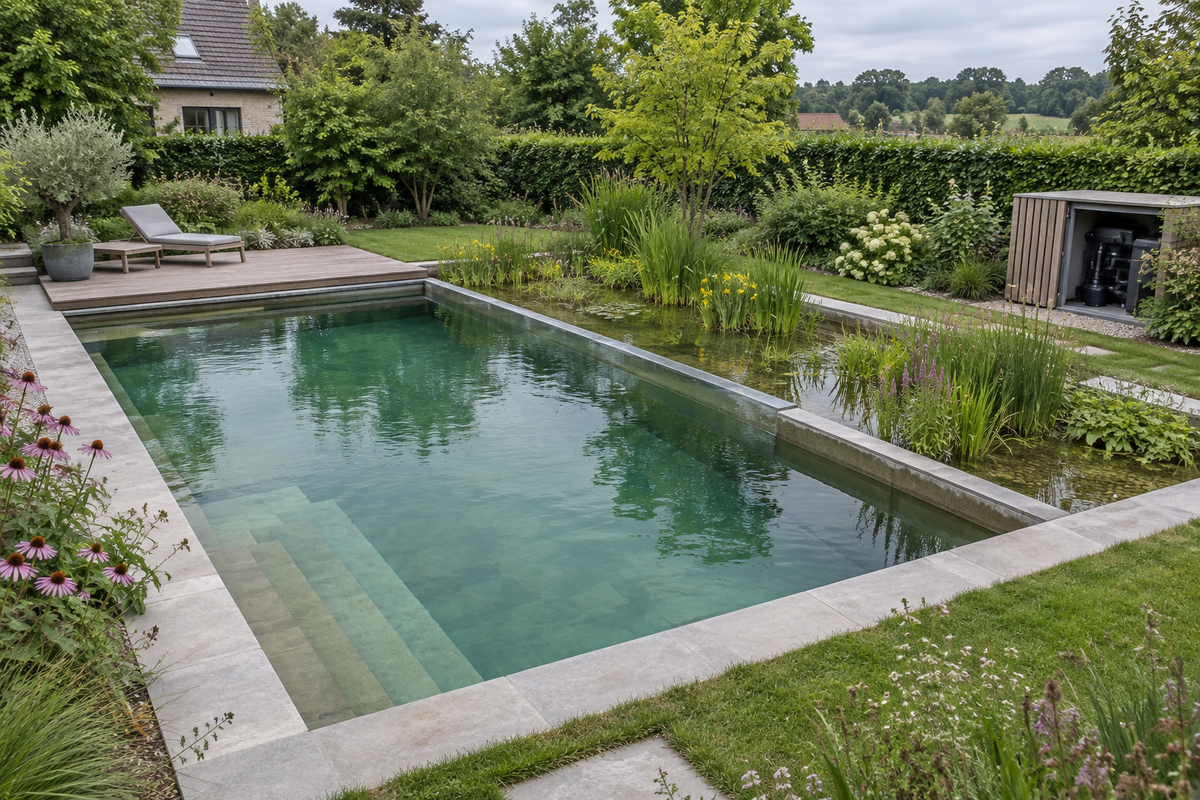
Building a biological swimming pool begins long before the excavation. You must organize a swimming area, a water treatment system, and a maintenance routine that you can sustain long-term. The visible pool is only one part of the installation: circulation, pre-filtration, materials, and technical access must be thought through as a whole.
The first step is therefore to turn a desire into a set of specifications. You will then be able to compare complete solutions and request quotes that truly cover the same project.

1. Define uses and the accepted level of maintenance
Do you wish to swim, cool off, supervise children, or simply enjoy the presence of water in the garden? These uses influence the length, access points, depths, and expected footfall. Also describe the desired period of use and the number of people usually present.
Specify what you are willing to maintain. A planted zone requires monitoring vegetation and removing certain materials. Technical equipment requires cleaning and checks. The natural look does not eliminate these interventions; it changes their nature.
Keep a few inspirational images, but annotate them: what you like might be the coping, a view from the terrace, or a planting style. This method avoids replicating an assembly you do not need and helps the designer understand your priorities.
2. Choose the biological treatment principle
Several designs exist. A swimming pond may include a planted regeneration zone associated with circulation and mechanical equipment. Other biological pools rely more on technical filters and targeted nutrient management, with less vegetation in the treatment system.
There is, therefore, no universal percentage for lagooning. The manufacturer Biotop describes proportions and dimensions specific to its planted natural pool system, while its Living Pool range uses another organization. These examples show why dimensioning must be tied to a specific system.
Ask the professional to explain the water path, particle removal, and the role of each compartment. Plants can contribute to the operation and the landscape, but a simple flower border does not, on its own, constitute a complete swimming treatment system.
3. Study the terrain and administrative requirements
Note slopes, equipment access, nearby trees, and rainwater runoff paths. A low point in the garden may seem practical for digging, but it may also collect runoff laden with soil or other contaminants. These water inlets must be prevented before drawing up the borders.
The nature of the soil, any potential water table, and the stability of the excavations may require a specific study. Also plan for what will be done with the excavated soil. Storing or removing it influences the cost, site organization, and sometimes the necessary permits.
In Belgium, contact your local urban planning department with a plan, dimensions, and any associated facilities. Conditions differ depending on the Region and the context of the plot. Any potential permit exemption must be verified for the entire project before starting work.
4. Design the structure and waterproofing
The structure depends on the terrain, depths, and the chosen shape. Walls, stairs, and any partitions must be designed for the stresses they will be subjected to. A method used for a small decorative pond is not automatically suitable for a swimming pool.
Choose a waterproofing method confirmed for swimming use, with a consistent system of fittings, conduits, and protections. For a membrane, the substrates must be prepared and installation details defined before ordering. Corners, steps, and through-wall components are points to be treated with care.
The EPDM membrane offered in the Aquishop catalog can be part of a technical discussion, but its choice for a pool requires confirming the exact reference, its compatibility with swimming, and all necessary accessories. The material alone does not validate the construction.
5. Dimension the circuits and choose equipment
The useful flow rate depends on the hydraulic path: pipe length and diameter, elevation change, elbows, valves, and filter pressure drop. The maximum flow rate printed on a pump does not necessarily correspond to what will circulate in your installation.
The OASE AquaMax Eco Premium 12000 in 12 V, reference 50382, is presented by OASE for swimming ponds. Its datasheet indicates a maximum flow rate of 11,400 l/h and a maximum head of 3.20 m. These two values correspond to different limits on the curve, not to a flow rate of 11,400 l/h available at 3.20 m.

The 6000 version in 12 V is another reference to study depending on the circuit. Do not choose based solely on the model name. The mains power supply, its location, cables, and protections must be integrated into a compliant installation, verified by a competent professional. Suction safety also requires a design adapted for swimming.
6. Plan for plants and maintenance access
If your system includes a lagooning area, select plants based on the water level at their crown, exposure, and growth habit. The substrate and circulation are defined by the designer. Avoid freely adding potting soil or fertilizer to an area intended for treatment.
Plan how to remove debris, reach valves, and clean compartments without dismantling the terrace. A discreet cover remains useful only if it opens easily and leaves enough room for interventions. Also think about the destination of the cleaning water.
A PondoVac 5 can be studied for vacuuming deposits depending on the depth, lining, and discharge requirements. It does not turn a pool into a maintenance-free installation, and its use must follow the manual, away from swimmers.
7. Organize checks before the first swim
Filling the pool does not mean the project is ready for use. Check for leaks, flow rates, connections, and the operation of each circuit. Have the settings and actions to take in case of a breakdown or abnormal level explained to you.
Define a water monitoring program including sanitary aspects. pH and hardness tests provide information on the pool's operation, but they do not replace appropriate microbiological assessment. Visual clarity does not guarantee the absence of contamination.
Drowning prevention must be integrated from the design phase: access, appropriate protection devices, supervision, and family organization. Applicable requirements must be verified locally. Low depth or a pond-like appearance does not eliminate this risk.
Documents to request at completion
- A plan of the pipes, cables, valves, and equipment actually installed.
- References, manuals, and warranty conditions for the equipment.
- The volume measured upon filling and the chosen settings.
- The maintenance schedule and water checks to be performed.
- Instructions for start-up, winterization, and managing a breakdown.
- Usage limits and the contact details of the person providing follow-up.
Prepare your biological swimming pool filtration with Aquiflor. Bring your plan, the envisioned dimensions, and the constraints of the terrain: this allows for a discussion of the equipment within a complete project, before ordering separate components.
Sources and documentation
- Aquiflor: organization of a natural swimming pool.
- Biotop: design of its planted natural pool system and presentation of different biological system families.
- OASE: AquaMax Eco Premium 12000 in 12 V, supplemented by the related Aquishop datasheets.
- Wallonia Public Service: preparing an urban planning application.
- SPW: water and health in swimming.