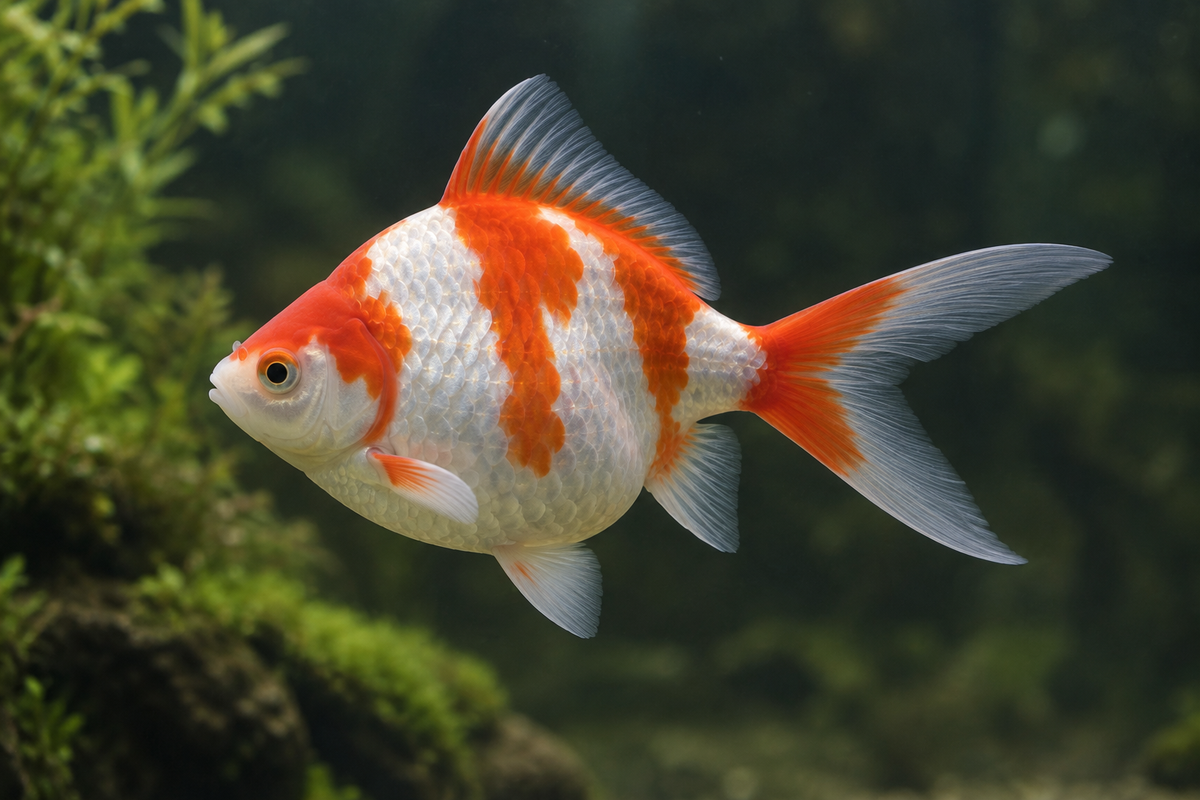
The Tamasaba intrigues from the very first glance: a well-rounded body, a pronounced dorsal fin, and a single tail that accompanies lively swimming. This Japanese fish has a style all its own. It belongs to the goldfish family, and housing it requires more than just a pretty container filled with water.
Are you looking for a Tamasaba and want to prepare for its arrival? Here are the points to know to identify it, discuss its origin, and plan a suitable aquarium or pond. For a search at Aquiflor, start by having the arrivals and ordering possibilities confirmed.

A Japanese goldfish associated with Niigata
The Tamasaba is a variety of goldfish, Carassius auratus, developed in the Niigata region of Japan. Breeders in this region associate it with an aquaculture tradition also known for koi carp. However, its trade name does not refer to a miniature carp.
Breeders describe a fish with a tall, rounded body and a single tail. A red and white coat is common, but patterns and shapes vary depending on the individuals and lineages. Some fish have longer tails than others. A profile photograph and a short video of the fish swimming are therefore particularly useful for comparing offers.
Variety and lineage names can also overlap in the trade. If a precise designation is important to you, ask for the name of the breeder or the known origin. Reliable identification relies on several elements, not just the red and white color.
Tamasaba, Ryukin, and Sarasa: visual markers
The Tamasaba reminds one of the Ryukin due to its compact and deep body. The tail is a major marker: the Tamasaba's is single, while the Ryukin has a double tail. Sarasa primarily describes a red and white coloration; common or comet-type pond Sarasas generally have a more elongated silhouette.
| Name encountered | What to observe |
|---|---|
| Tamasaba | Rounded body, pronounced height, and single tail; variations depending on lineage. |
| Ryukin | Deep and compact body with a double tail. |
| Comet-type Sarasa | Red and white coloration, slender body, and elongated single tail. |
| Koi carp | Different species, with barbels around the mouth. |
A single tail can be forked: its two upper and lower lobes do not constitute a double tail. This nuance avoids a common confusion when observing a fish only from a photo taken from above.
What housing should be provided for a Tamasaba?
Reason based on future growth, swimming habits, and the intended population. The Tamasaba can become an imposing fish; its round shape does not mean it stays small or swims little. A fishbowl or a small decorative vase does not allow for a suitable environment.
For an aquarium, consider the swimming length, the width available for turning around, and the space actually occupied by decorations. A cluttered setup may look large from the outside while leaving little room for the fish. Keep clear passageways and avoid abrasive elements or openings where a fish could get stuck.
For a pond, the depth, volume, exposure, and temperature variations must be studied together. Before deciding on the number of fish, present your project with its dimensions and equipment. A lone figure in liters is not enough to judge an entire setup.
Can it live outdoors in Belgium?
Japanese breeders describe good cold resistance in the Tamasaba. This does not guarantee the successful overwintering of any individual in any Belgian container. An established pond, an above-ground tank exposed to wind, and a small patio basin undergo very different conditions.
Ask how the fish was kept before purchase and prepare for its transition. An animal coming from relatively warm water should not be abruptly transferred into a cold pond. Discuss overwintering before autumn, considering the temperatures actually observed and the characteristics of the housing.
The advertised hardiness does not replace water monitoring. If you are hesitating between an aquarium and a pond, have the two possible setups compared rather than choosing solely based on the fish's Japanese origin.
Filtration and monitoring: preparing the environment before purchase
Filtration must handle the load produced by the fish and their food. In a new aquarium, biological startup requires monitoring nitrogenous compounds. In an existing setup, adding fish increases the load and also warrants surveillance.
Aquipond Aquarium NitriBoost 150 ml is intended for freshwater aquariums. It can support biological filtration according to its instructions, without constituting authorization to immediately stock a new tank. For an outdoor pond, choose the Aquipond reference corresponding to that usage and its volume.

The JBL ProAquaTest CombiSet Plus NH4 allows for checking ammonium/ammonia and nitrites. Note the values, date, and temperature. If the fish is breathing abnormally or remains lethargic, this information will help guide checks.
How to feed this goldfish?
Start by finding out what food is used by the breeder or seller. Then choose a food adapted to goldfish and a size that is easy to eat. The naturally round silhouette of the Tamasaba does not justify increasing meal frequency to make it gain more weight.
Present small quantities and observe their consumption. If surface feeding is accompanied by buoyancy difficulties, have the situation checked and discuss an appropriate sinking food. A persistent loss of balance should not be automatically attributed to food: it deserves an investigation into the cause.
The Aquifood Pond Fish Food Mix Goldfish Floating 3 mm sheet refers to a floating food for pond goldfish. Its suitability therefore depends on the size accepted, the method of keeping, and the behavior of your fish. Have this choice confirmed for the individual purchased, rather than considering all pond foods as interchangeable.
Choosing compatible companions
Some breeders keep Tamasabas with koi, but this does not automatically validate such a mix in a garden pond. Size, swimming speed, feeding opportunities, and pond capacity remain determining factors. A fish can be peaceful while still monopolizing food.
With other goldfish, also monitor differences in mobility. A very slow-moving fish or one with significant anatomical peculiarities may be at a disadvantage. For beginners, a coherent group and an easy-to-monitor setup simplify the process.
Where to find them and what questions to ask?
Availability of Tamasabas varies with shipments. Before traveling to Aquiflor, ask if individuals are offered or can be sourced. Specify the desired size, your setup, and your possible preference for a specific identified origin.
- What is the known origin of the fish?
- At what temperature and with what food is it maintained?
- Is it possible to observe its swimming and profile before purchase?
- What transport and acclimatization should be planned?
- How should quarantine be organized if other fish are already present?
Contact Aquiflor regarding Tamasabas and to prepare for their arrival. A photo of your setup and its dimensions will allow for discussion of a concrete project, even before a fish is available.
Sources and references
- Golden Fish Farm Otohime: description of Tamasabas and shape variations — Japanese breeding source.
- Iyashi no Sato Farm: presentation of Niigata Tamasabas and breeding conditions.
- Niigata Tamasaba Promotion Association: maintenance and feeding; the treatments mentioned on this page do not constitute a protocol to be applied without diagnosis.
- OATA: water monitoring, feeding, and compatibility of fancy goldfish, used for general precautions.