An iris clump overflowing from its basket, duckweed covering the water, and an exotic plant capable of colonizing a river do not pose the same problem. Yet, they are often grouped under the same word: "invasive."
To regain control of your pond plants, start by identifying them. You can then choose between routine maintenance, dividing them at the right season, or specific management. Preparing for the following year mainly consists of better organizing plantings and nutrient inputs, without disrupting the entire pond.

Vigorous plants vs. invasive alien species: making the distinction
A plant can become too large for your pond while still being native and beneficial to wildlife. Some irises, reeds, or cattails quickly take up a significant amount of space. In a small volume, their vigor requires monitoring or a more appropriate choice.
An invasive alien species presents a different issue: its dispersal can affect natural environments. The SPW highlights the difficulty of controlling these plants, some of which grow back from stem or rhizome fragments.
The scientific name is therefore useful. Take a photo of the whole plant, its leaves, and, if present, its flowers. Finding the label or the purchase receipt can also help. Rough identification based on a small floating leaf is not always sufficient.
Duckweed cannot be managed like a large rooted clump. Filamentous algae require a different approach entirely. Avoid using the same product or tool for all green vegetation in the pond.
Check the plant's status before moving it
In Wallonia, certain species are subject to European or regional restrictions. The rules do not only concern sale: depending on the list, transport, trade, reproduction, or planting may also be regulated or prohibited.
Consult the official list of species of concern from the SPW using the exact name. Lists evolve; an old presence in a catalog or a gift between neighbors does not constitute validation.
If you suspect a regulated species, ask the competent authority for guidance before transporting it or undertaking major work. For a pond connected to a ditch, stream, or other body of water, this check is particularly important.
Observe the progression before choosing an intervention
Take an overall photo and identify the affected areas: surface, edge, depth, water inlet, and outlet. Also, note other plants that are disappearing under the dominant vegetation.
This observation helps set a concrete goal: reopening a water passage, clearing a small surface area, saving a crowded planting, or preventing dispersal. "Removing everything" is rarely a sufficiently precise goal.
For an ornamental pond, the RHS suggests maintaining a significant portion of visible surface. This benchmark should not become an obligation to empty half of a well-balanced natural pond. The useful space depends on the pond's function, the plants, and the wildlife present.
Maintain ordinary plants without damaging the pond
For an identified plant that is not subject to special management, work in sections. Prepare a container to collect what is removed and avoid letting pieces drift toward intakes or outlets.
Lift accessible baskets with caution. If roots have escaped, check where they go before pulling. A sharp tool used blindly can damage the liner or a fitting.
The division of kept plants should be scheduled according to their species. Water lilies that have become too bulky are generally divided in the spring; therefore, autumn maintenance does not mean you have to repot all plants at once.
Keep refuges and inspect removed material to spot small wildlife. For ordinary vegetation, controlled temporary placement near the water can facilitate their return. This practice must not be applied to an invasive plant capable of rooting or regenerating from fragments.
Why a general cutting can worsen an invasion
The SPW explains that cutting alone can stimulate the regrowth of some species. For others, the resulting pieces become new starting points. The Australian swamp stonecrop (crassula) illustrates the problem: the RHS advises against cutting it, as very small fragments can regrow.
Work can thus give the impression of having cleaned the pond while actually spreading the plant. You must choose a technique proven for the species, organize recovery, and plan for follow-up.
Do not rely on a pond vacuum to eradicate an invasive plant. The discharge water, accessories, and deposits could contribute to moving fragments. Clarify the method before using the device in a suspected infestation site.
What to do with removed vegetation?
Never throw them in a pond, ditch, stream, or natural area. Do not offer divisions of a suspect species to other gardeners.
The disposal route depends on the plant and local regulations. Domestic composting is not a solution that should be applied to species capable of surviving from fragments. Contact your waste management service or the competent authority to find out the collection conditions.
Before moving to another pond, check tools, boots, baskets, and hoses. Remove debris and follow appropriate cleaning instructions, preventing rinse water from entering an aquatic environment. The involuntary transport of a few pieces may be enough to create a new outbreak.
Prepare the substrate and baskets for the next season
In a lined pond, "preparing the soil" often means reviewing the containers and planting substrate. It is not necessary to turn over the bottom or add a layer of potting soil over the entire liner.
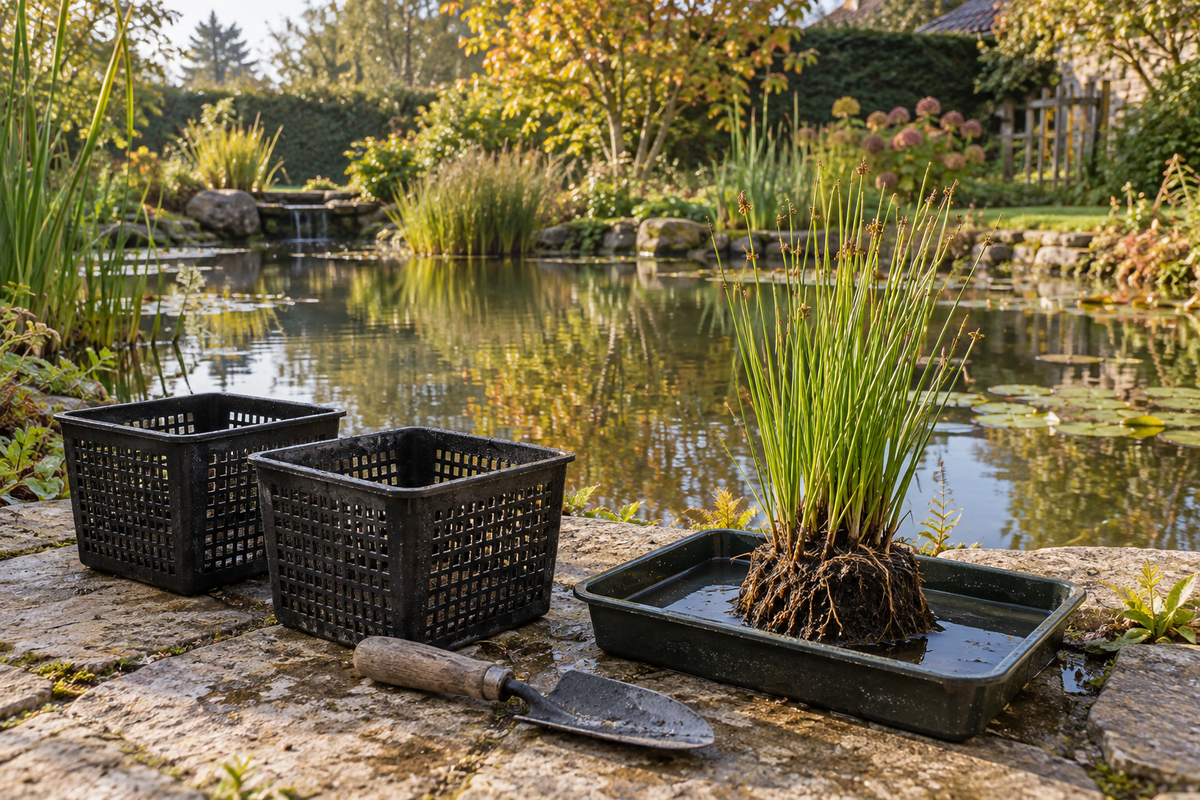
The square planting baskets make it easier to locate, move, and maintain a plant. Choose a size consistent with its growth and the width of the pond ledge.

An openwork basket is not an absolute barrier to rhizomes and roots. It facilitates control, but regular inspection remains necessary. A plant too large for the pond does not become suitable simply because it is placed in a basket.
The RHS recommends a substrate appropriate for aquatic plants, with a sufficiently heavy structure. Avoid enriched universal potting soil and systematic fertilizer applications. Depending on the basket, a suitable liner limits soil leakage; a layer of gravel can help hold the substrate in place.
Choose plants adapted to the available space
The SPW suggests prioritizing native species and cites, in particular, the marsh marigold among the interesting alternatives. Caltha palustris brings a yellow bloom in the spring in a bank or shallow water area.
The Aquishop data sheet indicates a height of 30 to 40 cm, sun or partial shade exposure, and a crown placed near the water level, possibly under up to 10 cm of water. Respect this guide: a bank plant should not be placed at the bottom with water lilies.
Native status does not guarantee a small size. A cattail can be interesting in a large landscape and disproportionate in a small pond. Always compare the mature size, method of propagation, and planting depth.
Also, inspect new pots and submerged plants before introduction. The RHS advises a separate observation period, as unwanted vegetation can arrive as contaminants with another plant.
Limit nutrient inputs that fuel proliferation
Nutrient-rich water can encourage excessive growth. Look at what enters the pond: runoff from a fertilized lawn, leaves, uneaten food, and soil washed in from the banks.
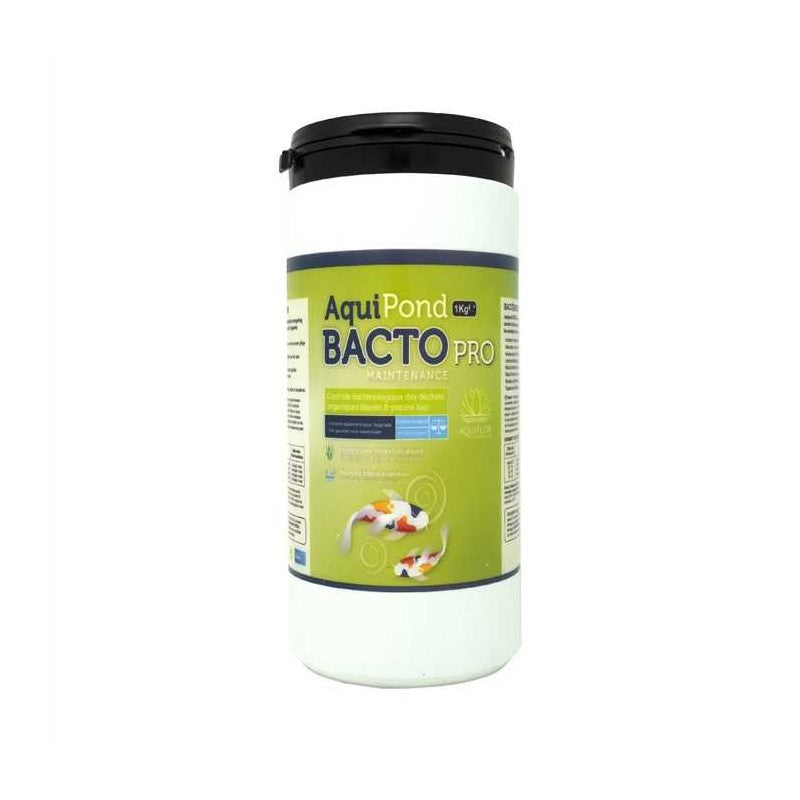
For a pond without an invasive infestation requiring a specific procedure, a PondoVac 4 can help remove accessible deposits. Aquipond Bactovase targets the organic fraction of the silt according to its conditions of use.
These tools concern deposits; they do not replace botanical management. Keep a regrowth control schedule, with photos taken from the same spot. A subtle regrowth is simpler to treat than a new complete covering.
Prepare easy-to-monitor plantings
Identify species, measure ledges, and choose containers before replanting. Keep labels to track growth and organize future divisions.
Sources
- SPW — Acting on plants: prevention and management of invasive species.
- SPW — Lists of species of concern: Walloon and European regulatory framework.
- SPW — Beware of invasive aquatic plants: local alternatives.
- RHS — Aquatic Weeds: growth and fragmentation risks.
- RHS — Choosing Pond Plants: selection and introduction of plants.
- RHS — Aquatic Plants: Planting: baskets and substrate.
- RHS — Pond Care: maintenance schedule and divisions.
- Aquishop data sheets for the plants and accessories mentioned.