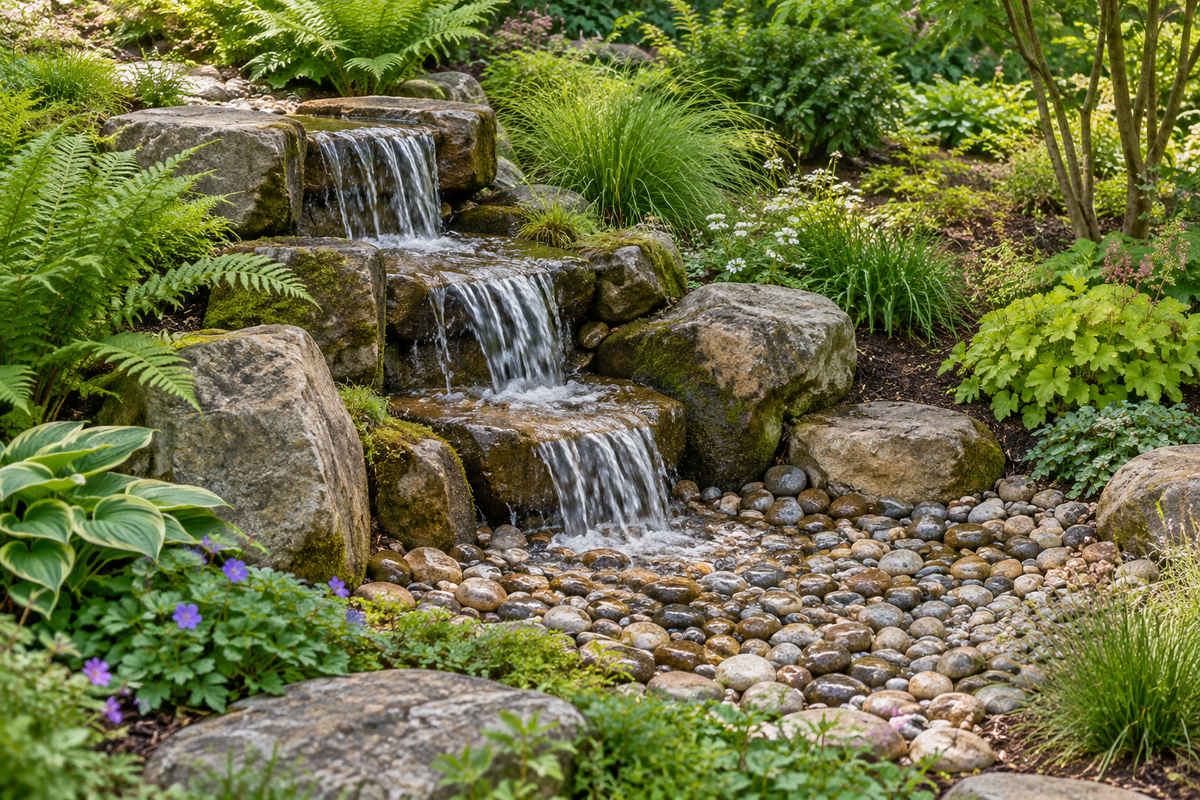
A closed-loop waterfall can bring a small garden to life without the need for a large visible pond. The water flows from a reservoir, is pumped upward, and then cascades back down into the same reservoir. To achieve a pleasant and reliable flow, you must choose the pump based on the desired flow rate at the top, the height to be overcome, and the circuit's head loss.
The size of the reservoir and access to the pump are just as important. A high-performance device installed in an inadequate reservoir may run out of water as soon as the waterfall fills up.

What does "closed-loop" mean in a garden?
The same water recirculates between the reservoir and the waterfall. The return can be into an open pond or into a reservoir hidden under pebbles and a structure designed for this purpose.
The system is not airtight. It loses water through evaporation and may lose more through splashing, wind, or overflow. Checking the level and topping it up remain necessary.
If the waterfall also supplies a fish pond, its pump may have a filtration-related function. In this case, biological requirements and filter constraints must be factored into the choice. A purely decorative waterfall with a hidden reservoir is sized primarily for its water effect and circuit.
Measurements to take before looking at pumps
- Vertical height: from the water surface in the reservoir during operation to the upper exit point.
- Flow width: at the point where you want to achieve a sheet or waterfall.
- Pipe length: follow its actual path.
- Inner diameter: distinguish this measurement from outer diameter and thread sizes.
- Accessories: elbows, valves, potential filters, flow splitters, and waterfall components.
- Useful reservoir volume: take into account pebbles, supports, and equipment that take up space.
A sketch including these data points allows for a much more precise selection than requesting "a two-meter waterfall pump." This expression could refer to the length of the stream, the total height, or the width of the display.
Choosing the flow rate based on the desired effect
A discreet trickle over a stone and a thick sheet across a full width require different flow rates. The shape of the rocks, the irregularities of the threshold, and the height of the fall also change the result.
For a manufactured component, start with the manufacturer's recommendations. OASE, for example, provides pump recommendations linked to height for its Waterfalls. The figures for a specific model should not be applied to all natural waterfalls.
For a stone composition, describe the expected outcome and provide a photo or drawing of the threshold. Rules of thumb for flow per centimeter of width are good starting points, which must be cross-referenced with your project. An adjustable trial is particularly useful before permanently setting the final decor elements.
Also consider the sound. A high, concentrated fall can be louder than a distributed trickle. The desired flow must suit the patio and the neighbors as much as the appearance of the waterfall.
Reading the pump curve
The advertised maximum flow rate corresponds to a situation very different from lifting water through a long pipe. The total dynamic head is the sum of the elevation change and the losses associated with the water passing through the circuit.
The method presented by OASE consists of determining this total head, then consulting the performance curve. The point of interest is the flow rate the pump can provide at that height.
The maximum head and maximum flow rate are not available simultaneously. Choosing a device whose maximum head just reaches the top of your waterfall generally leads to an insufficient result.
Example procedure: you want a specific flow rate at an outlet located 1.20 m above the reservoir. You must then include the losses from the pipe and accessories, then check this flow rate on the curve. The "1.20 m" figure alone is not enough to select the model.
A pipe that is too narrow can ruin the result
The choice of pipe goes hand-in-hand with the choice of pump. A circuit that is long, narrow, or full of elbows can absorb a significant part of the available capacity.
Compare routing possibilities before opting for a more powerful model. A more direct path and suitable fittings can improve flow without unnecessarily increasing consumption.
Also prepare for maintenance operations: accessible quick-disconnect fitting, pipe protected from kinking, and a location that allows the pump to be removed. Repairing becomes more complicated if everything is buried under heavy stones.
If several outlets are planned, the flow must be distributed. Specify the number of branches and the desired operation: all together, some only, or independent adjustment.
Sizing the reservoir for startup and shutdown
At startup, some water leaves the reservoir to fill the pipe, small ledges, and the stream. The pump must continue to receive enough water during this phase and during steady-state operation.
At shutdown, water returns to the reservoir. It must be able to accommodate this without overflowing. Both situations must be checked before finishing the decor.
For its Pondless projects, Aquascape uses an estimate of the stream's water volume and recommends a reservoir corresponding to at least double that volume in its calculation method. This is a design benchmark to be supplemented with the actual geometry, the minimum pump level, and other circuit volumes.
A geometric example helps to understand: a channel containing an average of 4 cm of water over 2 m long and 40 cm wide represents about 32 liters. Dips, ledges, and the pipe add to the total. This estimate does not mean that a 64-liter nominal tank will automatically suffice.
Pebbles take up space. An excavation filled with stones does not offer the same water volume as an empty reservoir of the same dimensions. Use the useful capacity announced for the modules and supports used.
Which pump family to consider?
A small, relatively clean water feature can use a compact pump for water games, such as the Aquarius Universal Classic 1000, if its curve and assembly match the requirements. A more demanding waterfall requires a different selection.
The AquaMax Eco Classic 8500, reference 51099, is a pump designed specifically for filtration and waterfalls. Its specifications indicate a maximum of 8,300 l/h, a maximum head of 3.20 m, and a power rating of 80 W.

These values allow you to pre-select a reference, but not to guarantee a flow rate for your waterfall. Also, verify that the reservoir offers the installation conditions provided in its manual.
If you want to modulate the effect, look for a pump whose adjustment is explicitly provided by the manufacturer. The Classic 8500 mentioned here must not be connected to a generic electrical dimmer. A model with its own controller meets a different configuration.
Filtration and maintenance: plan for access from the start
Leaves and dust eventually reach the reservoir. Accessible intake protection and regular maintenance limit annoying accumulations. The chosen system must respect the pump's needs without suffocating its water intake.
Remove large debris before it decomposes. If deposits form in an accessible area, a suitable vacuum, such as a PondoVac 4, can facilitate targeted cleaning while monitoring the water level.
A decorative reservoir, a fish pond, and a natural pool do not have the same requirements. The choice of treatment or biological filtration depends on the actual use. Specify this when preparing the project.
Estimating consumption without forgetting the running time
Consumption is calculated based on the power absorbed and the operating time. An 80 W pump used for eight hours consumes approximately 0.64 kWh; over twenty-four hours, approximately 1.92 kWh.
Multiply this energy by your electricity rate to estimate the cost. These are calculation examples, not a consumption guarantee for all settings and devices.
An independent decorative waterfall can be designed with schedules adapted to its use. If the same pump serves a fish pond filter, a shutdown schedule must be evaluated according to the biological functioning of the whole system.
Test the system before finishing the surroundings
Perform several startup and shutdown cycles. Observe the reservoir level, the water return, and splashes. Also check the fittings while running.
Before winter, follow the instructions for the pump and accessories. Ice can divert water out of the return area. Aquascape highlights this risk in its winter maintenance recommendations for waterfalls without a visible pond.
The structure that supports the pebbles and closes access to the reservoir must be designed for the loads and use of the location. A concealed design does not exempt you from securing the installation, especially if children can access it.
Preparing your pump choice
Gather the height, waterfall width, pipe path, and useful reservoir volume. Then compare the required flow rate with the curve of the considered model.
Consult the AquaMax Eco Classic 8500 →
See a pump for a small water feature →
Sources
- OASE — Calculate total dynamic head: height, losses, and pump curve.
- OASE — Waterfall 30: recommendations specific to a waterfall element.
- Aquascape — Pondless Waterfall: circuit principle and hidden reservoir.
- Aquascape — Calculating the volume of a Pondless waterfall: circulating volume and reservoir.
- Aquascape — Winter maintenance of a Pondless waterfall: freezing and water return.
- Aquishop product sheets for the pumps and PondoVac 4 linked in the article.