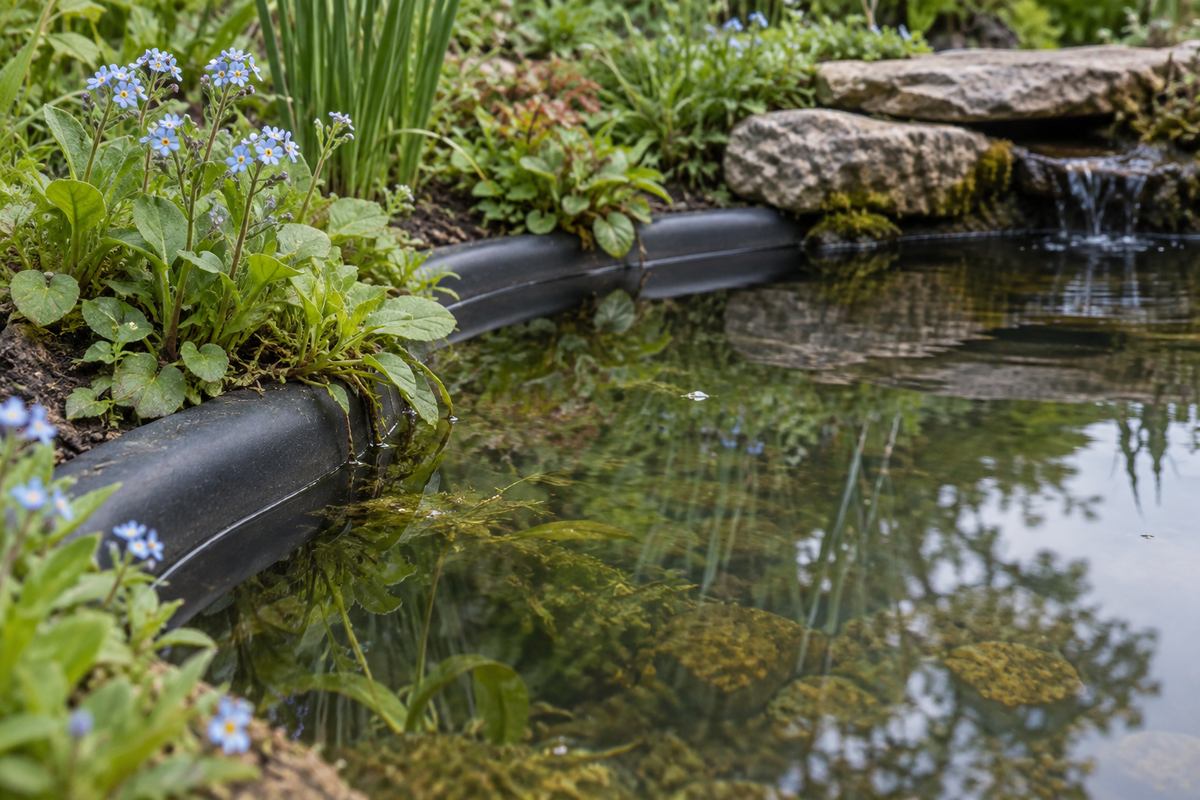
Are you looking for a "plastic pond" to install a small water feature in your garden? The term generally refers to a preformed pond: a watertight shell with predefined shapes and depths. They come in various sizes, with profiles that are more or less suitable for plants and small wildlife.
The material alone is not enough to make the right choice. You must also consider the intended use, dimensions, how to install the shell, and maintenance possibilities. Here are the questions to resolve before buying your pond.

Where can I find a suitable shell for a garden pond?
Aquishop offers preformed ponds, including Ubbink models. The product pages allow you to compare external dimensions, stated capacity, and shape. Prepare a selection before asking the Aquiflor team for advice.
If visiting, Aquiflor is located at Rue de la Liberté 22, Nodebais. Check the opening hours and contact details, then confirm the availability of your desired model and the options for collection or delivery.
A shell may be lightweight but still bulky. Before ordering, measure access points, doorways, and the path to the garden. You need to be able to transport the pond without forcing it or letting it rest on a fragile edge.
Check the material and intended use
Product descriptions may mention polyethylene, often abbreviated as PE or HDPE, or fiberglass-reinforced polyester. These are different materials: installation instructions, compatible accessories, and repair options must be verified for the exact model.
Choose a shell designed to be a pond. For a repurposed container, you must know its previous use and its compatibility with the long-term presence of water and aquatic organisms. A container that has held unknown products requires checks that a simple clean appearance cannot replace.
The mention "for in-ground use" is also important. A shell intended to be supported by the soil does not become a standalone above-ground pond just because it seems rigid when empty. Follow the stated purpose and the manufacturer's instructions.
Look at the interior profile
A photo taken from above shows the contours but explains the planting potential less clearly. Ask for the depths and the width of the shelves. Verify that a basket can be placed there stably and that its height will leave the plant at the correct water level.
The bottom must remain accessible for observations and occasional work. A highly intricate shape may look nice, but it sometimes leaves narrow areas that are difficult to plant or reach.
For a pond oriented towards wildlife, look primarily for the ability to create an exit. Vertical steps do not replace a gentle slope that small animals can use when the water level drops.
A compact example: the Start 250

The Ubbink Start 250 pond is listed at 250 liters, with dimensions of 135 × 105 × 46 centimeters. It has various planting levels. These details help prepare the site and plan a suitable plant composition.
For more space, the Start 500 is listed at 179 × 140 × 50 centimeters and 500 liters. The choice is not simply about doubling the number of plants or fish: the profile, usage, and maintenance must be reconsidered.
Stated capacities are just a guide. Once baskets, stones, and equipment are installed, the actual volume of water present is different. Measure the filling if you need a reliable baseline for monitoring the pond.
Plan the installation before breaking ground
Receive or verify the dimensions of the shell before finalizing the excavation. You must be able to adjust the levels to its actual shape. The soil must be prepared to support the bottom and the shelves without any sharp objects or pressure points.
Using a spirit level on multiple axes avoids an edge that protrudes significantly on one side and overflows on the other. Leveling and backfilling are carried out according to the manual, with a coordinated progression of filling and external support.
Do not load the rim with heavy stones without having provided their own support. The finish should conceal the pond without compressing the shell or causing elements to tip into the water.
If the ground is waterlogged or you are planning an unusual location, ask for specific installation conditions before proceeding. A general manual does not replace an examination of soil that presents a particular difficulty.
Composing a small planted pond
Start with a few plants whose growth habits you are familiar with. In a small volume, a vigorous species can quickly occupy the available space. The composition should leave areas of water visible and access for maintenance.
Planting baskets allow you to group the substrate and move plants if their position needs to be adjusted. Choose their size according to the species and the shelf, with a substrate adapted to aquatic plants.
The water forget-me-not is one of the plants to consider for a very shallow, moist zone. Its position should be chosen based on the depth indicated on the product page. A marginal plant should not be placed at the bottom just because it is sold as "aquatic."
A small pond without fish can spontaneously attract interesting wildlife. Let animals arrive on their own and avoid transferring water, silt, or eggs from another water source.
Arrange the edges without creating a trap
Prepare a rough, stable, and continuous exit between the water and the bank. It must remain usable when the level varies. Regularly check that a plant, stone, or decorative element does not block access.
Also, keep part of the edge easy to observe. Plants can soften the transition with the garden, but complete coverage makes inspections more difficult. Child safety and pond access should be planned separately from features intended for wildlife.
How to maintain and monitor the shell?
Remove visible debris gently and limit the addition of soil. A thin natural presence on the walls does not justify scrubbing the entire pond. Maintenance depends on the living project, the plants, and the amount of sediment.
If the level drops, first observe for splashes, overflows, and potential leaks in hoses. For a suspected crack, identify the material and the model reference before considering a repair. Glue intended for a liner is not automatically compatible with a rigid shell.
For winter, follow the instructions for the pond and equipment. A mention of frost resistance does not exempt you from correct installation or from monitoring plants and any animals.
Prepare a selection that suits you
Send a photo of the garden, the available dimensions, and your objective to support@aquiflor.com. Specify if you want a wildlife pond, a planted composition, or a pond with equipment. You will then be able to choose the shell, baskets, and plants for the same project.