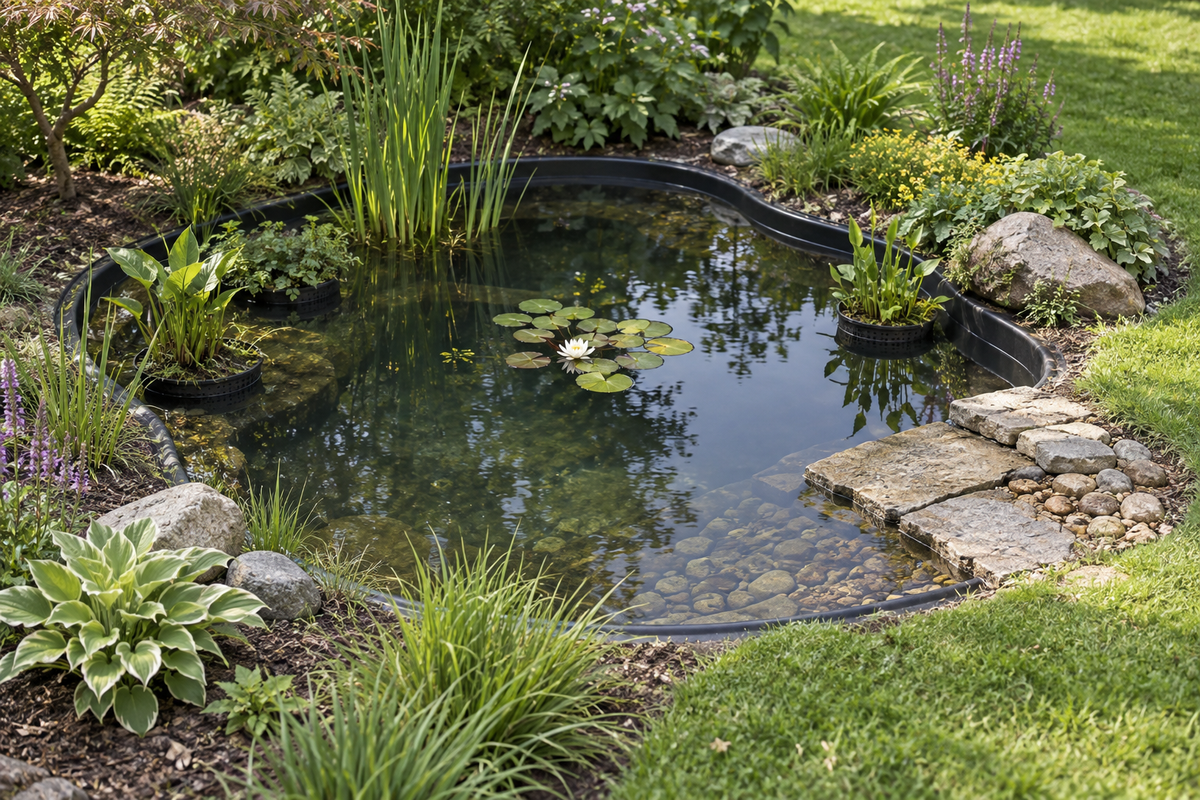
A preformed pond allows you to start with a known shape and volume to create a water feature in your garden. The shell defines the contours, the bottom, and, depending on the model, the tiers intended for plants. The right choice depends primarily on the intended use, the depth, and the space available around the pond.
Before ordering, take the time to mark out its location and examine the interior profile. Two shells with similar capacities can yield very different results: one offers more surface area, while the other provides a volume more concentrated in depth.

What kind of project is a preformed shell suitable for?
This solution is suitable when you want to choose a specific format and organize the garden around it. It allows you to quickly visualize the final footprint and the available depths.
However, the shape remains that of the model purchased. If you are looking for very specific dimensions, a long sloping beach, or a layout that follows a terrain precisely, a flexible liner may offer more freedom.
A preformed pond does not eliminate the need for ground preparation. Its bottom and tiers must be properly supported, and leveling requires care. A rigid shell should not be used to mask an poorly adjusted excavation.
Start with the living project
A pond intended for insects and amphibians does not have the same requirements as a pond with fish. For a project centered on spontaneous wildlife, planning for plants, refuge areas, and easy entry into the water is a good foundation.
If you want fish, have the species, adult size, actual available volume, depth, and necessary equipment studied. The volume indicated on a shell is not an automatic authorization to install a given population.
A small, shallow pond requires particular attention to temperature and level fluctuations. For koi, a specifically dimensioned project with appropriate volume and filtration should be considered, rather than choosing a small shell as a temporary solution.
Compare dimensions, not just liters
Here are three formats offered on Aquishop. The dimensions and capacities below are those announced on the product sheets; the actual water volume introduced will depend on the filling level and the landscaping.
| Model | Announced dimensions | Announced capacity | Point to examine |
|---|---|---|---|
| Ubbink Start 250 | 135 × 105 × 46 cm | 250 liters | Compact footprint and placement of planting baskets |
| Ubbink Start 500 | 179 × 140 × 50 cm | 500 liters | Surface area available for varied planting |
| Ubbink Quadra C1 | 118 × 78 × 70 cm | 520 liters | Deeper format, rectangular layout |
These examples show why a comparison by volume alone is insufficient. Check the width of the tiers, their depth underwater, and access to the bottom. Also, think about the space the plants will take up once mature.

Choosing the location in the garden
Place a hose or rope on the ground to represent the footprint. Keep a passage allowing access to the plants and equipment. View the pond from the terrace or window: the location should also allow you to enjoy it.
Observe the sunlight at different times of the day. Partial shade can be useful, but the needs of the selected plants must still be considered. Nearby trees contribute leaves and can complicate excavation due to their roots.
Identify areas where runoff carries soil into the future pond. Also check for underground utilities before digging. If the soil is unstable or very wet, seek advice on the necessary preparation and drainage for the chosen model.
Preparing the installation methodically
The shell's instruction manual remains the reference for the work. Generally speaking, you must reproduce the different levels in the excavation, remove obstructions, and prepare an even base.
Leveling is checked on several axes. The bottom and overhanging areas must be supported without pressure points. A void under a tier must not be left in the hope that the weight of the water will correct the situation.
Filling and backfilling are done gradually according to the manufacturer's instructions, ensuring the shell remains stable and horizontal. The material around the pond must support the whole structure without deforming it.
Before finishing touches, observe the level and the banks. It is easier to correct an installation at this stage than after placing all the stones and plantings. Do not use a shell intended to be buried as an independent above-ground container without express validation from the manufacturer.
Adapting planting to the tiers
The planting baskets facilitate the positioning and maintenance of plants. Their width must fit on the tier, and their height changes the water depth above the crown.
Choose plants based on this actual depth, their growth habit, and the exposure. A small water lily of a known variety will be easier to integrate than a plant whose spread and requirements are unknown.
The selection of aquatic plants allows you to prepare a composition. Keep part of the water clear to observe the pond and intervene. A measured planting at the start leaves room for growth.
Planning for small wildlife access
The walls of a shell can be difficult to climb for an animal that has fallen into the water. Provide a stable and rough exit that connects the water to the bank, taking into account level fluctuations.
The exit must remain passable after the plants have grown. Avoid unstable stacks and elements likely to slip. Around a wildlife pond, bank vegetation and a few nearby refuges extend the value of the water feature.
Pump and filtration: decide according to usage
A planted pond without fish does not systematically need a filter. If you want a water feature, its equipment should be chosen according to the desired effect and the necessary protection for small organisms.
For a compatible decorative fountain, a pump such as the Aquarius Universal Classic 600 can be considered. Its suitability depends on the head height and the circuit. With fish, circulation and filtration must be studied together.
Keep equipment accessible and plan for its maintenance from the moment of installation. A small waterfall added after the fact may require more space, hose, and water reserve than expected.
Preparing the complete order
The budget must include the shell, ground preparation, finishing touches, plants, and any equipment. Also check the access to the garden, transport, and delivery or pickup options.
Send the available dimensions and a photo of the location to support@aquiflor.com. The team will be able to help you compare the shells and prepare the useful accessories. This way, you will start with a format compatible with your garden and with the pond you want to bring to life.
Useful sources and documents
- Royal Horticultural Society — pond construction and liner installation.
- Royal Horticultural Society — wildlife access and landscaping.
- Ubbink / Outside Living Industries — equipment manuals.
- Aquishop product sheets for Start 250, Start 500, Quadra C1, and the mentioned accessories.